By Cain O’Mahony
There has been radio silence in the western media about the tumultuous events currently underway in Serbia. When reporting Eastern Europe, the western media prefer safe, charismatic ‘democrats’ leading from the top. They don’t like rank and file movements that rise up from below, especially if they involve trade unions, socialist movements or class action.
The massive protest movement and strike wave in Serbia is significant in this usually pro-Russian country, as the masses have copied similar methods and protests used four years ago in equally pro-Russian Bulgaria. At the moment, the Serbian masses are clearly winning, but they must learn the lessons of events in Bulgaria in 2020/21, where the movement eventually failed because the workers’ organisations failed to present a class alternative to the rule of corrupt gangster-capitalism.
The current events in Serbia also show just how weak the so-called ‘strongman’ states of Eastern Europe really are, when the mass of workers and youth move into action – and this is a warning to Putin.
The fuse was lit in Serbia on 1 November 2024, when the canopy of the recently-reconstructed railway station in Novi Sad collapsed, killing 15 people. There was outrage in the city, as the corruption and resultant corner-cutting of the project were well known locally. The anger turned to fury when the government of President Aleksander Vucic’s Serbian Progressive Party (SNS) attempted a cover up.
In protest, local students and teachers held a vigil, which included a fifteen minutes silence in tribute to each of the victims. This respectful, peaceful vigil was attacked by a gang of thugs, known to be supporters of the SNS. This, in turn, provoked a mass protest of the city’s population, the largest demonstration in Novi Sad’s history.
Intimidation and repression has failed
Rather than listen, the belligerent SNS government threw petrol onto the flames. Their methods are straight out of Putin’s playbook: intimidation and repression. But unlike in Russia, it has blown up in their faces. The protests and strikes have rolled out across 400 cities and towns, spreading from the student movement to organised labour.
First came the name calling, through the state-owned broadcast media and tabloid newspapers owned by SNS-friendly oligarchs. SNS Ministers denounced the students as “fake commie intellectuals” and “social scum”, and the trade unions that have since joined them as “Bolsheviks”.
Sinister gangs of thugs armed with baseball bats have attacked unarmed students, while there have been deadly car-ramming incidents, with SNS supporters driving into crowds who were blockading roads. The western media makes a car-ramming attack headline news if it is carried out by an alleged Islamic extremist. But the eight car attacks in Serbia since the protests began in November – which so far have left many injured, seven of them seriously – go unreported.
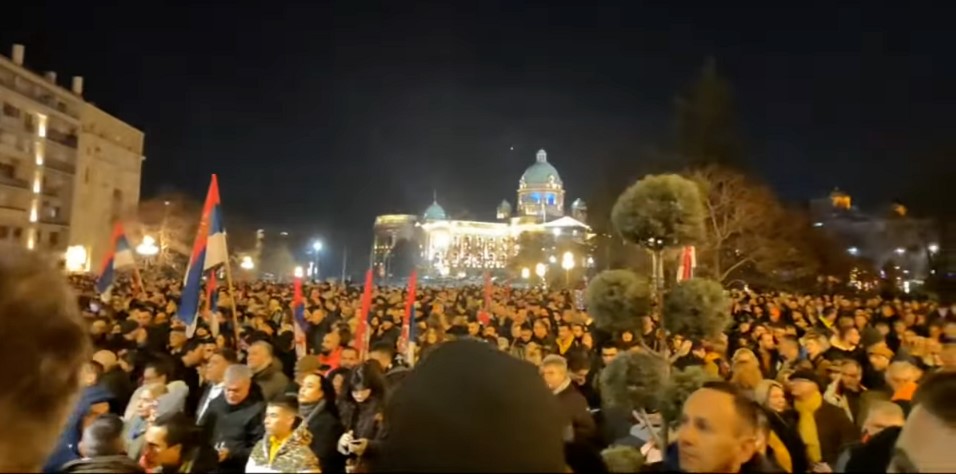
Yet every act of intimidation has seen the movement just grow and grow, with a huge protest in Belgrade on 22 December, attended by over 100,000 people, at that time the largest political demonstration in Serbia’s history. Since then the protests have got even bigger. By December 2024, the student anti-corruption protests had spread to over 50 universities. The main action, like their Bulgarian counterparts in 2020/21, has been ‘Serbia Stop!’ protests where masses of students and workers blockade trunk roads and key bridges.
Many sections of workers joined in protests
Farmers, angry at tax increases, joined them bringing in tractors to shield the protests from car-ramming attacks. Lawyers meanwhile, in protest at the government’s flagrant abuse of the country’s constitution, began holding strikes. By January, the original Novi Sad protests had become a general movement against the SNS government. Teaching unions held several strikes backing the students. Then the ‘heavy battalions’ of the labour movement joined in, with a one-day strike by the unions at Elektropriureda Srbije, the state-owned power industry, and by miners at RB Kolubara, one of the largest coal mines in Europe.
Since then, the protests have snowballed. There have been strikes, blockades and protests right across Serbian society, with ongoing industrial action by teachers, civil engineers, more strikes by miners, the Belgrade transport workers, health service unions, the Serbian Medical Association (GPs and dentists), the Belgrade Taxi Association, digi-tech companies and even small businesses, who held a ‘general strike’ on January 24 in Belgrade, which left shops, bars and businesses boarded up for the day.
The ’unorganised’ have joined in too – hundreds from Serbia’s notorious biker gangs have joined the protests alongside the farmers, to help defend the students. The Belgrade Philharmonic Orchestra has held fund-raising protest concerts, after its members were among those injured by car attacks.
In one marvellous incident, a SNS supporting headteacher was given much state media coverage for criticising striking teachers, saying they were allowing school children to go hungry, and offered all pupils who turned up for lessons free sandwiches. The children dutifully filed in, collected their sandwiches – and then walked out again, filming themselves feeding the sandwiches to stray dogs.
The mass movement is now at its peak
All the time, the SNS government is getting more desperate. At the latest mass demonstration in Belgrade on 18 March, attended by a staggering 325,000 people, there have been claims that the authorities fired a ‘sonic cannon’ at the mass of protesters.
The mass movement is now at its peak. The road blockades as a method of protest has been learnt from similar tactics used in Bulgaria, over four years ago. But if the Serbian workers and youth are learning tactics from their Bulgarian counterparts, they must also study the failure of that movement and quickly learn the lessons.
So what happened in Bulgaria in 2020 ( which again met a wall of silence from the western media) ?
Of the Eastern European countries, Bulgaria is the most corrupt – the Corruption Perception Index run by NGOs records Bulgaria as the most corrupt member of the European Union, and ranks it number 74on the global scale. The scale of the corruption is gargantuan. We are talking millions supposedly for developing seaside resorts, but ending up building mansions for oligarchs. Or millions in EU agricultural subsidies being claimed for non-existent livestock.
Backing up the corrupt politicians and oligarchs are the muscle-men of the mafia, who in turn are protected by a corrupt state. Since the fall of Stalinism in Bulgaria in 1989-90, there have been over 150 high-profile mobster assassinations in the capital Sofia, whether of rival gang leaders, corrupt politicians who didn’t deliver, or those investigative journalists and clean politicians seeking justice – in all that time there has only ever been one successful conviction of those responsible.
Government funds hived off to oligarchs
The corruption only worsened after the victory of the GERB party, Bulgaria’s conservative party led by Boyko Borisov, the former bodyguard of Bulgaria’s last Communist leader, Todor Zhirkov. In 2019, his government signed off over $10bn for so-called ‘infrastructure projects’ to various oligarchs, three times the budget allocated to Bulgaria’s crumbling health service.
The following year, in 2020, after attempts to remove President Radev – who was elected on an anti-corruption ticket with the backing of the Bulgarian Socialist Party (BSP) – events exploded onto the streets in July.
Between 60,000 and 100,000 workers and students each day blocked the streets of the capital, much of it organised by the BSP, calling for Borisov to resign. The protests lasted all month, being bolstered by the Confederation of Independent Trade Unions (CITU) – the largest trade union organisation in Bulgaria – officially backing the protests.
The oligarch-controlled media continually attacked the protesters as ‘criminals’ and ‘hooligans’, while Borisov’s government attempted to use agent-provocateurs to provoke violence between the protesters and the riot police, out on the streets in force.
Government plants agent-provocateurs among protesters
The latter backfired in an incident on the night of July 16, the same day as the CITU backed the protests, and demonstrated to Borisov that the Bulgarian state could no longer rely just on ‘armed bodies of men’. Amongst the mass crowds, agent-provocateurs began hurling smoke bombs at the riot police, trying to incite a riot. The mass of protesters and trade unionists responded by linking arms and marching to the front of the riot police to protect them. In response, the riot police laid down their riot shields in gratitude and solidarity.
A further provocation came towards the end of the month. Every year, the BSP gathers from across the country to hold an annual rally at Mount Buzludzha, to commemorate the founding of the Social Democratic Workers Party back in 1891. But they discovered that GERB government officials were warning all transport companies that if they transported any socialists to the meeting, they would no longer receive government contracts. So, instead, the BSP defied a government order not to assemble in Sofia, and over 20,000 BSP members marched through the city.
The month-long mass protests against the government began to take on the form of a wider social revolt. In one instance, for example, on the same day as the illegal BSP march, residents in one neighbourhood marched to the offices of the Mayor of Sofia, a GERB member, and demanded her resignation after she had privatised a plot of land that was supposed to be earmarked for a municipal kindergarten.
Yet the labour leaders failed to capitalise on this mass movement with a clear and radical socialist programme. The movement in 2020 fizzled out, as GERB’s term of office ended, and an election was called. But the BSP did not push forward with a clear socialist way forward.
Lacking confidence in the working class, the labour leaders instead reverted to the failed methods of Stalinism, of Popular Frontism, looking for alliances with confused liberals and democrats, trying to find a short cut to power, without offering any real political alternative other than ‘tackling corruption’. The repeated failure of this method saw the mass enthusiasm of 2020 whither away.
Bulgarian Socialist Party follows failed ‘Popular Front’ policies
Unlike in other Eastern European countries, the Bulgarian Communist Party did not disintegrate. It changed its name to the Bulgarian Socialist Party, and now looks to the European Union for salvation rather than Moscow (or sometimes both), but it is still a mass party, the largest in Bulgaria, its membership hovering between 80,000 and 100,000, and this in a country of only 6.5 million adults.
But unfortunately, retaining the failed Stalinist methods of Popular Frontism, they kept throwing their lot in with numerous new ‘democratic’ coalitions, hoping to find short cuts to power. This, of course, failed, and ever since all parties – both left and right – have been continuously scrambling around in ever decreasing circles, trying to prop up some form of ‘stable’ government. These always fail as they are not capable of tackling the crux of the problem – on the one hand, the failure of capitalism to deliver a solution, and, on the other, the fact that all politicians are terrified of provoking a new mass uprising.
In the past we spoke of the ‘Italianisation’ of politics, in the sense of having a succession of elections and failed governments, with none of them able to square the circle of a capitalist system in crisis. We could now speak of the ‘Bulgarianisation’ instead, because this country has now had seven general elections in just three years, and is now probably staggering along to the next one.
And around and around they go, while all the time the turn-out in elections by a disillusioned public dwindles (it was 38 % last time, and has been as low as 33%), while the BSP ‘withers on the vine’ electorally.
It is understandable that there is confusion about the ideas of socialism in Eastern Europe. For most of the last century they suffered at the hands of Stalinist dictatorships and they were told that this was ‘communism’. After the fall of the Soviet Union, politics in Eastern Europe became somewhat ‘binary’. The only choice apparently was between parties hankering after the ‘better’ aspects of the Soviet days and therefore having illusions in the ‘strongman’ gangster-capitalism of Moscow, or others putting all their hopes in the shiny ‘democratic’ world (and funding) of the European Union.
The pressures of capitalism have often resulted in Eastern European states looking in both directions at once, adopting Moscow-style governance and a reactionary outlook, but still needing EU money.
A socialist lead is needed for the mass movements
Today, all that has been further exacerbated by the sharp turn of global politics. Putin’s invasion of northern Ukraine has troubled those who looked to Moscow, while the Putin-loving Trump has confused those who looked to the West for salvation.
A socialist lead is clearly needed. The working class in the East actually has a more advantageous position than their counterparts in the West. The latter have the baggage of decades, if not centuries, of capitalist propaganda that assured us that those who have benefitted from the profit system have done so merely through their own personal hard work and diligence, and that the ‘rags to riches’ scenario is one open to us all.
In the East, workers have no such illusions – they know how their new bosses got rich and it had nothing to do with ‘free enterprise’. They have seen with their own eyes how the old Stalinist bureaucrats simply stole their country’s assets to become the new oligarchs, through gangsterism and corruption.
Socialists in the East should demand the renationalisation of the stolen industries, and have them put under democratic workers’ control, to drive out the crooks and gangsters, and to initiate a democratic, socialist plan of production so the wealth of society is used for the benefit of all.
Putin will be watching the events in Serbia nervously. Contributors to Left Horizons have rightly pointed out that mass resistance by the working class in Russia is currently unlikely because of the war against Ukraine, as mass conscription leading to labour shortages, alongside the boom in the war industries, has put workers in an advantageous position, in terms of pay and job security.
But that can last only as long as the war, and then for the workers it will be back to the ‘same old crap’, added to by an embittered generation who suffered the slaughter and sacrifices of war.
The political structure and methods of the Bulgarian and Serbian states are almost miniature mirror-images of Russia. So if the masses can rise up in these smaller states, why not – eventually – in Russia too. Bulgaria yesterday, Serbia today…Russia tomorrow?
[Feature photograph shows a demonstration in Belgrade, December 24, 2023. From Wikimedia Commons, here.]