

Most readers of Left Horizons and activists on the left are painfully aware of the details of the surge for Reform UK in the elections last Thursday. Suffice to say, that our immediate pre-election editorial anticipating that Starmer was going to throw away Labour votes, was more brutally confirmed than even we anticipated.
Most of those being defended were Tory council seats, but both Labour and Tories lost around two thirds of those they had held, and Labour lost the Runcorn by-election by a huge swing. Although there are many aspects of policy that have been a bitter disappointment to all those who voted Labour last July – ‘betrayal’ was on a lot of lips – the removal of the Winter Fuel Allowance became the defining feature of the government and it came across on the doorstep loud and clear.
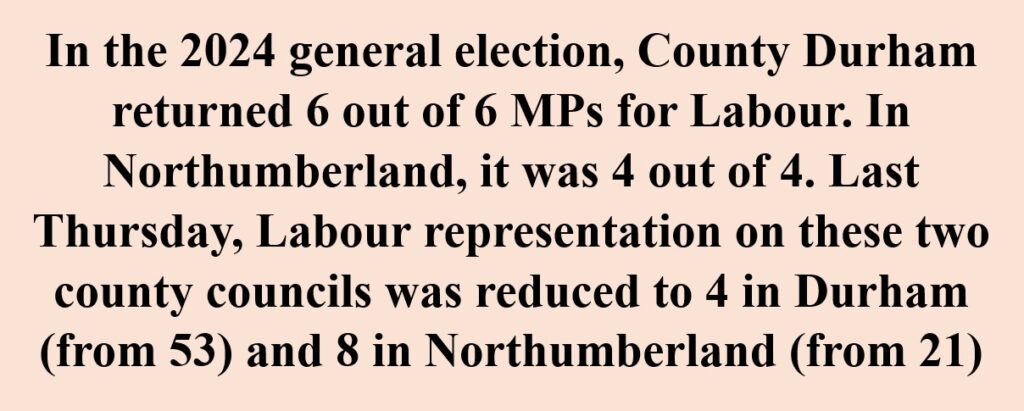
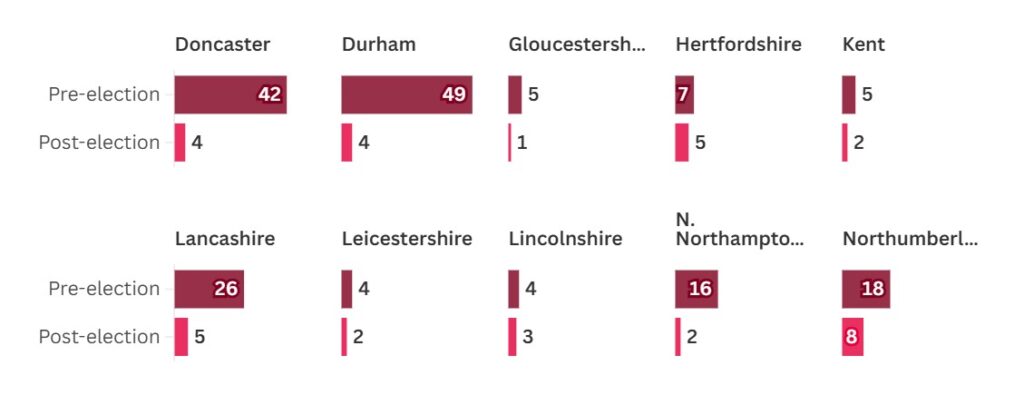
In areas that had been Labour strongholds in the past, like Doncaster and Durham, Labour councillors were all but wiped out, all thanks to the economic policies of the clique around Keir Starmer. The same people who argued that Jeremy Corbyn would destroy the Labour Party, like Starmer’s chief adviser, the election ‘genius’ Morgan McSweeney, are doing the job themselves.
There is little point here in laying out all of the grim details of what was a disastrous night for Labour. This article in Labour List, amply describes the losses across the country in mayoralties, councils, in Runcorn and in some local authority by-elections. What is perhaps more important for us is that we need a sober discussion about perspectives, to assess the direction in which British society is moving, and within that, the trajectory of the Labour Party.
British capitalists have no clear strategy for a way forward
British capitalism is in a dire crisis, its rate of investment in manufacturing, infrastructure and services, and consequently, its productivity, being well behind those of its economic peers in the other G7 countries. Although many on the left argue that Tory austerity was a ‘political choice’, that was not strictly true. Austerity – cuts in the real wages of workers, cuts in services and the NHS, etc – follow the inescapable logic of a market system rigged to benefit the rich.
The problem for the British capitalist class, however, is that it has no clear political strategy for a way forward. It has largely lost control of what had been, historically, its main political representation – the Conservative Party – to such a degree that the party even engineered Brexit, the greatest self-inflicted economic damage perpetrated by any government.
Many Reform members and candidates are refugees from the Tories and the rump of their old party is more split than ever. Having suffered huge losses to Reform UK, even more Tories will be leaning towards an eventual alignment with them.
Starmer elected Labour leader fraudulently
From the point of view of British capitalism, their best political representation at the moment are the right wing of the Labour Party. The tops of the party are controlled by a cabal around Keir Starmer who not only captured the leadership – fraudulently, by flourishing his ‘ten pledges’, only to bin them immediately afterwards – but used the apparatus under David Evans to build a parliamentary party largely in the same image.
In doing so, these infiltrators have arbitrarily shut down local democracy and driven out many longstanding party members. Their economic outlook is to manage capitalism better than the Tories did.
The day after the drubbing Labour received in the polls, one of the main theoretical organs of British business, the Financial Times, still offered its support to Starmer. Labour’s best option, its editorial (May 2) argued, “is to adopt a laser-like focus on growth, and jettison anything that detracts from that goal. That strategy has risks. But it may be the only way to restore its own and Britain’s fortunes — and fend off rivals that tout more radical, but illusory, solutions”. (emphasis added).
The same day, Keir Starmer had a column in Murdoch’s Times, writing “I will wake up every morning determined to go further and faster.” In other words, there will be no change in policy, no new direction. If there is a change in tack, it will be towards the right, aping the anti-immigrant, faux patriotism and flag-waving of Nigel Farage. But on fundamental economic policy, ‘hard choices’ are still the only things on the menu. The question is, how long will Labour MPs, members and affiliated trade unions accept it?
According to the BBC, a number of MPs contacted them, including some who would have been considered Starmer supporters in the past, to complain about the trajectory of the government. “This is not a verdict on our failure to deliver” one of the new 2024 intake of Labour MPs told the BBC, “It is a verdict on what we have delivered. People on the doorsteps are using the word ‘betrayal.‘” A defeated Labour councillor suggested that “it feels like a Labour Party that just isn’t Labour enough.”
Many MPs, even on the right, fear losing their seats
When the cuts in disability benefits come up in parliament in a month’s time, there is likely to be a substantial rebellions by former Starmer loyalists. The government are aware of the growing disquiet over yet one more austerity measure, and unusually, they have suggested in advance that MPs might ‘abstain’ without having the whip withdrawn.
With such a large majority, the leadership clearly think they can still accommodate a modest rebellion and cut disability benefits. But on the other hand, on current trends, with opinion polls showing that as many 250 Labour MPs would lose their seats in the next election, a rebellion over disability PIPs might be a lot bigger than Starmer anticipated.
More important than the goings-on in parliament, are the reactions of workers and youth to the rolling out of more ‘Labour’ austerity and in particular the reaction of the trade union movement. A number of key trade unions, including four of the largest – Unite, UNISON, Usdaw and GMB – are affiliated the Labour Party and the last three of these are dominated by right-wing officials who have supported the Starmer strategy every step of the way.
Their support for Starmer and the Labour right wing was always premised on the introduction of a ‘New Deal for Workers’ to improve rights in the workplace. These new ‘rights’ have yet to see the light of day, and when they do – if they do – they will have been watered down so much to be virtually useless.
With a ‘betrayal’ on workers’ rights, and ongoing austerity – public sector workers are likely to be offered wage increases below the rate of inflation, for example – it can only be a matter of time before there is a significant groundswell of opposition in the trade union movement to the Starmer/Reeves project.
We will see the trade union opposition to Starmer in the spring conferences of the unions, in their nominations to regional and national executive positions in the Labour Party, and, not least, in the internal elections within the unions themselves. It will be the rank and file members doing the pushing, not the superannuated tops of the unions.
There needs to be a discussion in the labour movement, and not least in the Labour Party, about the best way to combat Reform. Farage’s brand of right-wing populism will not be defeated by aping his policies. The so-called ‘Blue Labour’ group is pushing the party precisely in that direction, as if creating a second-rate Nigel Farage tribute band would attract more support than the real thing.
What Labour needs – and this must be debated right throughout the affiliated trade union movement – are socialist polices that answer the needs of all workers, including those who voted for Reform: on the issues of housing, the NHS, low pay and public services. It may not appear so to Nigel Farage, but the economic instincts of his voters are to the left of Keir Starmer’s policies.
A fraction of the disillusioned Labour supporters will inevitably move towards the Green Party and independent lefts, and the question will be raised, certainly at a local level, of some kind of united left front candidates to beat Reform. But with the millions of affiliated trade union members as its foundation, there is no serious alternative to Labour nationally.
Moreover, we still believe that a serious opposition to Starmer is likely to develop inside the Labour Party, beginning with the affiliated unions. This would lead to a huge rift between those who are seeking alternative policies and the outright representatives of capitalism on the right of the party. That rift will become a gaping chasm, as the weeks and months go by. How that split works itself out, and at what tempo, remains to be seen, but it is going to happen.
A new phase in UK politics
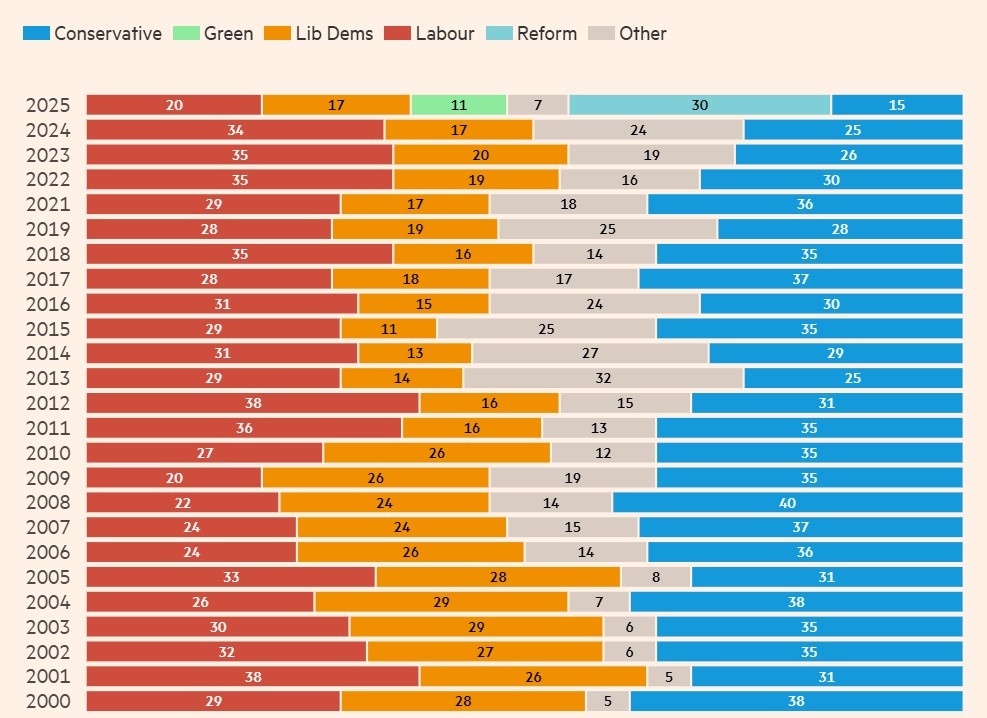
In the immediate aftermath of the July 2024 general election, we wrote this in the editorial in Left Horizons: “The election of this government ushers in a new phase in UK politics, one characterised by sharp changes and sudden turns in the class struggle as workers refuse to accept more austerity…” This prognosis was confirmed last Thursday, when what had once been the two ‘major’ parties found their collective share of the local election vote reduced to a third (35%), whereas they had together taken two thirds (67%) of the votes twenty-five years ago. (See FT graphic). The old system of voting is breaking up.
As much as the Labour Party is in crisis, the Tories are in a worse mess, and they will continue to haemorrhage support to Reform in the coming months. Kemi Badenoch is toast, but any replacement is unlikely to stem the flow of support away from this party, leading inexorably to a deal with Reform as the only way of avoiding obliteration.
We live in a period characterised above all by growing mass opposition to an economic system that leaves workers mired in uncertainty and insecurity. Hundreds of millions are running hard just to stand still, as living standards and social welfare come under attack. Without a single exception, every single election victory in modern times is won on the slogan of ‘change’. It is only because the organisations of the labour movement have failed to offer genuine change, that in its place every charlatan and snake-oil salesman has adopted the slogan, and in many cases won election with it.
This is true of British politics as well. The serious changes that Reform would introduce – complete privatisation of the NHS, abolition of trade union rights in the workplace, etc – are always kept under wraps, in favour of xenophobia. But they have for the moment convinced millions of workers that they are a vehicle for ‘change’ from which voters would benefit. They will be disabused of that.
We have a taste of what a Reform government would do in Nigel Farage’s remarks to workers of Durham County Council, now under Reform control, that they need to look for “alternative careers”. Their councillors will be quickly exposed to local voters as being far worse even than Tory councillors in relation to schools and local authority services in general.
Heading for a Tory/Reform coalition
Notwithstanding that Reform will be tested in their control of some local authorities, the national picture looks grim, and if opinion polls are to be believed, we may be heading for a Tory/Reform coalition after the next election. That will put their policies to the test and they too will be found wanting.
As one of its columnists wrote in the Financial Times after the election, the “Reform surge shows Britain will keep voting for change until it sees it.” Exactly right. The surge towards Reform is only in its outward form a move to the right. It is in reality a demand for change to the benefit of working people. When they are disabused of the results of a Farage government – as they will be – voters will surge just as dramatically to the left.
The working class today is immeasurably stronger than at any time in its history, even if the number organised in unions is smaller than at the peak forty years ago. The problem is that these millions of workers are not conscious of their power and not aware of how they need to wield it to challenge capitalism and to bring about a genuine change of society in their own interests.
The rise of Reform UK, to become a central element in British politics, is a cause for sober reflection. But it is not the end of the great political changes coming down the line. In the coming months and years, there will be many sudden, sharp and unpredictable political swings from left to right and back again. Within that maelstrom of ideas and discussion, we have to ensure that a genuine socialist movement is built to find a way out of perpetual crisis.
[Feature picture is BBC graphic of final local election results]