
By Gauthier Hordel, of La Riposte
During the Cold War, the conquest of space was one of the areas where the rivalry between the USSR and the United States was most expressed. Beyond the scientific and technological aspects, it represented for these two superpowers a means of asserting themselves militarily and economically in the battle for the rank of first power. Today, artificial intelligence (AI) is the perfect successor to the conquest of space, in the expression of rivalries, although this time between China and the United States.
AI is not new. This scientific discipline has existed since 1956, and has known periods of booms and crises. But from the 2010s onwards, it has accelerated dramatically with the appearance of deep learning, thanks to big data and the considerable increase in computing power. It will henceforth, over time, spread to all spheres of society and human activities: economic, artistic or daily life.
In this article, there will be no question of taking a position for or against AI and its use. Behind AI, there are major strategic issues and whether we like it or not, it will prevail. The aim here is to analyse its implications, not only from the point of view of technological competition between rival powers, but from the point of view of the general balance of power, economically and militarily.
One of the characteristics of capitalism is the economic competition that arises from the private ownership of the means of production. Companies are competitors and engage in a fierce struggle to capture market share. This means that every company is in a constant battle to increase its productivity to offer more attractive prices than its competitors. In the everyday language of the dominant ideology, this is called competitiveness.
Ability to innovate and offer new products
One of the important factors that allows a company to be well positioned in the market is its ability to innovate or offer new products. This is well-known to technicians and engineers who work in advanced technologies for the general public, industry or the military. The problem could be summarized as follows: “The survival of the company you work for depends on your ability to innovate more than your competitors.”
Under capitalism, technological development is necessary to survive in the face of competition, and when companies win the competition, this advantage is used to enrich a minority of capitalists who own the means of production.
The AI sector will offer solutions that are increasingly adapted to the needs of companies in their quest for “competitiveness”. The power of these new tools will make it possible, in the years to come, to increase the productivity of companies tenfold by offering considerable time-savings in, for example, data analysis or in decision-making, whether in the management of the company, its commercial strategy, or in research and development.
The same is true in the military field. Weapons equipped with AI will have increased performance. We already have concrete examples of this in theatres of military operations. Israeli imperialism, resting on war and the power of its army, it needs a cutting-edge arms industry that is already integrating AI into its drones to eradicate the Palestinian people.
States and companies that are ahead of the curve in the use and exploitation of AI will have a decisive advantage. That is why money is flowing into AI. Fundraising for companies like OpenAI in the United States, DeepSeek in China or MistralAI is in the tens or even hundreds of billions of dollars.
AI has become a priority for the leading economic powers, in order to stay in the race. Last February, Donald Trump announced a $500 billion investment plan, under the name of the Stargate project, which brings together tech giants.
The power of AI is based on exploiting masses of data
SoftBank, the funder specialising in the technology industry, will bear financial responsibility. OpenAI, famous for developing ChatGPT, will be responsible for operational aspects and technology development. Oracle will provide the infrastructure to host the data centres.
The power of AI is based, among other things, on the exploitation of data, which will allow it to be trained (deep learning) to increase its performance. Big data is an essential aspect that requires substantial infrastructure. Its development requires the construction of datacentres that house servers to store data.
Other companies, such as Nvidia or Arm, which specialise in the development of chips, CPUs and GPUs, are gravitating around this project. TSMC, the powerful Taiwanese semiconductor company, will be used to manufacture the electronic chips. Microsoft will be responsible for managing the advanced computing systems.
The American strategy is to use all the means to maintain its technological lead over its competitors, in particular by injecting astronomical sums of money. The United States, through OpenAI, wants to impose its own dominating standard throughout the world. At the Paris AI Summit last February, US Vice President JD Vance said: “The Trump administration will ensure that the most powerful artificial intelligence systems are built in the United States with semiconductors designed and manufactured in the United States.”
If states and companies adopt American solutions, then they become totally dependent on the United States, which will thus be able to maintain its economic and military domination over states and companies. The construction of data centres on American soil is a major strategic issue. They can both secure their servers, but also control access to their customers’ data.
Open AI is pressing for restrictive laws to be relaxed
We can immediately understand that if, for example, tomorrow, a customer (state or company) becomes an enemy, it will be easier for the United States to neutralise it economically and/or militarily.
To maintain its lead over its competitors, OpenAI is putting pressure on the laws around AI to be relaxed. Currently, legislation governs its development and uses. It is not keeping pace with the pace of progress, which has accelerated in recent years. It is becoming obsolete in the face of the reality of the situation and there are still grey areas.

“Ethical” questions arise mainly in sensitive areas such as autonomous weapons, autonomous cars, or health, to name but a few examples. These are questions such as “what responsibility do we leave to the machine?” that arise.
The debates around these issues argue in favour of a more or less strict framework. But for Sam Altman, CEO of OpenAI, who is on the front line of the Stargate project, the laws need to be made more flexible because “an overly strict legislative framework slows down the speed of development“.
OpenAI wants to dominate the market and impose its machine learning models. Sam Altman’s strategy is to convince Donald Trump that the interests of OpenAI and the United States coincide. For example, he wants to tighten the legislation regarding the permissiveness of foreign models on American soil. By campaigning for technological protectionism, he wants to get rid of foreign competition. He hopes that with such a policy, combined with massive funding, he will do what Microsoft did earlier with Windows, imposing itself in the field of operating systems.
This desire to crush competition is also taking place within American borders. Elon Musk posted on his social network X on January 22 against the Stargate project that “they don’t really have the money“. He also claims (without providing any evidence) that Softbank has far less than $10 billion to pump into Stargate.
Musk has founded his own AI company
Musk co-founded OpenAI with Sam Altman, whom he officially left due to strategic differences. Since then, he has founded xAI and is in direct competition with his former partner. However, xAI was excluded from the race by the Trump administration even though Musk was then himself a member of the administration. It is another rift appearing between Musk and Trump, and is the expression of divergent capitalist interests.
One obstacle standing in the way of the development of OpenAI’s machine learning models is intellectual property rights. To train its models, OpenAI needs access to human knowledge, in this case all the data available on the Internet. As a result, copyrighted data, ie data subject to intellectual property and copyright, was used but without authorisation, to limit development costs.
The New York Times, one example among many, has taken legal action against OpenAI for using its data without permission. This is another legislative aspect that Sam Altman wants to blow up, or at least “relax”, copyrights, while his AI models are under intellectual property. Here, in our example, the defence of the latter’s interests contradicts those of the New York Times Company, which derives its profits among other things from its copyrights.
For a long time, AI was mainly developed through academic work. During conferences and the publication of scientific articles, teams of researchers presented their models, their advances, etc. This allowed other teams of researchers to use this work to move forward on their own and present new models. Thus, the work of the different teams made it possible to feed each other. This is how science advances.
However, OpenAI breaks with this principle by closing access to its models through intellectual property to prevent other companies from financially exploiting the models it has developed, but which would not exist without the upstream work of other scientists. OpenAI is a for-profit company, but above all else, it wants to dominate the market by crushing the competition.
Capitalism is a system based on private ownership of the means of production. OpenAI owes its development to scientific knowledge, but it is also hampered by an aspect of private property, copyright. At a certain stage of its development, capitalism comes into contradiction with the productive forces, and we see this blatantly in the field of artificial intelligence.
The Chinese DeepSeek AI is open source
On the other hand, the private Chinese company DeepSeek-AI, OpenAI’s main competitor, has chosen to make its models (and in particular DeepSeek V3 and R1) open source, or more precisely under the MIT license, ie to make its models available free of charge. To put it simply, the MIT license allows copying and commodification of copies.
DeepSeek-AI was founded by Hangzhou Huanfang Technology Ltd Co, better known as High Flyer, which is a Chinese hedge fund that specialises in quantitative trading, which means that it uses mathematics and data analysis to exploit market inefficiencies, automate trades, and improve trading efficiency and profitability.
High Flyer is a company whose objective is to use the stock market to make the maximum profits, which some would qualify as the pinnacle of modern capitalism, in a state that some would describe as “communist”: note the contradiction (see our article on the subject).
If DeepSeek-AI has chosen Open Source, it is certainly not out of ethics or love of science. It’s because it has an interest in it. Behind Open Source, there is a community of developers who participate in improving software and AI models, either by proposing corrections and improvements or by proposing new models – based or not on the old ones – without remuneration. Here, information sharing is the driving force behind improvement. By this way of proceeding, development costs can be considerably reduced.
The release of the R1 version at the beginning of the year was made with a bang because DeepSeek-AI announced a development cost of only $5.6 million, while ChatGPT-4 is estimated to have cost more than $80 million. Each of its models has advantages and disadvantages, but DeepSeek has a serious advantage over its competitor as it costs 27 times less for each query. DeepSeek’s models have advantages that make Americans tremble.
Just like the United States, AI is defined as a priority for China. It is an important strategic means for it to take the initiative in the global competition in science and technology. If China manages to impose its models as standards, then it will also gain economic advantage.
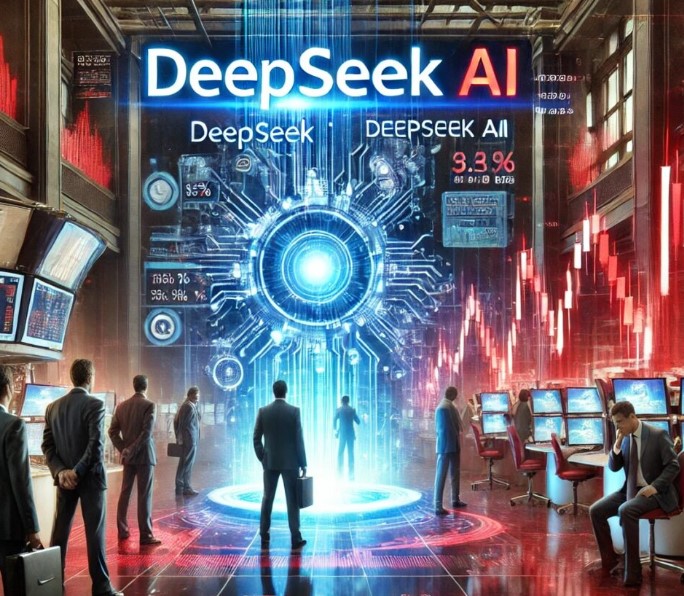
This threat to the interests of American capitalism is used by Sam Altman to identify OpenAI as the choice of the American administration, the ‘horse to bet on’ in the AI sector, and thus to oust his internal competitors.
It is not only a technological struggle between China and the United States, but an imperialist rivalry between these two powers, in which AI will play a decisive role.
European capitalism is left trailing behind
In the midst of this struggle between the two great superpowers, Europe is trying to make its way so as not to be left behind. There is a retreat of European capitalism on the international scene. This is particularly the case in France. It is therefore vital for them to attract investment in AI and to make themselves as little dependent as possible on American technologies.
The United States is trying by all means to keep Europe under its control and thus to impose economic and military dominance, for example with AI integrated into weapons systems.
Ursula Von Der Leyen, President of the European Commission, announced a €200 million public-private partnership, the largest in the history of the EU. The Paris summit on AI was an opportunity for Emmanuel Macron to play the role of salesman for French capitalism, because all the potential financial benefits of these investments will be in the hands of the capitalists.
In this technological race for economic supremacy, AI is dragging other strategic sectors behind it. AI is not just about models, algorithms and neural networks. In order to be successful, AI needs training. To give a simple example, it must be given hundreds of thousands of photos of cats so that its accuracy in recognizing this animal is close to 100%. In other words, AI is also based on its ability to access data.
To increase its performance, it needs proximity to a massive amount of data, hence the need to host and process this data in data centres. It’s not an abstract technology, it’s based on hardware. The data is processed by GPUs (graphics processing units) and TPUs (specialised processors), among others.
NVDIA develops electronic chips for the use of AI, while TSMC has the technology and know-how for the manufacture of the semiconductors that make up electronic chips. This type of firm plays a key role.
The states that control this industry then have an advantage over their adversaries. For example, Taiwan, which is home to the world’s largest semiconductor manufacturing industry, is coveted by the United States and China (see our article on the subject).
AI and the struggle for strategic resources
In the same way, all the elements of a data centre are above all materials and minerals. Access to the various mineral and rare earth resources is therefore a strategic issue, so it is clear that the race for AI will contribute to the intensification of international tensions and lead to military conflicts for access to strategic resources (see our article on the subject).
Finally, there is another important and problematic aspect to consider: AI is an energy-intensive technology. According to the IEA (International Energy Agency), on average, a query using AI consumes 10 times more energy than a query on a search engine related to its infrastructure. This means that the more it is deployed and used, the more it will take a significant share of global energy consumption.
Today, data centres account for between 1 and 2% of global electricity consumption, and AI accounts for a third of this consumption. According to the IEA, data centre consumption could double by 2030. Fierce defenders of AI, given the significant environmental impact of this technology, claim that it could participate in the energy transition. However, an energy transition that would try to reduce the pressure of human activities on the environment, within the framework of capitalism, would undeniably clash with economic interests (see our video on the subject).
In a world where the amount of energy consumed is only increasing over time and where fossil fuel reserves are dwindling to the point where at a certain stage production will tend to decrease, systems and machines will depend more and more on non-fossil electrical energy. This situation will cause fierce competition.
This is one of the limiting factors for the development of artificial intelligence in the future. Without energy, there is no artificial intelligence. This is a point to emphasise in order to deflate the speculation around which artificial intelligence would become, as an autonomous entity, a threat to the very existence of humanity. Some companies and individuals focus attention on this, but the primary threat to humanity is not AI; it is capitalism, which causes wars and environmental destruction.
Like all innovative technologies, the development of AI will profoundly change people’s daily lives. But also, as Marx tried to explain as early as 1848 in the Communist Manifesto, progress accentuates the class opposition between capitalists and workers by transforming society into a battlefield. We see it in front of our eyes. Under capitalism, technology is not only a tool for the emancipation of the ‘animal condition’, it is also a tool of domination at the service of a minority of capitalists.
AI in the hands of this class and their political representatives has no other objective than to increase military capacity and means of surveillance and to extract the maximum profit to establish their domination. Technology like AI is neither a good nor a bad thing in itself, but as long as there is a class society, it will remain a tool at the service of the ruling class.
This article was first published on the Marxist website, La Riposte, here.
Feature picture from Wikimedia Commons, here.