
Every government involved in this month’s ’12-day war’ – Israel, Iran and the USA – is claiming victory. But in fact, even if the ceasefire holds – which is by no means certain – none of the three governments in question can really count itself a ‘winner’.
Socialists condemn the bombing of Iran
As we said in our previous editorial, socialists do not support the regime in Tehran, but we nevertheless condemned the outrageous and unprovoked attack on Iran which has suffered the greatest blows in terms of loss of life, destruction of infrastructure, and militarily.
It was always known that Israel was the Middle East superpower, but its outrageous and unprovoked attack was more devastating than even Iran had anticipated. Israeli raids not only damaged uranium enrichment sites and military targets, but also killed many high-ranking officers in the army and revolutionary guard. It became clear that Israel had Mossad agents already in strategic positions in Iran, to facilitate the attacks.
Iran is therefore completely exposed militarily and its air defences all but eliminated. When the final blowcame from US stealth bombers, dropping ‘bunker buster’ bombs on three sites – as many as six on the key Fordow uranium enrichment site – the Iranian regime had extremely limited resources with which to hit back. In the end, its missile attack on the US base in Qatar was a token effort, with the USA warned in advance and able to prevent any damage or casualties. Donald Trump, adding to the Iranian humiliation, thanked them for the ‘heads up’ before that attack.
While we condemn the attacks on Iran, we have to recognise that the main concern of the Tehran regime is staying in power. The gesture of the Qatar missile attack was to give the pretence of ‘hitting back’, but without doing enough to incur the potential US response.
Regime weaker than before
This short war has left the Tehran regime far weaker than ever before, perhaps desperately so. As Michael Roberts has explained in his article on the Iranian economy, ordinary workers are suffering from years of mismanagement and corruption. Workers will now be asking why, when their living standards are falling, and the economy was strangled by sanctions that billions were spent on uranium enrichment and on the military, neither of which were much help when Israel bombed the sites.
According to the Iranian government, 627 people were killed in the bombing, the big majority of them civilians. Israel thinks nothing of destroying a residential block to target one leader, with the dozens of civilian deaths being just so much ‘collateral’. Then Netanyahu has the nerve to complain at Iran targeting Tel Aviv, a largely civilian city, but with military installations dotted around. So what Israel has done to the people of Iran only embitters them more.
Iranians have seen the genocide in Gaza and have now had a small taste themselves. The bombing might have reinforced their hatred of Israel, but it has done likewise for the theocratic regime. Now that a ceasefire has come into effect, there will be growing resentment towards a regime characterised by corruption and repression, one which over the years has killed many Iranian dissidents.
It is impossible to predict what is going to happen next in Iran. There does not seem to be any organised opposition, but like in the Arab Spring of 2011, a spontaneous movement of workers could easily burst out into the open. The regime is politically exposed more than ever before. It put all its hopes in the development of a nuclear programme, but in a single bombing campaign, that programme has been set back for at least months and possibly years. Workers will see this as money down the drain, so in the coming months, even assuming the ceasefire holds, something will have to give.
Unprecedented political change will overtake Israel
In Israel, Netanyahu had managed to do at last what he has wanted to do for two decades. He has not only bombed Iran, but he has demonstrated the overwhelming military superiority of Israel. Israel was able to effect a devastating strike against Iran, and in future wars it will want to be stronger still, especially in technological terms, as with the ‘stealth’ drone it is now developing.
All of this is music to Netanyahu’s ears and he may succeed in the short term to milk this war to his political advantage. But on the other hand, Israeli newspapers like Haaretz are suggesting that he was ‘blind-sided’ by Trump, for agreeing to a ceasefire with no written agreement. Trump strongly chastised Israel and demanded it call off its final bombing sorties – which it did – which was a rare public dressing down.
Netanyahu is crowing now, but it will become clear that the Iranian nuclear programme is not completely destroyed. CNN has carried a report, repeated in the Israeli press, to the effect that Iranian uranium enrichment is set back but not destroyed.
The damage done to the Fordow enrichment facility could not have been done without US help and according to the Financial Times, “The findings of the preliminary report into the attack by the Defense Intelligence Agency, described by some US media, came just three days after Trump authorised the bombing of Iran’s most important nuclear sites”.
Raining on Netanyahu’s victory parade
In international relations, a few months here or there is no time at all and it raises the question of Israel having to launch more bombing in the future – although this time, possible without US help. Another issue raining on Netanyahu’s ‘victory parade’ is the missing uranium. There is still around half a tonne of it, enriched to around 60%, that is completely unaccounted for, and Iran will be carefully husbanding (and repairing) its storage and enrichment facilities for the future. If there is one thing the Israeli bombing campaign has guaranteed, it is that Iran will definitely proceed to acquire nuclear weapons now.
Then there is the physical and financial cost of this short war. Most of the Iranian drones and missiles were shot down by Israel’s sophisticated multi-layered defence system. But enough got through to create real trauma in Israel. Out of around 550 missiles sent, around 10% got through.
It is important to note that the destruction in Israeli cities bears no comparison in scale or intensity to the utter obliteration of Gaza – where there were no bomb shelters – and the ongoing savage genocide and starvation. A minimum of 56,000 have been killed, probably tens of thousands more, compared to a less than thirty in Israel.
But still, for Israelis this is new, even on this scale…and they don’t like it. “…the Iranian missiles have narrowed the gap between Israel and Gaza in a brutal fashion”, one correspondent tastelessly wrote in Ha’aretz. “The images of destruction from Tel Aviv and Ramat Gan evoke those of Beit Lahia and Gaza City. [Two cities in the Gaza Strip] Suddenly, through Israeli eyes, one can understand what it looks like to have a ton-and-a-half of explosives dropped on you”.
In another article, the writer noted the effect of bombing on people’s attitudes. “Until recently”, she wrote, “statements like ‘trapped under the rubble,’ ‘trying to locate missing people’ and ‘widespread destruction in the area’ hardly appeared in the Israeli media”.
There are questions about why two million Israelis had no provision of bomb shelters, especially Palestinian Israelis (some of whom were denied entry to shelters), and why, with the attack on Iran being months in the preparation, there was no investment in public safety.
When the dust has settled, Netanyahu will find he has banked no extra political capital from this bloody adventure. It has led to the most damaging bombing campaign suffered by Israel in modern times, yet ultimately, it has gained little. Israelis will fear, not without reason, that Iran will rebuild its military, stronger than before and that more wars will be launched by the Israeli regime.
Notwithstanding the temporary rallying around the government in time of conflict, Netanyahu and his ‘forever wars’ are not an attractive proposition, except for those on the far right of the political spectrum.
Gaza genocide has resumed centre stage
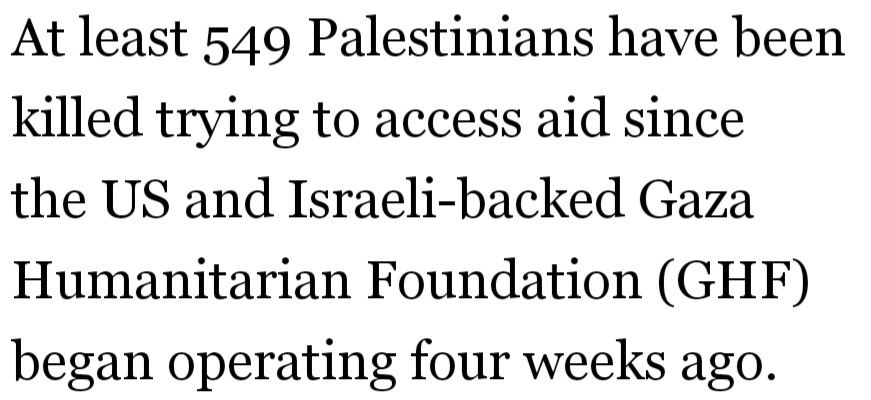
For two weeks, the genocide in Gaza was off the headlines. Gaza: where a half-starved population risk being killed when they go for food to the ‘official’ aid agencies. Haaretz reported that least 86 Palestinians were killed in Gaza in a single 24 hours, 56 of them while waiting for humanitarian aid.
Gaza has again resumed centre-stage and for Netanyahu it is a problem that will not go away. The genocide perpetrated there, combined with the continued ethnic-cleansing of Arab villages and farms in the West Bank, has made Israel a pariah state among workers and youth across the world.
No other single, world-wide political movement has generated so many protests, demonstrations and rallies and these must continue to demand an end to the complicity of western governments in the slaughter, and for boycotts, divestment and sanctions against the Israeli state. In time, this level of international opposition will have an effect in Israel itself.
In the USA, AIPAC is a powerful lobbying organisation on behalf of Israel, far bigger than the Labour Friends of Israel in the UK. As a result of what has happened in Gaza, everything AIPAC has built is being undermined and its influence tarnished. Even the most right-wing Republican politicians, often vehemently opposed to the idea of Iran having nuclear weapons, are becoming increasingly impatient with Netanyahu’s permanent state of war.
As an aside, it was very revealing, that Zohran Mamdani, a Muslim, won the primary contest to be the Democratic candidate for mayor of New York, a city with a large Jewish population. Throughout the race, Haaretz reported, polling consistently showed Mamdani placed second among Jewish Democratic voters, behind only Cuomo. That result is an indication of the huge shift in public opinion on Israel.
The messianic fervour of Netanyahu – and that is an expression used by his Israeli political opponents as well – will not help him in the long run. He is trying, like Trump, to tie the state security apparatus, Mossad and Shin Bet, as well as the judiciary and the press, into his authoritarian rule. But he will not succeed. History will not judge this month’s war as an upturn in his fortunes, but another milestone in his demise.
In the longer run, Trump will have gained nothing from the war
Donald Trump will bluster and blag his way through the aftermath of the war. He is a politician like no other and what he says bears no relation to what he said before (which might be the opposite), or what he may say in two days’ time. Everything he says is for effect, and for only that moment in time. He is basking in the sunshine of being a ‘peacemaker’ lauded by his narrow clique of supporters. But here, too, we are looking at a passing phenomenon.
There is no guarantee that the ceasefire will hold. Trump promised to end the war on Gaza and the war in the Ukraine when he campaigned last year. He has done neither. Just as he ended with no agreement with North Korea in his first term of office. He is a past-master at bragging about deals, but he has actually achieved nothing in his first six months in office.
When the US stealth bombers returned from bombing Iran, Trump boasted about the total “obliteration” of the targeted nuclear sites. “They [Israel] have guys that go in there after… and they say it was total obliteration,” adding that “Israel is doing a report on it now.” It doesn’t matter to Trump that this just isn’t true. The chair of the Israeli ultra-orthodox Shas party told Haaretz that “no one” was sent by Israel to inspect the damage done to the Iranian nuclear facilities.
Doubt that nuclear programme was “obliterated”
It is difficult to say what the truth really is. We will probably not know for some time, but we can be sure that when the assessments of the US military are made, we doubt that “obliteration” will be in their report. Not that it matters to Trump, since his opinions will have moved on by then.
Still, the White House released a statement attributed to the Israel Atomic Energy Commission, saying that US strikes, “combined with Israeli strikes on other elements of Iran’s nuclear program, have set back Iran’s ability to develop nuclear weapons by many years,”
In truth, Trump got off lightly in this conflict. Iran was so badly hurt by Israeli bombing and the regime was so terrified of losing its grip on the population, that it held back from serious retaliation against US bases in the region.
But there are still up to fifty thousand US military personnel in the region. Their situation is still very precarious, and every new crisis threatens casualties, each one worse that the one before. It is only a matter of time before the military support for Israel creates a crisis that is not so easily managed.
Steve Bannon, once a close adviser to Trump and one of those Republicans critical of US involvement in foreign wars, suggested that the ceasefire was done to get Israel off the hook. “You saw why Bibi can’t be trusted”, he wrote on X, “The ceasefire was as much to save Israel. That’s the hidden story. They bit off more than they could chew. Yesterday was brutal for Israeli citizens, especially in Tel Aviv and Beersheba.” He suggested that Israel were running out of Defense missiles.
There is disenchantment within the military at longstanding US support for Israel. As we previously reported, a key US army colonel in the Middle East, Nathan McCormack, the chief of the Levant and Egypt branch at the planning directorate of the Joint Chiefs of Staff, was removed from his position this week after he criticised Washington’s support for Israel, which he described as “our worst ‘ally’…We get literally nothing out of the ‘partnership’ other than the enmity of millions of people in the Middle East, Africa, and Asia…”
The MAGA movement is not completely split, but this war has revealed new divisions and has brought some opponents of Trump out of the Republican woodwork. Those divisions will grow and like Netanyahu in Jerusalem and Ayatollah Khamenei in Tehran, Trump will find that his untouchable public image is suddenly tarnished and vulnerable.
Trump’s foreign policy adventures will do him no good
It is extremely doubtful, especially in the longer term, whether Trump’s foreign policy adventures will do him any good at all. Added to his failure to resolve the bread-and-butter issues facing ordinary workers in the USA – wage levels, affordability of housing, ICE harassment, and so on – it will become apparent in the coming months that Trump is a colossus standing on chicken legs.
From the standpoint of a wider, historical perspective, this war was a momentary episode. But it is perfect representation of the period in which we live – one of revolutions, counter-revolutions, but above all wars. It is workers who suffer the consequences of the wars, although it is not their system that is to blame.
The sooner the rule of religious dictators, messianic demagogues and billionaire chancers is ended, the better it will be for all of us. Crises and wars are permanent features of capitalism, a system historically redundant, but not yet overthrown – that is the task facing the workers of the world.