By David Cartwright
On 6 July 1995, 30 years ago today, the Bosnian Serb Army of Republika Skpska surged into the UN-controlled town of Srebrenica in Bosnia and Herzegovina during the final year of the Bosnian War. The Bosnian Serb leader, Ratko Mladić declared that his army had taken over Srebrenica for the Serbian nation. Despite initially pretending that he would protect the refugees in the town, he was intent on “revenge on the Muslims”. Within a period of just a few weeks 8,372 Bosniaks (Bosnian Muslims), mainly men and boys, were slaughtered, in what is recognised as the first genocide in Europe since the Second World War.
Thousands of Bosniak men, women and children were gathered in Srebrenica because they had been expelled from their own towns and villages by the Bosnian Serb nationalist forces who opened up a civil war in the country in 1992. Bosnia had been part of the former Yugoslavia and had always been a multi-ethnic republic within Yugoslavia. In 1992 the population comprised 44% Bosniaks, 32.5% Orthodox Serbs, and 17% Croats (mainly Catholic).
The collapse of the former Yugoslavia
With the collapse of the former Yugoslavia, the different republics within it were separating into different national states, starting with Slovenia and Croatia. A referendum for independence took place in the Socialist Republic of Bosnia and Herzegovina in February 1992 but Serb nationalists within the republic called for a boycott. Many Serbs within the country were proud to be part of a multi-ethnic state but the Serb nationalists were driven by the idea of a Greater Serbia, where they saw themselves taking as much of the former Yugoslavia as possible into that new state.
The Serbian leaders in Bosnia such as Ratko Mladić and Radovan Karadžić were following the virulent Serb nationalism promoted since the late 1980s by Serbian leader Slobodan Milosevic, who was in charge in the neighbouring state of Serbia. The referendum for an independent Bosnia was passed but they instead declared a Republic of Skrpska within the borders of the republic. They had access to the forces of the Yugoslav Army and started a civil war to establish control in as much of the land as possible.
After a number of initial clashes and military attacks pointing to the growing threat of war, a multi-ethnic demonstration for peace took place in Sarajevo in April 1992. Approximately 100,000 people attended the demonstration. By this time the Serbian nationalist forces had begun surrounding the city and snipers from the Serb Democratic Party (founded by Serb nationalists in Croatia) located in the Holiday Inn fired on the demonstration. Shortly afterwards, a complete blockade of the capital began and didn’t end until February 1996. This siege of Sarajevo (lasting 1,425 days) cost the lives of nearly 14,000 people (5,000 of them civilians).
The Bosnian War and the role of the UN
The height of the war was in 1992 and 1993. Driven by the ideas of Serb nationalism, people of the Muslim faith were attacked. Neighbours were set against neighbours. Family against family. The Bosniaks were simply Bosnians who converted to Islam during the period after the Ottomans invaded in the late 1400s. Yet they became a target for the rampaging forces of nationalism. The Serb forces carried out a policy of ethnic cleansing aiming to turn mixed towns and villages into Serb only ones.
The UN security council passed a resolution in September 1992 imposing an international ban on sending arms to any of any of the forces in Yugoslavia, supposedly to avoid escalating violence. The Yugoslav People’s Army (JNA) was well armed but was considered to be neutral. But the Serbs took control of the JNA and, hence, gained superiority in weaponry.
The Bosnian forces ie the Army of the Republic of Bosnia and Herzegovina (ARBiH) in the blockaded city of Sarajevo had to resort to making their own weapons to defend themselves. They also found a way to adapt sewage pipes into missile launchers.
In 1993 US president Bill Clinton argued for the lifting of the arms embargo but European nations like the UK, France, Germany and Italy were all opposed. Those countries had troops in the country under the banner of the UNPROFOR (UN protection force) and feared that they would be attacked. Pakistan was the fourth largest contributor to the peacekeeping forces. They deemed the embargo illegal and later declared that they would supply arms to the ARBiH.
The siege of Srebrenica
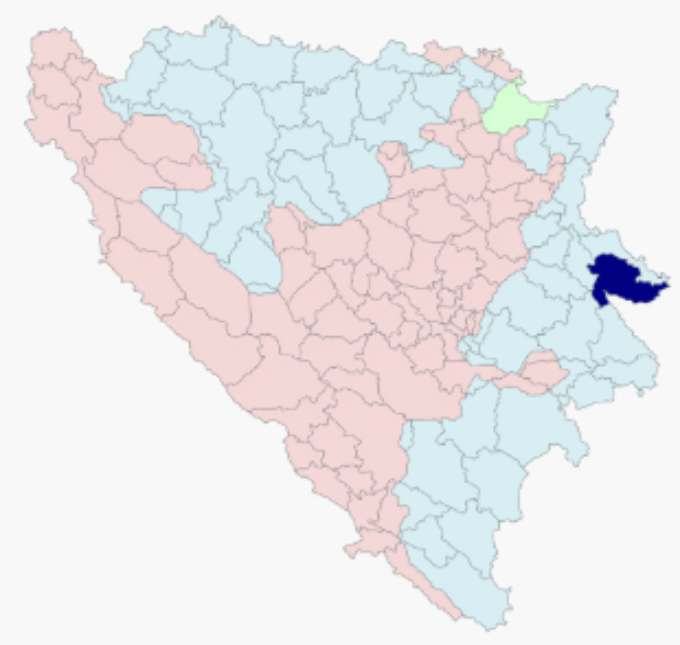
The region around Srebrenica had been the scene of much fighting early in the war. Serb forces had removed tens of thousands of Bosniaks from villages in the area and 50-60,000 had fled to Srebrenica itself. The Serb army told the UN that the town should be evacuated because they intended to take it over.
The area of Srebrenica was designated as a safe haven by the UN in April 1993. In return both sides were meant to demilitarise but this proved impossible. A UNPROFOR base was set up in Sreberenica initially with troops from Canada. Those soldiers were replaced by 600 from the Netherlands in April 1994. Fighting continued in the area and Srebrenica remained a target for the Serb nationalists. By March 1995 they were strangling the area, preventing food and humanitarian aid from coming in. Despite the dangers the UN allowed the number of Dutch troops to steadily reduce from 600 to under 400.
The VRS enters Srebrenica
On 6 July 1995, 2,000 soldiers from the Army of Republika Srpska (VRS) entered Srebrenica. The Army leaders were well aware of Directive 7 from April 1995 in which Radovan Karadžić had said: “By planned and well-thought-out combat operations, create an unbearable situation of total insecurity with no hope of further survival or life for the inhabitants of Srebrenica.”
Although there were 6,000 Bosnian forces from the ARBiH in the area they were no match for the VRS and they withdrew. By the 11 July the VRS had taken full control of the town. The refugees feared for their lives and sought help from the UN. There were now 20-25,000 refugees gathered in and around the UN base, a disused battery factory called Potočari. People were desperate. On 12 July they could see houses being burned down and could hear gun shots. Summary executions among the crowds started to take place.
Buses had been arranged to evacuate people to Bosnian-held territory to the north. But the Serb soldiers separated out those men and boys who were of fighting age. Many of these men and boys would be executed systematically over the next few days. 25,000 women and girls were able to be evacuated to the north, following negotiations by the UN with the Serb leaders.
Attempts to escape
The 6,000 ARBiH troops decided to lead a column of 7,000 civilians north towards safety in Tuzla in Bosnia controlled territory. They would have to break through Serb-held areas to reach Tuzla and many lost their lives on the way. Those that managed to survive after several days of risking their lives arrived in Tuzla exhausted and traumatised. Others tried different routes to flee the massacre and they were also subject to capture and shooting.
Mass executions continued in Srebrenica and many of those fleeing were hunted down and killed. The Serb forces tried to hide the extent of their genocide by moving bodies away from the initial place of execution, trying to make their deaths look like the result of fighting. Some bodies were moved several times. But painstaking work by forensic experts since has reconstructed the horrific systematic nature of the massacre.
Convictions for war crimes and genocide
In 1993 the UN set up an International Criminal Tribunal for the former Yugoslavia (ICTY) to investigate the war crimes that had been committed including the charges of genocide. In May 2011, Ratko Mladić was arrested after spending 16 years hiding in Serbia. Charged with being responsible for the Srebrenica massacre, he was given a life sentence in 2017 for war crimes, crimes against humanity and genocide. Radovan Karadžić was also convicted and given a life sentence in 2016. A number of top Army officers were also found guilty of genocide or abetting genocide.
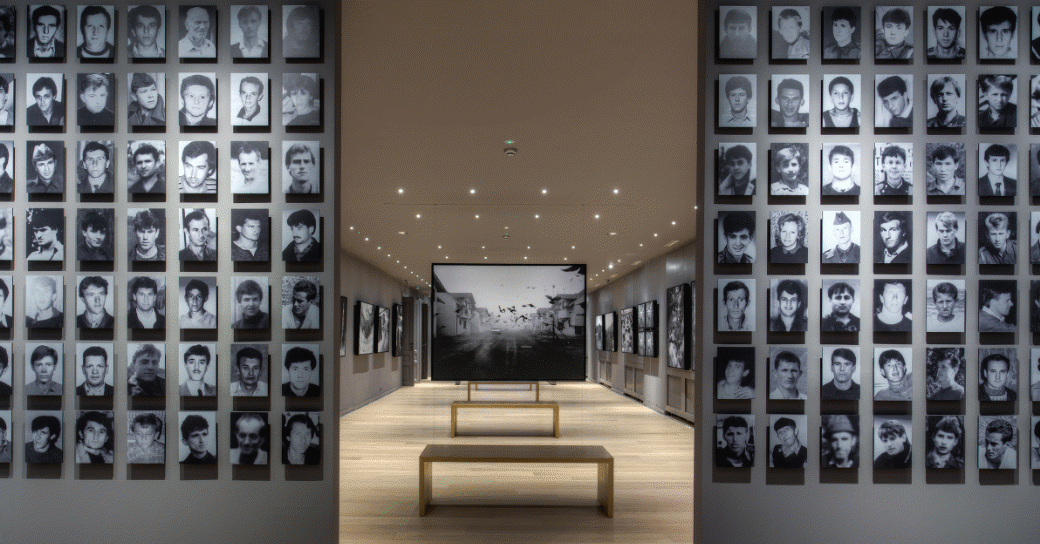
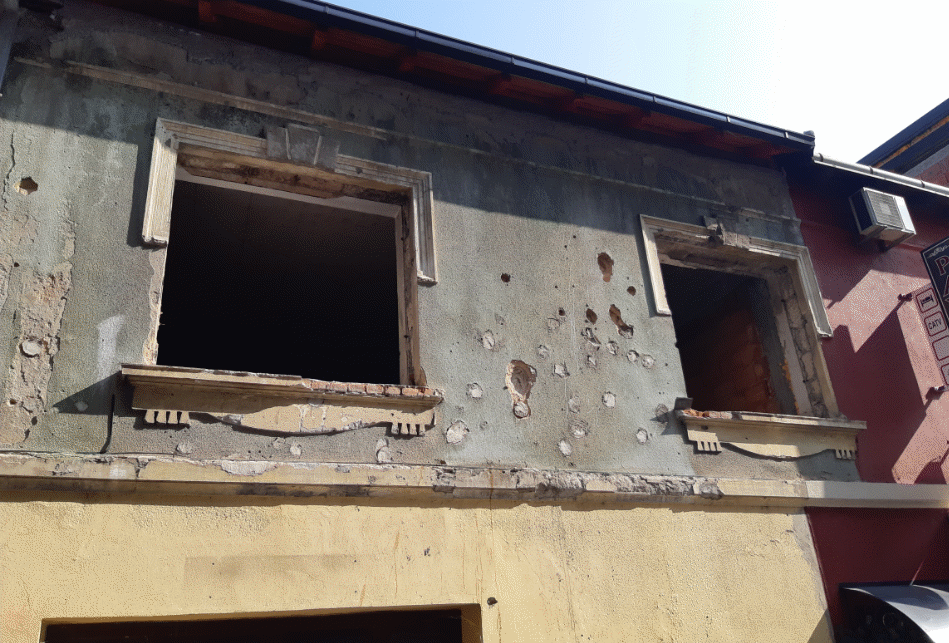
Bosnia today is still scarred by the war just 30 years ago. The country is tied down by an ethnically based constitution that was implemented at the end of the war via the Dayton Agreement. But as a visitor you sense a positive multi-ethnic energy in mixed cities like Sarajevo and Travnik. There is a very moving Museum/Gallery in Sarajevo dedicated to the memory of Srebrenica called Galerija 11/07/95. The portrait pictures of victims show that these were just ordinary people whose lives were cut tragically short. It also contains disturbing images of graffiti of a racist nature by some of the Dutch troops found at the UN base Potočari.
On the wall in the exhibition there is a quote from Primo Levi who said “If it happened once, it can happen again.” In fact, as we know, without a united workers movement to overthrow capitalism war crimes and genocide can happen again and again.
The featured image at the top of the article is from the Museum/Gallery in Sarajevo dedicated to the memory of Srebrenica called Galerija 11/07/95.