
By Adel Mostowfi, Iranian socialist
“Militarism is not an offshoot of capitalism; it is a necessary tool of capitalist class rule. It is the shield and sword of capital.”
Rosa Luxemburg, The Junius Pamphlet, 1915
For those curious about the rise of neo-militarism and how it serves contemporary global capitalism, the Israeli and US attack on Iran is a case study. Here, I will try to demonstrate how the dynamics between Israel, the US and Iran serve them all in a perverse way.
Why June 13?
The first question that comes to mind regarding Israel’s attack on Iran is why it took place on June 13 and not June 12 or 14. The answer to this question could reveal the true motivations behind Netanyahu’s initiation. Netanyahu’s government has been under heavy pressure:
1. The international pro-Palestinian activists, namely the Freedom Flotilla Coalition (which included Greta Thunberg) and the Soumoud Convoy, which are part of the Global March to Gaza, were supposed to reach Rafah the same weekend, but were stopped, partly in Egypt.
2. Religious parties in the Prime Minister’s ruling coalition threatened to support a push to dissolve the Knesset in the same week, triggering early elections, if the government did not pass a bill to permanently exempt ultra-Orthodox Jews from military service.
3. The sixth round of Iran-US talks was scheduled for the June 15 in Oman. Both NBC and CBS cited unnamed US officials who said that Israel is ‘fully ready’ to carry out an operation and that’s because Israel believes that the US and Iran were nearing a framework agreement.
After the attack, all the activists of the Soumoud Convoy who were going to Israel were detained on their way in Libya and Egypt and deported back to their home countries without any news being broken (which is significant, given that the main goal of the campaign was to empower pro-Palestine discourse).
The state of emergency declared by the Israeli Ministry of Defence avoided ultra-Orthodox Jews threat in the Knesset. This allowed the Israeli government to ignore court rulings and detain people without trial. This was just when the government needed to deal with the opposition, who had been protesting in the streets of Tel Aviv since 2021 as part of the ‘Balfour Protests’ against Netanyahu’s trial, and who more recently protested in ‘Hostage Square’. Finally, not only were the US-Iran talks cancelled, but the US also bombed Iran’s nuclear facilities. So, this attacked solved all three of Netanyahu’s problems.
Why cease fire after 12 days?
The Israel Defence Forces (IDF), through air strikes and spies and agents who were able to manufacture micro-drones equipped with handmade bombs, hit many important officials and a great deal of infrastructure with high domestic significance (without disturbing international markets). The question then arises as to why they did not continue with the attacks if the operation was so successful? There are several answers to this question.
First, the IDF’s resources rely heavily on NATO support and rearmament, which means it has a limited inventory. That is why the IDF wars are generally intense but short to allow the inventory to be replenished.
Secondly, the hit rate of Iranian missiles, which was initially less than 10 per cent, tripled to 30 per cent over the course of the war (based on Tasnim’s citation of an IDF official). Moreover, prolonging the war would mean continuing the battle on the ground, where, contrary to the air war, Iran’s army has the upper hand, with around five times more active personnel (not counting Hezbollah and Hamas).
US bases in Iraq are especially vulnerable (note the most recent missile attack on Irbil), as the Iraqi government actively supports Iran by intercepting IDF attacks from southern territories.
But the most important reason may be that the Israeli government relied on the unpopularity of the Islamic regime, imagining that the absence of governance will automatically lead to protest that would cause a regime change with Pahlavi [son of the former Shah] as the new head of the new puppet state. Israel also relied on Kurdish, Turkish and Arab nationalists groups taking up arms to establish the ‘Free State of Kurdistan’, become a territory of Azerbaijan and an “independent” Arabistan, respectively.
However, opposition to the Islamic government, inspired by the examples of Iraq, Afghanistan, Syria and Libya, and the slogan “Woman, Life, Freedom for Peace”, thwarted this plan. This was a massive defeat for Iran’s right-wing opposition (e.g. monarchists or Pahlavi), who lost most of their credibility.
Did the MAGA division really grew?
The “Make America Great Again” (MAGA) movement advocates for non-interventionist foreign policy. There are very good reasons to believe this is indeed the case. Trump, a great rentier capitalist, sold the government of Afghanistan to the Taliban in his first term in office, protecting his regional interests. As the result he reduced US troop involvement in the region, (though the transaction took place under Biden’s administration).
In his current term, he has a similar strategy with respect to Zelensky’s Ukraine: he is milking Ukraine to profit Putin (e.g., rare earth minerals of both west and east side). Lastly, in the leaked Signal chat about the US strike on the Houthis, who are supported by Iran, we can see the contempt for European allies expressed by Vice-President JD Vance and Secretary of Defence, Hegseth.
But is Israel’s attack really a deviation from MAGA’s foreign policy, or is it its logical continuation? The US government has effectively “outsourced” its military actions in the Middle East to Israel. If the legislation passes, the B2 bombers that struck the Iranian nuclear facility would be transferred to Israel, meaning the US would only have to get involved at a bare minimum (e.g., radar support for missiles interception).
Why should there be any division? Empowering the IDF to replace US troops in the region must be one of the primary aims of MAGA’s foreign policy. Plus, “Daddy” Trump (as he was called by NATO Secretary General Mark Rutte) stopped the “kids” from fighting and displayed himself once again as a peacemaker! He also can claim to have degraded Iran’s nuclear programme by one to two years.
But how could the Iranian government possibly be happy?!
What could symbolise life in Iran better than Israel’s bombing of Evin prison? Being literally imprisoned by an exploitative and dictatorial regime and bombed by a violent, aggressive, genocidal regime, supported by imperialist NATO, is the ultimate symbol of living in Iran. Especially that the most devastating damage was inflicted on the women’s section of the prison!
Strategically, this bombing is very hard to rationalise for Israel, but it is worth pausing to examine it carefully. What was Israel’s interest in carrying out this attack on the prison? It is highly improbable that the bombing was intended to free the prisoners.
Assuming that the political prisoners, who condemned the attack days before, could find the time and opportunity to pass through seven locked doors while the whole place was on fire, with walls falling, is far-fetched. And assuming that there wouldn’t be any security guards outside the prison waiting to shoot them en masse, to execute them all before escaping?
These examples illustrate why the Iranian government benefited from the sadistic nature of Israel’s government, where gang rape of a Palestinian female prisoner by ten Isreali male guards at the Sde Teiman detention facility in the Negev desert is legitimate.
However, in fact, the Iranian government is probably more upset than their counterparts that Israel’s attack on Evin was unsuccessful and the prisoners are still alive! Consider the cases of Jacques Paris and Cécile Kohler, two international syndicalists and members of the CGT (Confédération Générale du Travail), who are imprisoned in Evin and have been charged with ‘spying for Mossad’.
This is ironic, given that these two condemned Israel’s attacks when it started. The same accusation has also been used to justify anti-refugee policy of the state by the mass deportation of Afghans, including those who have lived in the country for over three decades and hold Iranian passports. The benefit of the war for the Iranian government are several:
1. In recent years, crippling mass protests and the labour movement have challenged the government. Compared to previous movements, the most recent one was more organised. It consists of several social groups with a common, specific demand of the government. One such example is the recent nationwide strike by truck drivers in 160 cities, against rising insurance premiums, poor road security, high fuel prices and low freight rates. However, the strike has now stopped following the Israeli attack.
2. The secularism of the Woman, Life, Freedom uprising has undermined the government’s political Islamic rhetoric. The government’s adoption of a nationalistic discourse has been evident since the attack. The god that it preaches has been replaced by the holy borders. This is probably the greatest benefit of the war.
3. Regardless of the actual damage to [the enrichment facility at] Fordow, the government has suspended cooperation with the United Nations Atomic Energy Agency, leaving the agency blind to Iranian nuclear work following US and Israeli strikes. This is significant because, firstly, during any future negotiations, Iran could demand something in exchange for allowing inspections to resume, so it puts Iran in better bargaining position.
Secondly, Iran can secretly pursue the bomb now; this possibility is no longer so improbable anymore. This is the first time that the need for a nuclear bomb has been openly discussed in the public political sphere since the nuclear deal with Obama. It is easy to justify it after the attacks of two foreign countries, both of whom have nuclear bombs!
“The main enemy is at home!”
Remember the “Iran–Contra” affair between Reagan and Khomeini? This was when the CIA got Israel to traffic US arms, through Hezbollah, to the Iranian Islamic republic, in order to fund terrorist ‘Contras’ against the Sandinista government in Nicaragua.
By pursuing war, the US promote capitalism more effectively. By directly promoting militarism, they look after only their own interests. In this, they are, as in many other cases, led by the “invisible hand” (Adam Smith) to promote an end which was not part of their intention, ie global capitalism.
Why did the anti-Vietnam war encampment in Berkeley in 1969 last for 40 days, while the pro-Palestine encampment at Columbia University in 2025 lasted only 14 days? What did they learn, and what have we forgotten?
The experience of Bashar al-Assad’s government collapse in Syria, followed by the swift IDF strikes on Syrian infrastructure, has had a chilling effect on revolutionary aspirations within Iran. As a result, any large-scale uprising in Iran is now overshadowed by the looming threat of an Israeli attack on Iranian soil, under the pretext of neutralising strategic threats. In light of these constraints, a synchronized action between the opposition movements in both Iran and Israel appears increasingly necessary. European internationalists can play this binding role to help them unite.
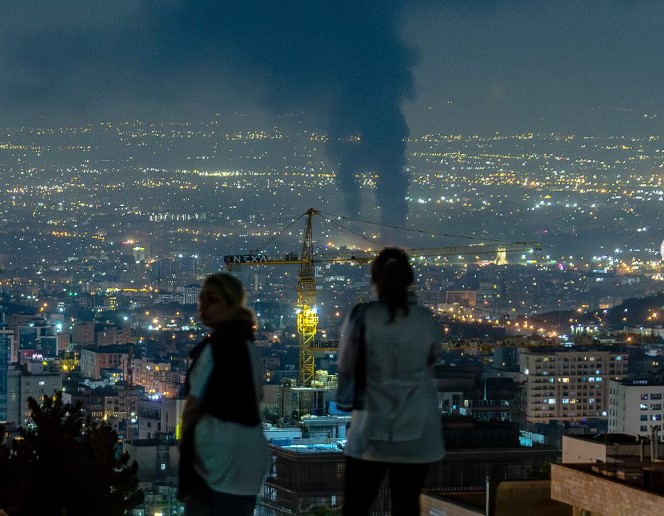
[Feature photograph from Instagram “middleeastimages, here.]