
By Jordi Escuer
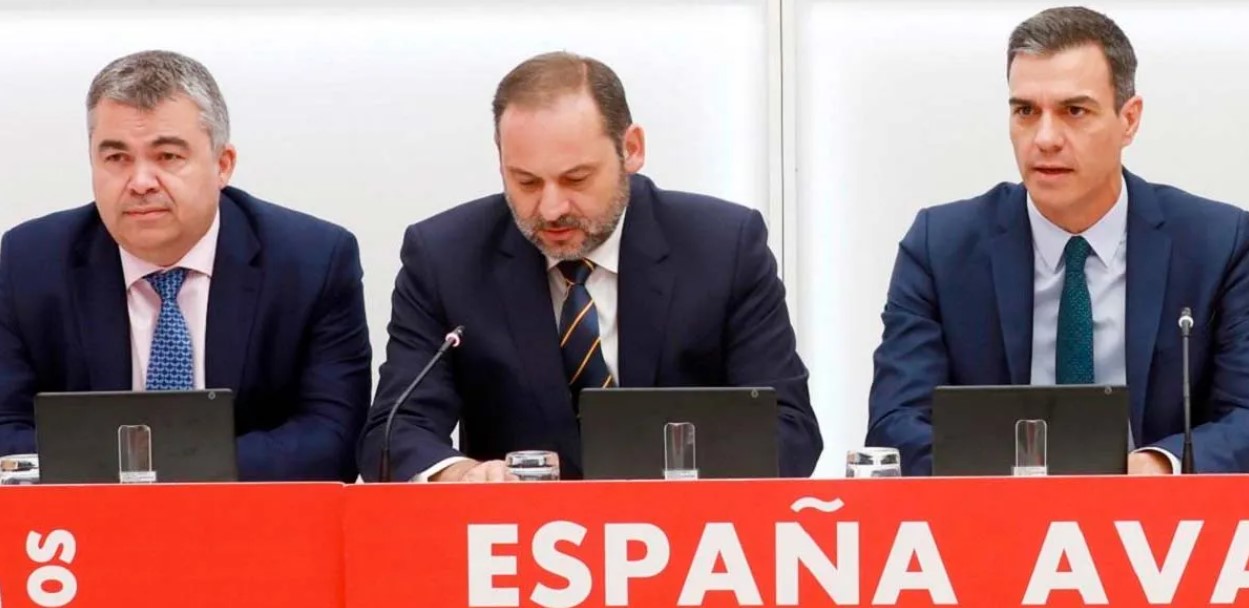
[Editorial note: in June, the coalition government of Pedro Sánchez was rocked by the arrest of a former party official, Santos Cerdán, on charges of corruption. A former transport minister, José Ábalos, was also implicated.
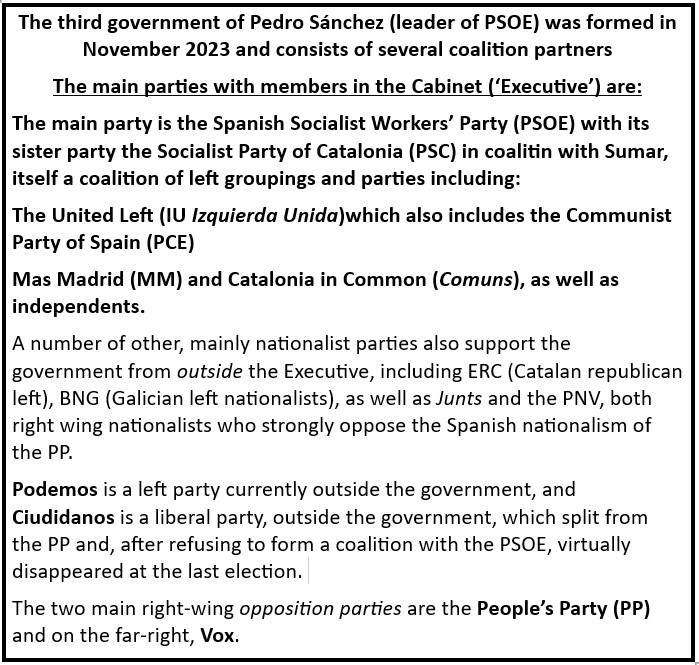
Jordi Escuer’s article here is based on the one published in porelsocialismo.net. It discusses the important tactial implications for the genuine left, (described here as the ‘transformational’ left, as opposed to the PSOE (Spanish Socialist Workers’ Party) which is the largest part of the government coalition.
See also the table of different parties below].
…………………………………………………………………………………..
A “Sadducean Trap” is a false question, which, however you answer, means you come off badly. The corruption rip-off, by the former PSOE organisation secretary, Santos Cerdán, and the former socialist minister, José Ábalos, place the transformative left in just that kind of trap.
If the left advocates the continuation of the coalition government rather than an early election – which would very probably lead to a new Executive made up of PP and Vox, (not necessarily in that order) – it will be accused of supporting the “mafia” in government. The only way to escape from this trap is break from right wing logic, recognise the inadequacies of the PSOE coalition and rearm the transformative left, ideologically, programmatically and organisationally.
Corruption is inherent to capitalist society with its huge inequalities, the economic control of big corporations and the unstoppable fight for enrichment. Accepting capitalist rules and fully integrating them into its institutions, the PSOE leadership has cultivated an environment that breeds corruption, infected by the habits of the right wing, and a coalition in which right-wing are still the masters.
However, the Podemos leadership make a mistake by putting PP and PSOE on the same level. Although “socialist” leaders have accepted bipartisanism — Feijóo [PP leader] call it “alternation”— and capitalism as the ‘least worst’ system, the two parties are not the same if we consider their social roots and history. That is the reason for the viciousness of the right-wing party attacks on Pedro Sánchez, risking the stability of the ‘democratic consensus’ that has lasted since after 1978 after the end of the Franco regime.
It is not so much who Sanchez is personally as what he represents – which is most left voters, at least it has been up to now. And it is an indication of the fact that the PP and Vox do not want to maintain the workers’ and democratic rights which were conquered during the fight against Franco’s dictatorship, despite how insufficient they were.
Today, Podemos representatives reject any meetings with what they call a “corrupted party”, but they were the biggest defenders of the coalition with this party in 2019.
Maybe it will be inevitable, but calling an early election is the worst possible solution. Not only because the transformative left parties and PSOE will do badly, but because the price of a Feijóo and Abascal government (PP with Vox) will be paid for the working class.
Trump, Meloni and Milei represent a clear warning, so trying to avoid an early election is a self-defence position; it does not mean support for corruption.
For now, the “Cerdán-Ábalos” corruption affair is a grave setback for government credibility. But it is not possible to understand this situation from a socialist perspective, without acknowledging that the government is not doing well, from the point of view of the working class.
The Government paradox
The economic statistics of the Pedro Sánchez Executive are among the best in the European Union. Its dependence on the support of the transformative left has meant that the government has promoted measures that would be unlikely if there were a PSOE absolute majority or a coalition with the Ciudadanos party.
This government is very different from the PP government of Rajoy and the previous government of Zapatero during the recession of 2009. This government has introduced its “social shield” as a result of pressure from the left. This includes the Employment Temporary Regulation Expedients (ERTE, its Spanish acronym), [welfare benefits for unemployed], the raising of the minimum wage, the Minimum Vital Income, the raising of pensions in line with inflation, the growth in indefinite labour contracts, and other things.
Despite this, the polls for the left throughout Spain are darker every day. The same is true for polls for the transformative left. This is why the left coalition government presents a paradox.
A right-wing PP/Vox government would be worse but, the reality is that most people who were poor in 2019, are still poor today. Working class families have more difficulty in making ends meet; public services continue to deteriorate and housing is more expensive and inaccessible. The government is lagging behind the social and economic needs of the working class.
If the right was in power, and the figures were the same, they would argue that “Spain was doing very well”. But today, genuine social discontent is being exploited by the PP and Vox to manipulate people and to mobilise support for their own voting base.
Ironically, big corporations are the main beneficiaries of coalition government policies, because they have made record profits. They would have preferred a right-wing government so as to gain even more, but things are going well with this Executive. Now, employers organisations believe that the government has ‘served its purpose and they are asking for a calm transition to assure the transfer of European funds in the next six months. Once they have got the money, the way is clear for them to roll back all the modest achievements of these years.
The decline of militancy
The participation and pressure of the left in government has not only positive achievements. Another result has been to lead Izquierda Unida (United Left, IU) and other left forces spending their main energies in insufficient short-term goals, leaving to one side the need to build a strong left alternative.
A mistaken idea strongly anchored in the left, is that “you can change more with the BOE (the official state bulletin, ie Spain’s Hansard) than from mobilisation”. Being part of the government has strengthened this idea, despite the fact that the BOE only reflects that which has been won through previous mobilisation and pressure.
This dynamic has fed a fall in participation in militant activity, because activists are the most aware of the misery, limitations and hypocrisy of PSOE, their government ‘partner’. It is not easy to forget the images of the Melilla massacre, [when asylum seekers were killed by police at the borders of the North African Spanish enclave], the failure of housing law, the betrayal of Saharan people that meant the agreement with the authoritarian Moroccan monarch, or the maintenance of the ignominious gag law.
A balance-sheet of the participation of the left in the government is indispensable and we must remember that there were other options, such as supporting the government from outside as, in fact, Pedro Sánchez himself preferred.
Certainly, only supporting the government from outside is not a guarantee of success. In Portugal, the transformative left has obtained a token presence in the Parliament, even though it was never in the government.
And, once you are inside the government, any proposal to leave then needs to be considered carefully, to avoid it being seen as merely an electoral manoeuvre. To take such a step now would contribute to the fall of the government to the benefit of the right. But supporting PSOE critically, against the PP/Vox double act, does not imply giving a blank cheque to the government or remaining in it to the end.
The United Left and other forces have proposed concrete measures against corruption —also against the corruptors, equally important, if not even more so— and have demanded a left turn by the government. But it is necessary to give concrete meaning to these measures and to set deadlines.
Furthermore, in this process it will be necessary to change some government members, the presidency included. Going on with policies that are not dealing with real social needs, and continueing with ministers people who might be tarnished by corruption would present a perfect target for PP or Vox to aim at.
It is not easy to be optimistic
If, after six months, the leadership of PSOE does not react appropriately, the transformative left would have to abandon the government. In that case, with its parliamentary votes, it would only support those government measures that would be beneficial to the working class.
Could we expect this kind of action from the PSOE leadership? It is not easy to be optimistic, when you remember that the initial possibility of governing with transformative left alongside was something that kept Pedro Sánchez awake at night. In fact, he would have preferred an agreement with Ciudadanos. Even so, he could be forced to take a different path in the face of merciless right-wing attacks.
In any case, the transformative left can only rely on the strength of its own forces and on the working class. Yes – avoid an early election, or delay it – but only to gain time which must be used to publicly advance an alternative to deal with deep, underlying social and economic problems.
A radical, social and democratic proposal
An ambitious programme must be put on the table to address the most pressing social and democratic needs, if a government turn is to be real:
- Reducing military expenditure and radically raising the social budget, as well as applying an economic policy that deals with social and ecological needs
- Guaranteeing material and human resources for health care, education, care and housing. For that purpose, the state framework and harmonisation laws have to be changed, establishing minimum mandatory rules for all autonomous communities (ratios, benefits…) and stopping the public money transfers to private healthcare and education businesses, creating a public housing stock, in accordance with real needs, and a public care system.
- Transforming the minimum vital income to a Universal Basic Income to eradicate poverty, plus a bold progressive tax reform.
- Establishing a working week of 32 hours and four days, and measures to guarantee living properly with salaries.
- Repealing the gag law.
- Proposing a democratic means to exercise the right to decide for the distinct nationalities of the Spanish State.
The PSOE leadership may not want to go so far, such is its trajectory, but many socialist voters and militants probably will view the proposals sympathetically. PNV and Junts will be even less willing to follow these policies, exposing the limitations and the real balance of forces in the parliament.
If “socialist” leaders are not prepared to face up to a serious change, the transformative left must show publicly that it has an alternative, without tying its future or the working class to an agreement with PSOE.
Unity and mobilisation over new bases
A programme of measures such as this must be opened up to social participation. It must be built collectively, if it is to have support. All the organisations of the transforming left should collaborate to implement it, from the grassroots to parliament itself.
The objective should be to join forces and promote a powerful single movement, which is the only way to turn this situation around. Ultimately, the working class must be encouraged to rely on its own forces to stop the advance of the far-right, without waiting for any leader to come to save us. Unity is needed, but it must be rebuilt on a different basis to the one we have been living with over these years We need:
- Unity without uniformity, starting from what unites us, without anyone renouncing their points of view. It strengthens everyone, without annulling anyone.
- With a common programme, which does not have to be a complete program.
- With freedom of criticism, we need it as much as we need unity.
- With democratic methods, everyone is heard and participates in the decision-making process of everything that affects them.
- Solid links with social organisations. With respect and autonomy, the political struggle and the social struggle must support each other.
There are tens of thousands of people working against the consequences of the system, in the social economy, in the trade unions, in democratic, feminist, ecological, and other campaigns. If they acted in a coordinated manner, with a common program and democratic methods, their strength would be multiplied.
The paradox of the anti-capitalist left
But unity is not enough. Even more striking than the paradox of the government —good economic indicators and bad electoral expectations— is that of the anti-capitalist left where it seems that the greater the crisis of capitalism, the greater the crisis of the left organisations.
Without a serious alternative to capitalism, you will inevitably submit to its rules or be reduced to an isolated sect. The PSOE shows clearly to where the acceptance of capitalism leads.
The eco-social crisis opens a new stage of the system. Its natural dynamic is to plunder the planet and exploit the working class, the two sources of wealth, but the crisis of natural resources and ecology is pushing the system to increase further the exploitation of human labour.
This process is feeding militarism and authoritarianism which will come to finish the task started by neoliberalism to throw overboard all that is left of the social, labour and democratic reforms conquered in past decades. The governments of Trump, Milei, Meloni, and party leaders like Ayuso, Abascal and others of the extreme right have declared war on the working class.
Despite the social and ecological disaster of capitalism, many are convinced that only a social democratic left is possible, because a “radical” one will never “win the elections”, but the facts tell us that most of the “left” is in free fall, including the “social democratic” one.
Ultimately, escaping from the Sadducean trap that the coalition government has created requires an honest and courageous reflection, which goes beyond the question of being in or not being in the administration, as relevant as that question may be.
………………………………………………………………………………………………..
Jordi Escuer is a member of the coordinating committee of United Left-Madrid, and the Manifesto for Socialism working team
This article is based on this one, on the website: porelsocialismo.net/
[Feature photograph shows Santos Cerdán, José Luis Ábalos and Pedro Sánchez, at the Federal Executive of the PSOE in 2019. From El Plural.]