In the first part of a two part report, Andy Ford, Health sector delegate, gives an overview of this really important Trade Union conference and provides a balance sheet of the strengths and weaknesses that were on show at the conference.
*******
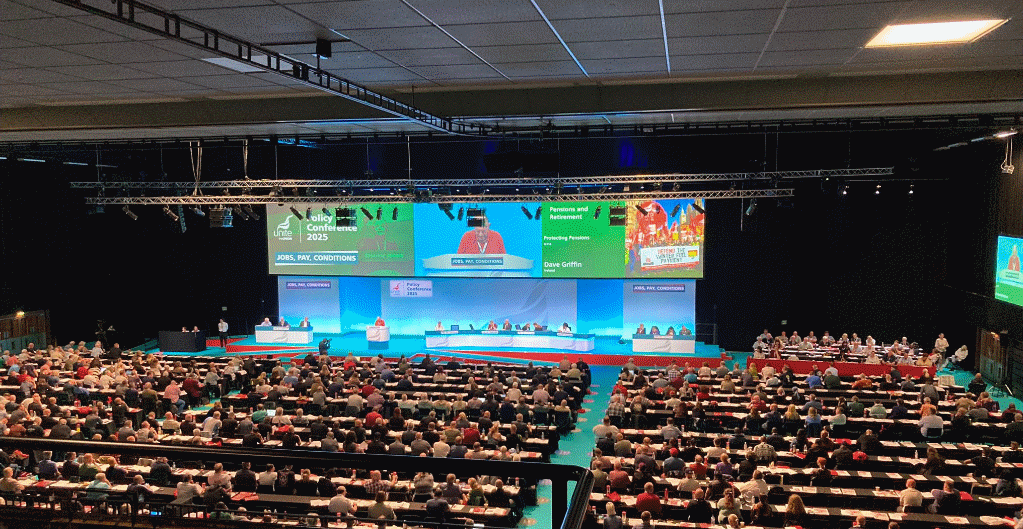
Around 600 delegates gathered in Brighton in July for the two-yearly conference of Unite the Union. They debated trade union rights, the NHS and Social Care, pensions, health and safety, equalities and the far-right, automation and AI, the defence of manufacturing, local authority cuts and fair taxes, climate change and a just transition to a low-carbon economy, Palestine and international solidarity, and finally, just one motion on the union’s relationship with the Labour Party. The agreed motions give Unite a programme far to the left of Starmer’s version of the Labour Party, and arguably, to the left of Jeremy Corbyn.
However, conference is always a barometer of the health of the union, and it is not a rosy picture. Of the 176 motions on the agenda, just 43 came from actual branches of Unite. Which means that only 1.5% of branches submitted a motion. This reflects what I called “…the slow-motion car crash in the union’s grassroots with a minimum of one third of branches inactive and another third being run by retired members”, in my report of the Unite conference in 2021.
Most resolutions come from regional and national bodies, not from branches
By contrast all of the Regional Committees – 100% – submitted a motion. Of the other component bodies of Unite, about 25% of the Regional Industrial Committees and 60% of the National Industrial Committees had a motion on the agenda. Maybe 25% of the Area Activist Committees, which typically draw together reps from across a county or metropolitan area like Nottinghamshire or Merseyside, submitted motions.
77% of the Regional Equalities Committees had a motion to conference and 90% of the Regional Retired Members committees submitted a motion. All the national equalities committees (Women’s, Young Members, Disabled, LGBTQ+, and BAEM) had a motion on the agenda.
This shows a union functioning much better at national level than at its grass roots, and meant that the vast majority of the motions discussed originated from national and regional bodies of the union. It can only be explained by the weak engagement and patchy organisation of our members where it matters – in the workplace – caused by decades of under-investment and care for the branches and reps at the base of the union structure. It is to be hoped that the current union leadership see the problem, and take the necessary action.
20% of motions were ruled out of order
Another new, and unwelcome, feature of conference was the number of motions ruled out by the Standing Orders Committee (SOC). In 2021 I was able to report that no motions had been ruled out of order. This time, 40 out of 212 motions submitted were ruled out. That is 20%.
Worse still, the reasons for ruling out were opaque to say the least. Our motion from the NW Health Committee calling for the Unite EC to publish its minutes (no minutes have been published since March 2023) was ruled out of order, initially because “Conference cannot instruct the EC how to conduct its business”, but on arrival in Brighton, we found that the reason given in the printed booklet was “Contrary to constitutional practice”. And when we appealed, a third and different reason was given: “That it is for each committee of the union to decide how, and whether, to report its proceedings”!
None of the three reasons make sense. Firstly, conference as the “supreme decision-making body of Unite” can indeed instruct the EC how to conduct its business – the EC is not the boss of conference; the relationship is (or should be) the other way round. Secondly, publishing the EC minutes cannot be “contrary to constitutional practice” because the minutes were published for decades up to March 2023. And thirdly, in a sane world, what committee of a democratic organisation could decide to withhold its minutes from those it represents?
Also, the SOC did not print the text of the barred-out motions in the conference paperwork, or even their titles, just the submitting body and the stated reason, so the lay delegates to conference had no idea what had been ruled out in their name. In just talking to a fellow delegate, I found out that his ruled-out motion simply called for each motion passed to be assigned to a member of staff to monitor progress and report back to the movers after 6 months. How can that be an improper subject for discussion? It is basic efficiency.
Most motions involved some sort of political action
It is revealing that despite the stress on strike action from many in the union, fully four-fifths of the motions carried instructed Unite to work with government or the Labour Party to secure improvements for our members – to raise the tax threshold for redundancy payments, abolish the youth exemptions to minimum wage, end Right to Buy, better access to public toilets, to make disability leave a legal right, for energy regulators to control prices, a legal right to be consulted on new technology, support for a Just Transition, government support for the steel and refining industries…and many others. Plus, the big issue – trade union rights and the Employment Rights Act.
The Composite motion agreed calls for a positive right to strike, solidarity action to be made legal again, repeal of all the anti-union laws passed since 1980 and a total ban on fire and rehire. How else can any of that be achieved except by changes in the law? Strikes can only achieve so much, and the delegates writing these motions clearly have that understanding. But a political party is the only vehicle to make those legal changes.
There were those in the hall who have given up on the Labour Party, and want to launch a new party; but for now the Labour Party exists, in fact we pay £375,000 every 3 months to the Party as our minimum affiliation fee, so why not launch a serious and organised campaign to push Unite’s policies at every forum, from top to bottom of the Labour Party: from the CLPs to the NEC and Conference? We have the money to do it, as the balance of the Political Fund (that previous General Secretaries used to just gift to the Labour Party at election time) is now sitting in the bank. It must be about £10 million plus now, even with the campaigns around steel and Grangemouth.
Another feature was the number of Emergency Motions. Sometimes it felt like it was easier to get an Emergency Motion onto the agenda than to submit an actual motion. The conference heard, and passed, Emergency Motions on ‘Disabled Workers Oppose Welfare Reforms’, ‘Affirming and Protecting Trans Rights in Our Union’. ‘Stop the Rollback on Equalities’, ‘Health Emergency: The NHS 10-Year Plan’, ‘Putting Care back into Care’, ‘Immigration Reform’ and even ‘Solidarity with Arrested Leaders of the Awami League of Gilgit/Baltistan’, despite I would guess, 90% of delegates not knowing where Gilgit-Baltistan actually is.
Emergency motion on the Birmingham bin strike
The motion that got the most media coverage was Emergency Motion 5, ‘solidarity with the Birmingham Bin Strikes, Condemn Labour’ which famously called for the suspension of Angela Rayner, and an investigation into her conduct “with a view to expulsion”. The young local authority worker who moved it caught the mood of conference and, coming as it did hot on the heels of the news that Birmingham Council, acting on the instructions of unelected commissioners appointed by Rayner’s department, had just placed the striking workers under threat of dismissal.
The motion received a standing ovation; such was the anger of delegates at the behaviour of a supposed trade union ally. But surely, if it was a serious motion, the SOC should have got the wording changed away from talking about expulsion? Otherwise, Angela Rayner’s lawyers would be able to tie the union up in legal knots as the motion and conference had clearly pre-judged her case, and any investigation, ahead of any process even starting. In the event Rayner declared that she had left anyway, around the time she visited the strike breakers, but not her fellow Unite members (at that time) who were on strike. Unbelievable.
Fresh layer of young activists at the conference
A hugely positive aspect of the conference was the delegates’ contributions when proposing their motions and taking part in debates. The level of thought that had gone into some of them was inspiring. And many of the speakers were young workers from call centres, manufacturing and hospitality. Unite has succeeded in organising a fresh layer of young union activists by listening to them, by going to where they can be found, and giving them a voice.
Just the highlights, the ones I especially remember, include the young comrade from the SW Aerospace industry who exposed the appalling treatment of immigrant workers in Jersey where they are denied medical services and housing, despite paying all relevant taxes on the island; the young woman from Dublin Clerical branch who explained why sex work should be decriminalised, the National Women’s Committee speech exposing sex for shifts in some fast food companies; the National Young Members who wanted to move beyond simple denunciation in countering the influence of the far-right; the young workers who explained the levels of abuse they faced in shops and call centres, and why that is happening; and of course the unforgettable speech from Mohammed Ajaz from West Midlands Aerospace who told conference about the massacre of 13 members of his family by the IDF, simply because his brother was a journalist exposing their crimes (see Left Horizons article on Palestinian delegate’s devastating speech at Unite conference.)
All the motions dealing with union administration, covering issues such as the powers of the General Secretary, the Unite strike fund, how to deliver reps’ training courses, better promotion of the branch structure, better intervention into unorganised workplaces, ran out of time, and were remitted to the EC.
Part 2 will look at the detail of some of the key debates and policies passed.