A people’s struggle against linguistic discrimination and erasure
By Md Islam
We are pleased to publish this article sent in by Md Islam. It provides a passionate defence of the Sylheti language spoken by 20 million people in the world mainly in Bangladesh. It also mentions the importance of Sylheti people in the building of the local community in Brick Lane in London. To find out more about the campaign to defend the language follow this link where you will find a petition you can sign.
*************
Sylheti before colonial borders
Long before colonial borders and modern states, the people of Sylhet spoke Sylheti. Historical evidence suggests the last Hindu king of Sylhet, Gaour Gobindo, would have used Sylheti to communicate with his subjects. In the fourteenth century, the Sufi saint Hazrat Shah Jalal, who brought Islam to the region, preached in Sylheti to reach the local people. From daily life to religious missions, Sylheti was the language of community and faith.
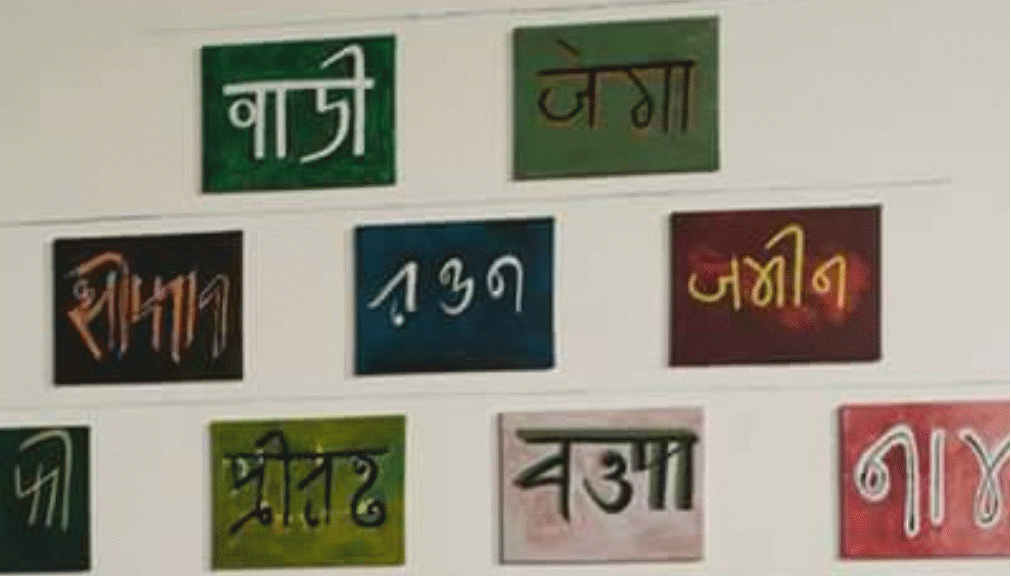
Crucially, the people of Sylhet developed their own script, Syloti Nagri, used from at least the fifteenth century for poetry, religious texts, and correspondence. This established a written tradition centuries before the standardisation of modern Bengali. On linguistic grounds, Sylheti, with its unique grammar and structure, challenges its classification as a mere dialect.
Globally, languages with shared roots are still recognised as distinct. French and Italian both descend from Latin, yet no one calls them dialects. Spanish and Portuguese remain separate though partly intelligible. Hindi and Urdu share grammar and vocabulary, yet are acknowledged independently. Assamese uses the same script as Bengali, but no one labels it a dialect. By contrast, Sylheti, with its unique grammar, tone system and its own historic script Syloti Nagri, is spoken by over 20 million people in Bangladesh, India and the diaspora, but remains denied recognition.
British rule and the politics of language
Colonial rule reshaped Sylhet’s identity. In 1874, the British transferred Sylhet from Assam to the Bengal Presidency. This was not a cultural decision but an administrative one, designed to tether the burgeoning tea industry to Calcutta’s commercial hub. Consequently, Sylheti identity was officially submerged under a broader Bengali category.
This political decision served colonial bureaucracy. Just as the British grouped numerous languages under the umbrella term “Hindi” for convenience, they dismissed Sylheti’s independent status. Standardising around one script and one official language was easier for the Raj, but the cost was the marginalisation of Sylheti culture and tongue.
Partition, nationhood and betrayal
When South Asia was divided in 1947, most peoples had little say in their future. In Sylhet, the choice was not between independence or continued rule by Britain, but between India and Pakistan. The vote was split, with a narrow majority favouring joining East Pakistan, a decision that divided families and communities. The Barak Valley remained in India while most of Sylhet became part of Pakistan. Neither new state recognised Sylheti as a language.
In 1952, Sylhetis marched alongside Bengalis in Dhaka to demand recognition of Bangla, believing in the promise of a multilingual Pakistan. Yet, when Bangladesh won independence in 1971, that promise was abandoned in favour of a monolingual state where only Bengali was recognised. Sylheti, spoken by millions, was officially dismissed as a “dialect,” erasing its status.
Linguistic discrimination in daily life
The consequences of this erasure are profound. Sylheti children in Bangladesh are often corrected or chastised in school for speaking their mother tongue, implicitly taught that their natural speech is “wrong” or inferior. This leads to internalised shame, with parents sometimes discouraging children from using Sylheti for fear of limiting their opportunities.
The discrimination extends to vital services. In courts in Bangladesh, including the Sylhet region, proceedings are conducted solely in Bengali. The lack of provision for Sylheti interpretation creates a significant barrier to justice for Sylheti-speaking defendants, potentially hindering their ability to understand charges and participate fully in their own defence.
In the diaspora, particularly in Britain, this erasure continues. Children are often placed in Bangla language classes for additional language learning, further distancing them from their true linguistic heritage. Media outlets, from Dhaka to London, broadcast overwhelmingly in Bengali, leaving Sylheti voices and perspectives unheard.
This systematic denigration of a people’s tongue, branding it unfit for education, justice, and public life, constitutes linguistic discrimination. It strikes at the core of cultural dignity and identity.
Sylheti Is not Bengali
Linguistic analysis confirms Sylheti’s distinct status. It possesses its own grammar, phonology, and a tonal structure absent in Bengali. Its vocabulary draws on Arabic, Persian, Tibeto-Burman, and indigenous sources. The existence of its own script, Syloti Nagri, created to represent its unique sounds, further underscores its rich heritage.
Globally, languages with far fewer speakers are recognised and protected. Maltese, with approximately 500,000 speakers, is an official language of the EU. Romansh, Faroese and Luxembourgish all enjoy state recognition. Assamese, which shares a closer genetic relationship with Bengali than Sylheti, is treated as an independent language. Yet Sylheti, with an estimated 20 million speakers and its own historical script, is denied this status.
Sylhet’s contribution, Sylhet’s neglect
This cultural marginalisation is mirrored by economic injustice. Sylhet contributes significantly to Bangladesh’s economy. Its gas fields supply a large share of the nation’s energy. Its tea estates are a cornerstone of the national export market. Most critically, remittances from Sylhetis working abroad, particularly in the UK, send billions of pounds annually that sustain the national economy.
Yet the Sylhet region itself remains underdeveloped. It suffers from inadequate flood defences, and its infrastructure lags behind other regions. Osmani International Airport in Sylhet has limited international operations, restricting direct access. Roads and railways receive less investment than those connecting other major hubs. Sylhet gives much but receives little in return, a pattern of economic extraction that parallels the extraction of its cultural identity.
The diaspora: builders of Brick Lane
In Britain, Sylhetis form the vast majority of the “Bangladeshi” community. They arrived as seamen, and later as textile workers, caterers, and builders of the NHS and transport system. They transformed areas like Brick Lane into vibrant hubs of community and immigrant struggle.
They faced and fought racist violence in the 1970s. The murder of Altab Ali, a Sylheti garment worker, became a rallying cry for a generation that marched alongside trade unionists, anti-racists, and socialists, standing shoulder to shoulder with the British working class.
Yet, even in the UK, their specific identity is routinely erased. Official forms, census categories, and school language policies mark them only as “Bangladeshi” or offer “Bengali,” refusing to name them for who they are. To outsiders, this may seem a minor distinction, but for Sylhetis, it is a fundamental question of recognition and dignity.
Culture and identity under threat
Cultural erosion has followed linguistic marginalisation. Distinct Sylheti traditions have been overshadowed by Bengali ones. Local foods and wedding customs have been repackaged and renamed within a Bengali narrative. Writers and artists have felt pressure to abandon Sylheti for Bengali to gain national prestige.
This is not natural cultural exchange; it is the slow suffocation of a unique heritage. When a language is lost, a world of cultural knowledge, memory, and identity fades with it.
A socialist question
For the left, this is a fundamental issue of class and justice. Sylhetis are a predominantly working-class people, both in their homeland and in the diaspora. Their language has been suppressed for not fitting a homogenising nationalist project. Their labour and resources have been exploited while their culture is dismissed.
The labour movement has a proud history of standing with Irish miners, Welsh teachers, and Scottish crofters in their struggles for cultural dignity and workers’ rights. That same solidarity must extend to Sylhetis. Recognising Sylheti will not divide nations; it will strengthen them by embracing true diversity and ending discrimination.
A call to solidarity
Sylheti is not a dialect. It is a language, a heritage, and an identity. To erase it is to erase the history of millions of people.
We appeal to comrades, trade unions, cultural organisations, and all who believe in justice: stand with Sylhetis. Raise awareness of this issue. Challenge mislabelling in census data and official documents. Support initiatives for Sylheti language learning. Demand its recognition in schools, in the media, and in public services.
Let us support British Sylhetis, and Sylhetis everywhere, in preserving their language, their heritage, their script Syloti Nagri, and their rightful place in history.
The featured image at the top of the article shows pictures made of Sylheti writing at an art exhibition in London. Credit: Acrestreet wikimedia commons, licence CC BY-SA 4.0