By Robin Jamieson, C Psychol, AFBPsS, former head of Psychology for an NHS trust.
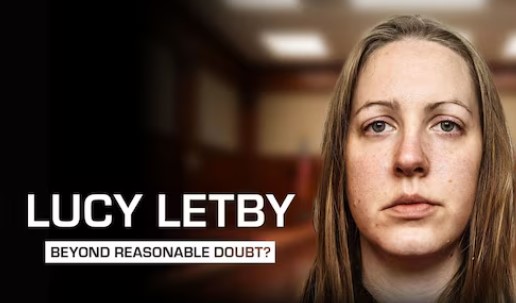
The Lucy Letby documentary on ITV disturbed me, not for its questionable answers but its unasked questions. I realize that trial by television can be dangerously one-sided and that a legal argument is better conducted by people who bother to learn the long words and to navigate elaborate sentences, as set out in Acts of Parliament, so they know what the law actually says, then to understand case law, to quote legal precedents, and to be familiar with concepts such as hearsay and admissibility of evidence.
From the outside, lacking that specialised knowledge, it left me wondering if any evidence presented by the defence from expert witnesses to counter the narrative presented by the prosecution, had been ruled inadmissible. And, secondly, if it is true that the police had withheld evidence from the defence concerning deaths when Lucy was not on duty, why that evidence had not been regarded as new evidence giving grounds for appeal.
But this case bothered me from the moment it was first reported, for reasons that the documentary ignored. I always start, as a psychologist, with the assumption that we are all murderers, at least in the mind, that we are capable of the most extreme cruelty and violence as seen in the hysterical screams of a baby when a toy is out of reach, and those toddler temper-tantrums in a supermarket. But mostly we hide it and don’t get caught.
That universal capacity for love and hate explains why killing is a mainstay of entertainment in film and TV channels. We have murder mysteries, documentaries and re-assuring weekly murders in idyllic villages or filmed with beautiful background scenery to be solved, as always, by a clever but lovable detective.
Leaving no forensic evidence
Everybody knows, or thinks, that they could murder someone by injecting air into their bloodstream, as it would leave no forensic evidence, but less well known (because entertainment focuses on the triumph of good over evil ) is the equal possibility that injection of air with no forensic evidence could be the perfect recipe for a wrongful conviction, in this case based mostly on extreme suspicion.
Everybody who watches courtroom dramas knows that the police have to find motive, opportunity and forensic evidence, yet there is surprisingly little mention of possible motives in the conviction of Lucy Letby. I have met some very dangerous people, and had the rare opportunity to talk to them in some depth about what it felt like to kill, and what was going through their mind in terms of personal constructs, an exploration of the world as they see it.
What makes us into real life actualised murderers is not the objective circumstances of our life and relationships, but the subjective reality that we build up to cope with it using fantasy, ideology or delusional thinking.
Serial killers are an endless source of fascination, reflected in media coverage, because they teach us so much more about our ourselves, and our capacity for enduring hatred far beyond the explosive violence of single domestic murders. There has to be a rationale or justification, a career path, a change of habits and loss of inhibition to enable the repetition of murder.
Sutcliffe, the ‘Yorkshire Ripper’
The Yorkshire Ripper, for example, was moving on from sex workers to other young women when he was arrested. Police had been looking for a man with a South Shields accent who had made a call saying “this is Jack”. When they received a complaint from a different man I had been seeing as an out-patient, who complained to the Queen and the Prime Minister that I had conducted research on him without permission. I had, apparently, appeared in his room at night, in a tower block, given him an injection in his foot and disappeared through the wall.
Two police officers came to see me, saying that all complaints had to be investigated but they were from Sunderland, and obviously trying to identify the person claiming to be “Jack”. I told them they were wasting their time because the serial killer had to be local to Yorkshire, not Tyne and Wear, that he knew the local areas, could drive and could talk his way through a road block. He would seem quite plausible and could hold down a job. He was more likely to be an engineer or a police officer, for example, than a known psychiatric patient with obvious delusional thinking.
The violent frenzy of these murders could only be possible if he lived in a subjective reality where the sexually desirable women were evil or dangerous and deserved what he did to them, which implies a moral or religious motivation and possibly voices in his head from a higher being. But his paranoid or delusional system would be hidden, encapsulated, and would eventually become more obvious and uncontrolled.
After Sutcliffe was convicted there was agreement from psychiatrists for the defence and prosecution that he should be transferred to Broadmoor hospital, though details of his delusional system were not made public.
Serial murders by a cult with a persuasive leader such as Charles Manson are possible because each member of a cult feels supported, justified and vindicated by belonging. It is also possible to have a cult of two, such as the Moors Murderers, Ian Brady and Myra Hindley, or Fred and Rosemary West, where the killers do not need a delusional belief system that would enable them to act alone, but have a pathological relationship based on power wielding sex and sadism.
Harold Shipman took his own life
Harold Shipman ended his own life in prison, having given no hint of an explanation for why he, a hard working unassuming GP, had for years been quietly ending the life of his patients. There is a plausible explanation which should not be put forward without further research.
The evidence against Lucy Letby would indicate that she acted alone, secretly and that no other person was involved, so she could not have been part of a cult which helped to feel good about killing babies. There are other possibilities, all by necessity very extreme.
Was there a voice in her head telling her that the premature babies had died and been brought back to life by the Devil, so they should be helped to go to heaven? Was she an emotionally disturbed and psychopathic young woman who never recovered from the shock of a younger sister getting all the attention in her family, and jealous of babies in her care?
Did she suffer from the partly mythical condition of “Munchhausen by Proxy” so had to kill babies to draw attention to herself? Was she convinced that she was “saving the NHS” or protecting the environment by reducing the number of less healthy children?
The possibilities are endless, but there has not so far been any suggestion of a possible motive.
Systemic failure is never dealt with
The claim that some of the babies were at a greater risk and should have been in a unit able to cope with their needs raises the issue of systemic failure. The problem of “excess deaths” crops up a lot now, especially in relation to mental health. There is always an investigation that promises to “leave no stone unturned” but does the opposite.
The NHS has been hollowed out since about 1990, with resources taken away from real patient care, with relentless destruction of clinical services helped by:-
Private Finance Initiative
The purchaser provider split
NHS trusts
Contracting-out of clinical services
Driving down of real wages
Brexit forcing staff abroad
Hostility toward remaining immigrant staff
Collapsing and inadequate buildings.
Against that background there will be systemic failures, such as the excess deaths in Essex currently being investigated by the Lampard Inquiry, and it can be predicted that:
- It’s the nurse’s fault
- The nurses will blame the doctors
- The nurses and doctors will blame whoever is currently trying to manage a failing system, and
- Terms of reference do not allow the Inquiry to question political decisions leading to systemic failure.
The ITV programme: Lucy Letby, beyond reasonable doubt, is available to view on TVX here. [Feature photograph]