
By Tim White
Introduction:
This week marks the sixtieth anniversary of one of bloodiest military coups in history, in Indonesia. To mark this important event, we republish here an article by Tim White, written on the twentieth anniversary inn 1985.
…………………………………………………………….
This is the twentieth anniversary of one of the world’s bloodiest military coups, the Indonesian massacre of 1965.
General Suharto’s regime has since ruled the fifth most populous nation on earth by sheer terror. Opponents are dragged off to concentration camps. In East Timor, the regime is committing genocide to colonise the islands. The dictatorship engages in periodic purges to kill off “criminals”, a label with a very flexible meaning for Suharto’s military thugs.
Yet in the years before 1965, the Communist Party (PKI) had two to three million members, one of the largest in the capitalist world. It also had the opportunity time and again to seize control of society and start the process of socialist revolution in South East Asia.
But the PKI leaders, far from understanding the situation, advanced the idea of popular frontism, that is, a coalition between the workers’ parties and a “progressive” section of the capitalist class under President Sukarno. The illusions thus spread in Sukarno’s intentions meant that workers were unable to resist the military takeover, the consequent annilhilation of workers’ organisations and the murder of around a million Communist Party members.
Independence from Dutch imperialism
The PKI gave their backing to the bourgeois nationalist leader, Ahmed Sukarno, who was identified with the gaining of independence from Dutch imperialism in 1949.
Indonesia’s economy was left as it was before liberation, still dominated by Dutch monopolies. Sukarno, the new president, believed Indonesia would be impervious to Marxist and class struggle. True enough, for five years there was a class truce, as workers and peasantry awaited the fruits of freedom. But the gradual disillusionment with capitalist independence prepared the ground for the dramatic rebirth of open class struggle – and the Communist Party
While the advanced industrial nations saw the start of the postwar boom, capitalism in Indonesia was incapable of delivering any serious reforms. Land remained in the hands of rich landowners. Workers’ wages stood still or were cut. Strikes began to develop alongside other signs of discontent. In 1957, Communists and other left wingers were elected as mayors and councillors. Unions began to grow and all the workers’ organisations began to be radicalised.
By 1959, the movement reached its peak when peasants and farmworkers occupied and seized the huge plantations and landowners were driven out. In the cities, workers seized the factories, and the working class showed their willingness to struggle for revolution.
During this period, the Indonesian Communist Party grew to three million members and had enormous influence.
The mood throughout SE Asia was so tense that a revolution there would have had an explosive effect. Unfortunately, the leaders of the PKI followed the bankrupt ideas of popular frontism even though it was strong enough to have achieved power itself.
Chinese Communist leaders urged support for Sukarno
The party looked to the Beijing bureaucracy, wrongly believing it to be more radical than the moribund Russian leadership. The Chinese Communist Party argued that as the tasks of the Indonesian revolution were “bourgeois”, the PKI should support the ‘progressive’ capitalist Sukarno.
Trotsky and Lenin had shown how false this perspective was in Russia in 1917. The first tasks of the Russian revolution may have been those previously forced through by the capitalists of Britain, France, etc, but the Russian capitalists had proven themselves incapable of transforming the country.
In Indonesia, the bourgeois had beven in power, displaying their impotence, for a decade. The circumstances and the masses themselves were crying out for workers’ rule. The PKI leaders put the brake on workers’ struggles, backing Sukarno uncritically, telling their supporters to stay calm and passive while the army drove the workers off the planations.
But the military held onto the estates themselves to increase their power in society and martial law was declared. For three years Sukarno had to balance precariously between the increasing power of the army and the militant working class, who were far from crushed by the ending of the 1959 movement.
Sukarno, realising he was out of favour with the army tops, started another wave of much “progressive” talk and some popular reforms to build up a firmer base of working class and middle class support against a possible coup. The Indonesian Communist leaders cheered yet more heartily and failed to warn the masses of the dangers of maintaining capitalism and its state machine.
Army tops waiting to strike
The army tops were only waiting for an appropriate moment to attack, and in September 1965, they brought the upheaval to a bloody end. The alleged killing of two army generals by Communists was the excuse for action.
Neither the bourgeois nationalists nor the workers’ PKI had prepared mass popular resistance, and their supporters were massacred. While the army demanded Sukarno ban the PKI, they and their followers began to exterminate it.
Counter-revolution took its revenge for months; around a million are believed to have been killed, mainly PKI members, the biggest holocaust at the hands of reaction since the days of Franco and Hitler.
The army used right-wing Muslim gangs in the countryside to behead whole families of communists, filling innumberable shallow graves. In the cities, the army and their fascist auxiliaries caused serious sanitation problems as rivers were polluted with hundreds of thousands of decaying bodies of workers.
“Make half a revolution and you dig your own grave”, Engels had warned a century before. These stark words were never truer than in Indonesia. The new regime was potentially unstable; it did not have a mass middle-class base like Hitler or Mussolini had done, but the workers’ organisations have taken many years to recover from the horrifying massacres of 1965.
When the workers do recover, Suharto will not last for long. The Indonesian working class will then revive their heroic traditions of their movement; they will also want to learn lessons from the mistakes of 1955-65.
This article was originally published in Militant, October 12, 1985.
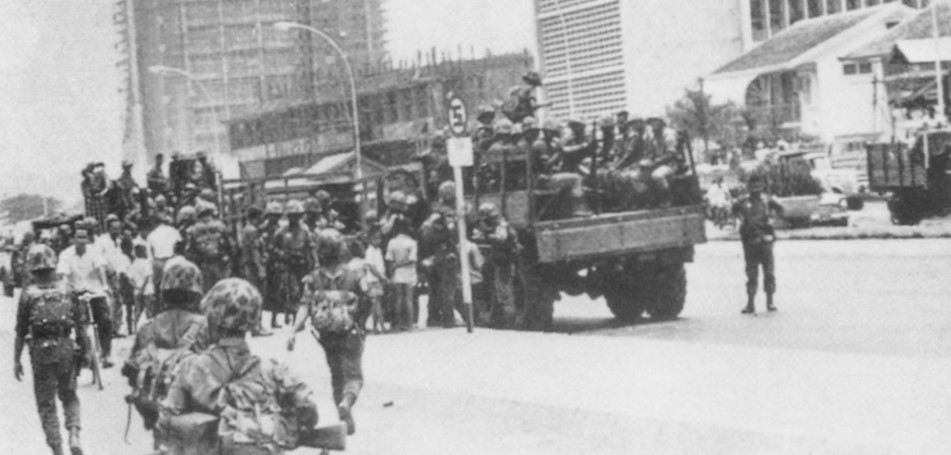
[Feature picture shows troops on the streets on Jakarta, September 30, 1965. From Wikimedia Commons, here]