
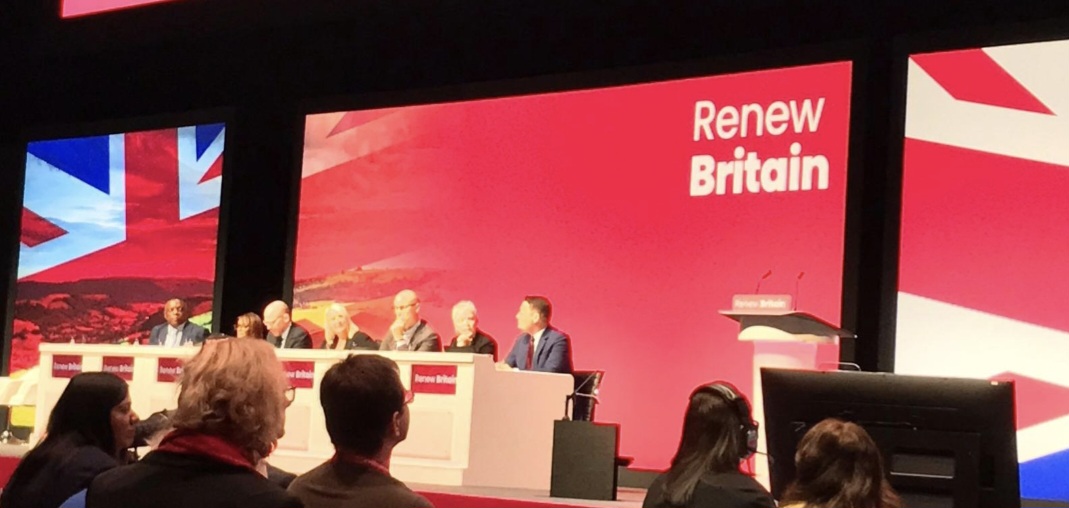
If we were to draw up a balance sheet of last week’s Labour conference, we could start by accepting that the right wing are still firmly in control of the event. However, there were also signs, particularly in the trade union delegations, that disquiet over the Starmer government’s direction of travel is beginning to undermine his leadership. The grip that the right wing has on the party may not be as firm as they imagine.
Because of the need of the leadership to close down free debate and discussion, the conference changed completely under the guidance of Starmer acolyte, previous General Secretary, David Evans. From the rostrum we used to hear the authentic voice of working class delegates, speaking from their experiences about the real problems of everyday life – and issues that they expected, and demanded, that a Labour government address.
But in the past two years, conference has become a rally for the Labour leadership and little else. Ordinary resolutions, previously allowed on any topic, are no longer accepted. Sessions are severely limited from the point of view of ordinary delegates, and if there is any debate at all, it is hand-picked councillors and MPs who get to the rostrum. Sessions are dominated by ministerial speeches and those of special ‘guests’ like heads of charities, single-issue campaigners, and even business representatives.
The high point of this collection of set-pieces is the leader’s speech, when a whole section of the visitors’ gallery is closed off, so that dozens of business people can troop noisily into conference beforehand (disrupting proceedings), listen to the leader, and then troop out again just as noisily. The selected delegates, visitors and attending MPs are like a hired ‘claque’, primed to applaud and cheer at appropriate moments.
Right wing would have barred Gaza agenda
The one section of conference not controlled ruthlessly by the right wing is that of the affiliated organisations and the trade unions. It was the trade union dominated Conference Arrangements Committee that allowed an emergency resolution on Gaza to get on the agenda – a motion which, if the right wing had their way, would not have seen the light of day.
This resolution, explicitly referring to the “genocide” in Gaza and calling for and arms embargo and comprehensive sanctions on Israel was a swipe against the right wing grip on the party, heavily influenced by the Israeli lobby, and was a genuine reflection of the sentiments of Labour Party and trade union members.
Likewise, delegates backed a motion calling for a wealth tax on the richest in society to raise money for public services. The motion, submitted by the FBU, CWU, TSSA and Unite the Union, was in direct contrast to the direction of government policy and the set speech by Chancellor, Rachel Reeves. It called on the government to reverse austerity, commit to progressive taxation, and increase public investment.
Steve Wright, FBU general secretary was well-received by conference when he said that “workers in Britain are paying the price for a broken economic model”. While millions suffer with the soaring cost of living and shrinking wages, he said, “the ultra-rich continue to reap the benefits of a rigged system that rewards wealth, not work”.
In the same session, there was an excellent response, too, for Sharon Graham, General Secretary of Unite, who emphasised one of the key points in the resolution, adding at the end, “Tax. The. Rich.” This debate, and the passing of the motion, was effectively a rebuke to the speeches of both Rachel Reeves and Keir Starmer, both of whom, promised more of the same, that is, ‘Labour’ austerity.
We heard all the euphemisms for austerity
From Starmer and Reeves, we had all of the usual euphemisms for austerity: “tough decisions”, “painful choices”, reminders that the “road will be long”, and so forth. All of these reflect a policy that desperately clings to a bankrupt and rigged economic system, where the only engine of “growth” – profitability – operates at the expense of workers and the public services on which they depend.
No-one at conference can have been unaware of the rise of Reform in opinion polls and the fact that Labour are losing council by-elections to Reform, often by crushing margins, all over the country. A poll from Electoral Calculus (September 27) shows that if there were a general election today, Reform would win over 300 parliamentary seats, twice as many as Labour. Around 250 Labour MPs would lose their seats.
Starmer’s answer to the threat of a Reform government – and it is a serious threat: to workers’ rights, to the NHS as we know it, to democratic rights, etc – is to hang on the coat-tails of Nigel Farage by a focus on the ‘small boats’.
In his speech, Starmer tried his best to “out-Union-Jack” Nigel Farage, and he gave a homily on what “Britain” is. This has led to a wave of hilarious memes, but, it will cut no ice among disillusioned voters seduced by Reform.
On the first day of conference, Sharon Graham wrote a column for the Guardian (September 29), in which she spoke for many Labour Party members, and probably most trade union members, when she wrote, “Labour just doesn’t get it”.
She quoted a Unite study which found that “17,000 companies found that average profit margins have soared by 30% since pre-pandemic levels, as workers and communities pay the price of these profits by spending an ever-greater portion of their income on goods. No wonder people feel the system is rigged against them. Our politicians, meanwhile,argue about black holes and fiscal rules”.
Catastrophic polling will not be changed
Sharon Graham was absolutely correct in her analysis of the rise of Reform and the dismal – one could even say catastrophic – polling for Labour. Among working people in general, and specifically among the millions drifting to Reform, there is a perception, based on the solid evidence of their own experience, which is a long way from the pampered lives of most MPs, that their living standards and quality are more insecure and uncertain than ever before.
Affordable housing is almost unattainable for many young people; the NHS is crumbling under the triple-whammy of the plunder by private outsourcing, low pay and staff shortages. Other public services, like education, are on their knees. If a Labour government seriously addressed these issues, by tackling the vested interests and powers of the rich, big business and finance, then the issue of the ‘small boats’ would shrivel away, but that is the last thing on Starmer’s mind.
Where we would take issue with Sharon Graham is that she seems to have no strategy to fight back against Labour’s right wing. Speeches at conference: OK. Articles in the Guardian: fine. But there is no evidence of her using the huge resources of Unite, regionally and nationally, to organise a large-scale fight back against the right wing, in the Labour Party and in TULO.
To be specific, it is not “Labour” that doesn’t “get it”. It is this Labour leadership and the faction around them. They are the oneswho need to be challenged, relentlessly, ruthlessly and consistently. Sharon Graham’s is not a strategy worthy of the name: to simply criticise the leadership and then offer disaffiliation as the only available alternative.
Labour’s right wing believes that it hashad a good Labour Party Conference. On balance, that may appear to be true. Card votes at conference would suggest that most CLP delegates – by around four to one – still support the right. It could hardly be otherwise, with so many CLPs closed down or otherwise suffocated by Labour regional officials.
But times are changing. The trade union delegations, as shown by the resolutions on Gaza and economic policy, are more to the left than the CLPs and they are beyond the grip of Labour regional bureaucrats.
Resolutions passed at conference in and of themselves mean nothing – they are consistently ignored by leaders and have been for decades. But for us, they are a useful indicator, of the mood among Labour and trade union members. In the economic climate that we face, it is more likely than not that those trade unions affiliated to Labour will move even more decisively against Starmer’s leadership and Reeves’ economic priorities.
After the leader’s speech, it is back to reality
On current trends, next May’s local elections will be a disaster for Labour. Starmer’s ‘uplifting’ speech to his claque of supporters at conference will be forgotten a week later, and then we will be back to opinion polls showing that more than half of Labour MPs will end their careers at the next election. As Jeremy Corbyn wrote after Starmer’s speech, it may well have been “the longest resignation speech” in Labour history.
It is only a question of time – a matter of “when” not “if” – there is a challenge to Starmer’s leadership and when it does happen, it will begin a new chapter in Labour politics and raise the possiblity of the revitalisation of its left wing.
How that dovetails with the new party to the left of Labour remains to be seen. ‘Your Party’ is attracting members from tens of thousands of those who left Labour, or were expelled, under Starmer. But even at this early stage, it is split at the top and therefore something of an unknown quantity. We cannot be sure how it will impact on Labour electorally. What we can be sure about is that the “iron grip” that the right wing think they have on the Labour Party is, in reality, anything but.











We saw the “flag waving” and Starmer trying to ape Reform but what we didn’t see and probably will never see with a completely discredited right wing Labour Party; is the Red Flag – flying there.
There is a roll up papers width between labour leadership and tories its sad and embarrassing .As your article on Starmers promises stated he and his spin doctors have just done what others before have done and that is lied and pulled the wool over the electorate .
There is no mention of the socialist bedrock that the labour party was built on nor is there any imagination I can see to put people first and that isn’t just working people as they all keep saying but pensioners and those amongst us who cannot work and children who are amongst the poorest in Europe.
Some who read this will perhaps say that I am living in the past and romanticise for a promised land that lives only in the words of Thomas Paine or Robert Tressell and there may be some truth in that but for the sake of our grandchildren I hope that peace fairness and equality can win over war greed and profit .
We live in hope .