By Jokin Mendizábal
[Editorial note: this article was published in Porelsocialismo, a Spanish socialist newspaper, two days before the mid-term elections in Argentina (on Sunday). Although when it was published, the election results could not have been known, it provides good background to the rise of Milei and the economic stagnation he has created.
In the elections 127 out of 257 Congress deputies were being elected, as well a third of 72Senate seats. As it turned out, it was a success for Milei, his party winning 41% of the vote to the 31% for the Peronist alliance, on a record low turnout of 68% (in a country where voting is supposed to be compulory). In both the upper and lower parliamentary chambers, Milei is still short of a majority, but has more than a third of the seats in each.
Business welcomed the unexpected win for Milei and, the day after, the Argentine peso strengthened about 8% against the dollar and the country’s stock index rose 18%]
…………………………………………………………………………………………………….
“Just a few years ago, the Argentine economy was in pieces… One man understood that government was not the solution, but the problem. One man had the courage to defend Argentina by standing up to the establishment. And that man is with us tonight. Today we recognize President Javier Milei for his tireless efforts to ‘Make Argentina Great Again (MAGA)‘”
This is how US Treasury Secretary Scott Bessent referred to Javier Milei on September 24, when the Atlantic Council awarded the tottering Argentine president the “Global Citizen” award. Senior officials of the US government are defending Milei, trying to make him arrive as undamaged as possible to next Sunday’s elections.
Not more than two months ago, Milei and the gang that occupies the Casa Rosada said that the economy was doing very well and that they were going to paint the Argentine political map purple, the colour of the ruling party. Only two weeks had passed and Milei was suffering the strongest political setback since he assumed the presidency on December 10, 2023. In the provincial elections of Buenos Aires, he lost by a landslide to the candidate of the Frente Fuerza Patria, Axel Kicillof, by 13 percent.
Now comes the real litmus test, the mid-term elections at the national level where 127 deputies of the 257 that make it up are up for election, as well as members of the Senate. Normally, these elections are never given much more importance than that of a plebiscite that can influence the course of the government in power, but in this case too many factors converge not to give them great importance, to the point that many shout slogans for the president to leave at Milei’s electoral rallies. The screams that are heard everywhere say Milei is a ‘traitor’ and most of the time they remember their mother in a disrespectful way.
It is clear that all right-wing or ultra-right governments, such as this one, lie to hide their true intentions, that is their ability to maintain their electoral support while governing against the working and popular majorities and in favour of a very small minority. But they all agree that we would have to go back a long way to find a government as bad as this one.
According to the Argentine historian Felipe Pigna, we should go back to the early 1930s, when the government signed the Roca-Runciman Pact1, when Argentina was controlled by the then dominant British imperialism. It is worth asking then how it is possible that a character like Milei, with clear symptoms of psychological imbalances, could reach the government.
Milei is the result of previous government failures
No such abrupt change in the opinion of large sectors of the population occurs in a few days; it is always the result of a process of years in which millions of people are separating themselves from their previous political sympathies and are being won over by another option that seduces them with promises that connect with the great anger they feel towards the old leaders from whom they no longer expect anything.
Thousands of articles and hundreds of books have been written trying to explain the rise of the right wing in the world. The left has to give an explanation, especially in order to be able to rethink how to rebuild the alternative to transform society.
How has it been possible that the right wing is dragging along sectors of the poor youth, those most punished by this system? Only two years before Milei’s arrival to power, Stefanoni, author of the book, Rebellion Became Right-Wing, wondered about the point of publishing this book in a country like Argentina where “the extreme right is weak.”
In any case, he considered that the appropriate way to introduce this problem was through the idea – certainly provocative – that what is at stake is a dispute for rebellion, as Diego Sztulwak tells us in his latest book The Tremor of Ideas. The government that did the most for the poorest, marginal, sectors of society was that of the Kirchners. Before that, we would have to go back to 1945-1955 to find another government that would have taken care of improving the living conditions of these sectors.
However, the first clear symptom we had of a political change was when, after the failed attempt against Cristina Fernández, there was little reaction in large sectors of the poorest neighborhoods, except for a large gathering next day in Buenos Aires. Many saw that attack as something that had happened very far from their reality.
The most convincing evidence of a change was the support that Milei was to get in poor neighbourhoods, and in traditionally Peronist neighbourhoods, where no one expected that support for a guy who showed up with a chainsaw in his hands, saying that he was going to cut the state budgets in social areas.

Milei also promised dollarisation, creating the illusion that workers were going to convert their wages, which were losing purchasing power every week, into strong and stable dollars. There were endless promises that made many voters believe that this time he was “serious.”
In less than two years, the country is being destroyed
But the magic formula that Milei brought under his arm did not work and it is destroying industry, employment, consumption, pensions, public health, education, public infrastructures, etc. Milei stopped in their tracks the completion of public works, increasing the level of road accidents.
To see the philosophy of his government, we can take the example of Bahía Blanca, an important city in the south of Buenos Aires province, which suffered heavy floods at the beginning of the year. The city urgently needed two bridges so its inhabitants could cross from one part of the city to the other.
The government ordered the installation of two mobile bridges to alleviate the problem, but at the same time charged a hefty toll for these bridges. When the National Congress voted for the economic aid that Bahía Blanca needed, government deputies opposed it, leaving the people of Bahia abandoned. Such examples of the failures of this government are so many that it is hard to believe that they can still get the votes they do.
The only sector that works is financial business
Industry in general has been destroyed with metallurgy operating at 40% capacity, and apart from the mining industry, the energy industry and little else, the only thing that is making wild profits is Finance. Financial speculation has been created by the government itself, through the loans contracted to the IMF.
Now, Trump, has his eyes on Argentina and is sending a veritable army of politicians to work with governors and various politicians. Some he already controls, like Milei’s star advisor, Santiago Caputo, nephew of the Minister of Economy Luis Caputo. There is, in addition, a legion of senior executives from JP Morgan, which has co-opted an entire area of economy, from the minister, down, so that the entire ministry answers to JP Morgan.
Argentina today is governed by the United States. It is not a metaphor, and it is being indebted at levels such that it cannot even pay the interest. The debt is already unpayable and continues to contract more debt which is not being used to build anything in the country: not a school, not a first-aid room, not a loan to an small or medium enterprise.
In a single day, US capital has sold $500mn to sustain the exchange rate between the peso and the dollar. This was done by the US for weeks so that the government can get to the elections by any means necessary. Everything creaks in the economy and in politics.
The election is important for the future course of events
Milei aspires to win a third of the deputies so that he is not impeached and can continue governing by decree, since overturning a presidential decree requires more than two-thirds of the Congress and the Senate. We do not know what the result will be, what is certain is that it will come out weakened and will have to rely on the Trump government.
Some think that a major defeat could lead to his abandonment of the presidency, even his self-exile to the United States. But it is most likely that he will try to hold on, with Trump’s help, to continue scrapping the state and Argentina’s natural resources.
If a victory for the opposition in these elections does not achieve a change of policy in the government, there is then the possibility of a wave of struggles, which is implicit in the situation. The Argentine people can no longer endure so much savagery against their living conditions and they will be forced to fight in the streets as the American people are already doing against Trump.
On Sunday, October 26, a new chapter in this history may open and signs are already appearing of new leaders willing to fight, from Fuerza Patria, such as Ciudad Futura of Juan Monteverde, and Patria Grande of Juan Grabois. Much attention will need to be paid to the evolution of these organisations that propose unity and new democratic methods for political construction.
On the night of October 26, some unknowns will be cleared up and others will be created. But there is no doubt that a new period of struggles is looming in Argentina.
Adapted from the Spanish socialist website, Porelsocialismo. The original is here.
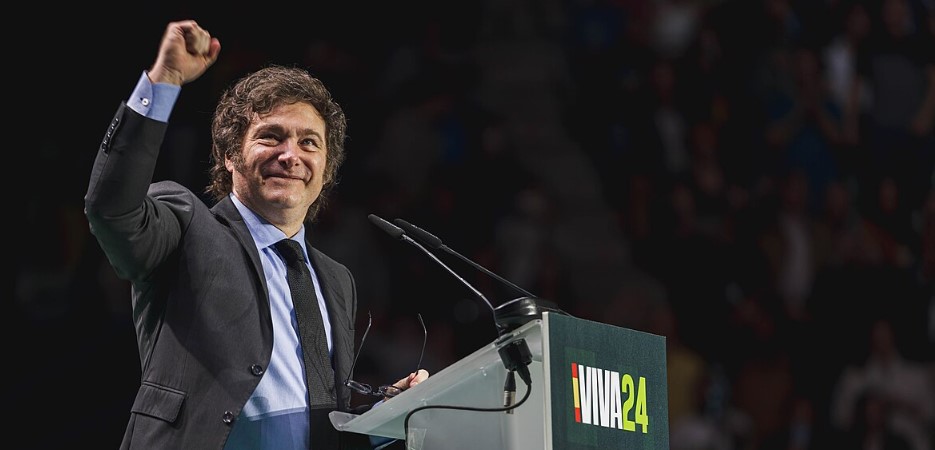
[Feature picture shows Javier Milei in 2024, from Wikimedia Commons, here]