George Orwell’s dystoptian novel, 1984, had a Ministry of Truth which issued nothing but lies and misinformation. That description pretty much sums up the big majority of the billionaire-owned British media which has been foaming at the mouth this week over the supposed ‘left-wing’ bias of the BBC, when any objective analysis would indicate the exact opposite.
The broadcaster has been plunged into a political crisis, with the resignations of Tim Davie, the Director General, and Deborah Turness, the Head of BBC News. It is clear that this crisis has been orchestrated by the right-wing media establishment, particularly the Daily Telegraph, to further undermine the BBC, one of the few remaining public services in Britain.
The backdrop to the resignations was a leaked memo to the Telegraph, criticising the BBC’s news coverage. It was written by ex-Sunday Times journalist, Michael Prescott, who served as an external adviser alongside Robbie Gibb, a member of the BBC’s Editorial Guidelines and Standards Committee. As reported by Deadline, Gibb was a blatant political appointment of Boris Johnson.
Before this, he was Theresa May’s Director of Communications. Gibb also acted as an editorial adviser for the right-wing channel GB News prior to its launch in 2021 and has described himself as a “Thatcherite conservative” in an interview with the TaxPayers’ Alliance. Until last year, he was a director of the Jewish Chronicle, which during his tenure retracted several articles after fabricating quotes from Israeli officials, as reported by Middle East Eye.
This context is crucial to understanding what is a glaring stitch-up. Reports from within the BBC outlets suggest Gibb was instrumental in pushing Prescott’s memo, which highlighted several areas where the BBC had shown allegedly biased in its coverage.
The content of the memo was just an opinion piece
On racism, it accuses the BBC of reporting incidents “where there were none”. Prescott cites one example of an article claiming ethnic minorities were being charged more for car insurance, calling it “ill-researched”. Yet research from the University of Bristol, co-authored by the campaign Fair By Design, found that people living in more ethnically diverse areas were quoted premiums around 20% higher than those in less diverse regions.
On immigration, his memo bizarrely claimed the BBC was not sending enough “push notifications” through its news app about the rise in migration, while “less significant” stories were prioritised. Prescott provided little to no evidence to support this assertion.
In relation to transgender coverage, the BBC was accused of failing to report sufficiently on trans-related stories, with the memo claiming its coverage was “one-sided.” Prescott cited one example, alleging the BBC had ignored a case where a group of nurses sued their employer over a policy allowing a transgender woman to use the women’s changing room.
Yet even a basic Google search shows the BBC reported on this story multiple times, dating back to 3 February, months before this memo was reportedly handed to the corporation over the summer.
In reality, the BBC has often shown a degree of hostility towards trans people. A Vice report revealed that many LGBTQ staff had quit over the BBC’s coverage of trans issues, while a secretly filmed meeting in 2021 of the BBC’s internal Pride network showed members expressing they were “disappointed and frustrated” by how the corporation had handled trans reporting, often providing negative coverage.
Appalling and unforgiveable BBC bias over Gaza
One of Prescott’s major criticisms accused the BBC of bias in its coverage of Gaza, by targeting the BBC’s Arabic service. He claimed it had failed to publish articles about the October 7 attacks, while editing coverage from the main BBC News output that he considered more critical of Israel.
Any objective analysis of the BBC’s coverage of the war in Gaza shows an utterly disgraceful bias in favour of Israel and against Palestine over the past two years. And these analyses have been done and they have elicited no outcries in the media – or even coverage in most cases – and there have been no demands for ‘heads to roll’ from the Daily Telegraph.
As Owen Jones noted in his Battlelines report and on YouTube, the BBC Arabic service has indeed shown more sympathy towards Palestinians, but only because the BBC’s overall coverage has leaned so heavily towards Israel’s narrative in its assault on Gaza. Hardly suprising, given that the head of the BBC Middle East news desk, Raffi Berg, is a self-declared fan of Mossad.
A report by the Centre for Media Monitoring (CfMM), published in June this year, found clear bias in favour of the Israeli state. The study exposed in detail an astonishing level of bias over Gaza.
Media Lens reported that the CfMM report had examined BBC content from 7 October 2023 to 7 October 2024, a total of 3,873 BBC articles and 32,092 segments broadcast on BBC television and radio This was as objective an analysis as it is possible to find. CfMM’s key findings were:
- Palestinian deaths treated as less newsworthy: Despite Gaza suffering 34 times more casualties than Israel, BBC gave Israeli deaths 33 times more coverage per fatality and ran almost equal numbers of humanising victim profiles (279 Palestinians vs 201 Israelis).
- Systematic language bias favouring Israelis: BBC used emotive terms four times more for Israeli victims, applied ‘massacre’ 18 times more to Israeli casualties, and used ‘murder’ 220 times for Israelis versus once for Palestinians.
- Suppression of genocide allegations: BBC presenters shut down genocide claims in over 100 documented instances whilst making zero mention of Israeli leaders’ genocidal statements, including Netanyahu’s biblical Amalek reference (see below).
- Muffling Palestinian voices: The BBC interviewed significantly fewer Palestinians than Israelis (1,085 v 2,350) on television and radio, while BBC presenters shared the Israeli perspective 11 times more frequently than the Palestinian perspective (2,340 v 217).
This detailed and accurate description of BBC bias had a parliamentary launch attended by various MPs and Richard Burgess, the BBC director of news content. The former chief political commentator of the Daily Telegraph, Peter Oborne, who is an outspoken critic of Israel was present and his excoriating condemnation of the hapless Burgess was filmed by a participant at the meeting. In this meeting, Oborne confronted Burgess with as many as six different ways in which BBC News has misled its audiences over Gaza.
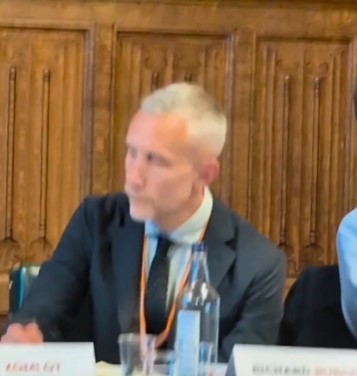
This report and the exchange in a House of Commons committee room was not reported anywhere in the British media (except the National, in Scotland). There were no demands that ‘heads should roll’ and no resignations.
The BBC jealously guards its right-wing bias, which it dresses up as ‘balance’. Only days ago, Owen Jones announced that he is being sued by Middle East desk chief, Raffi Berg over Jones’s reporting on the atrocities in Gaza and the BBC’s defence of Israel’s actions. Jones’s work has been robust, principled journalism, and it is deeply concerning that a senior BBC editor, implicated in the very bias being reported on, is attempting to silence scrutiny by resorting to the courts.
Then there was the BBC’s refusal to air the programme Medics in Gaza, which it had commissioned. Channel 4 eventually aired the documentary, but the BBC, in damage control mode after the backlash from Israel over a different programme featuring a voiceover by the son of a Hamas official, retreated. In doing so, the corporation once again prioritised appeasing the pro-Israeli establishment over exposing the genicide being committed in Gaza.
The accusation that has dominated the headlines, and which has led to Donald Trump threatening a $1bn law suit against the BBC, revolvles around a Panorama episode aired over a year ago. In the programme, clips of Trump speaking were switched around to reinforce the impression that he supported the assault on Congress on January 2, 2021.
In doing this, the programme makers clearly made an error, all the more unnecessary given that Trump was often on record repeating false claims that the 2020 election was rigged, and praising those who stormed the Capitol building. Faced with the threat of being sued for $1 bn, unless the episode is withdrawn, the BBC has issued grovelling apologies.
The Panorama edit may have been misleading, but the wider narrative it sought to illustrate was accurate. Trump did support the rioters, and the BBC must not cower in the face of his threats. True quality journalism comes from challenging power and holding the establishment, in any country, to account.
As an aside, we should note that the BBC has form in switching around news footage. During the miners’ strike, reporting the ‘Battle of Orgreave’, the BBC switched footage of miners throwing rocks and film of charging police horses, to make it look like the miners provoked the police charge. In fact, the police charge had happened before the miners reacted with missiles. That particular – and deliberate – distortion was not hidden away in a late evening documentary, but was put out on the main 6pm news.
The BBC has an inbuilt right-wing bias
The Michael Prescott memo is no more than an attempt to discredit the BBC for all the wrong reasons. Rather than calling for a more robust journalistic output with deeper research and coverage of issues that matter to the public it is a vapid hit job, and one eagerly grasped by the right-wing press.
The BBC has an inbuilt right-wing bias, dominated by ex-Tory students, and press spokespersons, with its heirarchy overwhelmingly public school and Oxbridge educated. The BBC was in the forefront “doing a job” on Jeremy Corbyn, over antisemitism above all. The bias over Israel is nothing less than a public disgrace.
But even this is not enough for the rabidly-right wing British media, who want the public corporations privatised and in the hands of the same kind of media moguls who own the newspapers. That is the reason for the coup at the top, leading to the forced resignations.
Boris Johnson has been quick to capitalise on the issue, urging people to refuse to pay their TV licences. Yet as The Independent suggests he was one of the key architects of the sabotage and during his premiership, he had personally pushed for Gibb’s appointment to the BBC board and he had pushed Michael Prescott, Gibb’s close friend, for various roles.
The ‘Royal Charter’ of the BBC comes up for renewal in 2027, and it will be then that there will be discussion about whether it remains a public service and if the TV licence will continue as its main source of funding. Lisa Nandy, Culture Secretary, is due to begin the consultation before Christmas.
Although she has offered some defence of the BBC, Nandy has previously referred to the licence fee as “deeply regressive”, suggesting that a subscription model could be preferable. It is precisely this kind of political wavering that puts the BBC at real risk of privatisation.
BBC is deeply rooted in the British capitalism establishment
Socialists must view the developments and progress of the BBC from a class standpoint. From the point of view of working class people, it is an organisation firmly rooted in the Establishment, and serves it as a bulwark against any criticisms from the left or against criticism of the capitalist system which it upholds, notwithstanding its position as a public corporation.
The BBC can only restore public trust, if it is detached from its myriad connections with the capitalist establishment. We do not expect it to come from Lisa Nandy, but a socialist policy for public broadcasting must include the election of a governing board by the viewing and listening public – the precise mechanics of which are not crucial – and the trade union membership of BBC journalists and technical staff.
Access to interviews and coverage by political parties and leaders should not depend on the current bias – where Nigel Farage, for example has a ‘season ticket’ to appear more regularly than anyone else – but should be based on the level of political support for a party. Moreover, this democratic model for a public broadcasting service, is one that socialists should fight for across the whole of the media: radio, television, newspapers and social media.
According to Ipsos and the Press Gazette (September 2025), the BBC remains the most-read news outlet in the UK, with 40 million users. Notwithstanding its bias in regards to its news and current affairs, it is still held in high regard by tens of millions, for its other output, like its world-beating natural documentary programmes, its children’s programmes and its tradition of excellent drama.
The answer to the news and current affairs bias of the BBC is not to allow, much less support, privatisation. That is something that would only put it in the hands of billionaire press barons, cementing in its pro-establishment bias and leading to a dumbing down of its other content. The monstrous bias at the BBC has to be challenged by socialists by a fight for a root and branch democratisation of the corporation.
[Feature photograph from Wikimedia Commons, here]