
By Left Horizons supporters in “Your party.”
The founding documents of the new party that were sent out a few weeks ago have now been revised following the consultation exercise based on local members’ assemblies held in every part of the country. These revisions represent clear moves in a socialist and democratic direction, though a number of key decisions need to be taken by members after the discussions at the Liverpool conference this weekend.
There are four documents – a political statement; the constitution; the standing orders; and a strategy for the first year. Taken together these documents outline the possibility of a fully democratic, member-led socialist party.
We will set out the revisions to each section and also highlight issues that have been proposed for votes on different options. Very many other amendments have been sent in by individuals or groups of members online. It is not at all clear at this stage how they will be dealt with at the conference. But the main issues to discuss are now emerging.
POLITICAL STATEMENT
The main goal of the party remains unchanged:
Our goal is the transfer of wealth and power, now concentrated in the hands of the few, to the overwhelming majority in a democratic, socialist society.
However this has been strengthened. Where the first version said:
Both at home and abroad, Your Party stands against the war economy, and the neoliberal capitalist order fuelling the climate crisis and grotesque levels of inequality – and in favour of public and community ownership of key economic sectors and services.
the revised version now reads:
We reject a capitalist order that is responsible for grotesque levels of inequality both at home and abroad. We favour the extension of democracy over the economy, including the public ownership of key sectors and services.
The same economic order that exploits people is destroying the planet, fuelling the climate crisis that threatens us all. Your Party stands for environmental justice.
It maintains the opposition to war in a different section:
We oppose the global system of imperial domination and colonisation, and support movements for national liberation and self-determination. We stand against militarism and for a world free of nuclear weapons.
Your Party stands for freedom – from poverty, exploitation and war – and in defence of democratic rights and liberties.
Public ownership
Left Horizons supporters would prefer a stronger commitment to public ownership of all the big companies and banks that dominate the economy and control our lives, not just those in an undefined “key sectors”, and to plan a society based on need, not profit. Socialism is not just a vague matter of a fairer, or more just society. It is a question of who owns and controls the economy and in whose interests society is run.
Failure to break this control by the capitalist class would mean they will still be able to force any government to carry out their wishes. Even the Labour party had a more explicitly socialist commitment to public ownership right up to the 1990s, but the new text does at least strengthen the explicitly anti-capitalist aims of the party. It also make clearer and more explicit the commitment to environmental justice and need to address climate change. It should be supported.
There are some important debates planned on different options. One option seeks to delate ANY use of the word “socialist”! That needs to be opposed, of course! Another amendment that needs to be opposed is one that seeks to remove references to “working class” in the following sentence:
Our task is to build a mass party for the many, rooted in the broadest possible social alliance, with the working class at its heart.
Yet another seeks to delete the reference to “mass” and “the broadest possible social alliance”. This may be motivated by a suspicion of alliances with other unspecified classes in society. The change of wording is not vital, but, on balance, it should be supported, leaving the following wording:
“Our task is to build a party for the many, with the working class at its heart.”
CONSTITUTION
A number of clauses in the first draft of the constitution have now been clarified or amended. There are now recall procedures for the Central Executive Committee (CEC) members and the Leader, and it has also been made clear that the officer group members will be elected from within the executive.
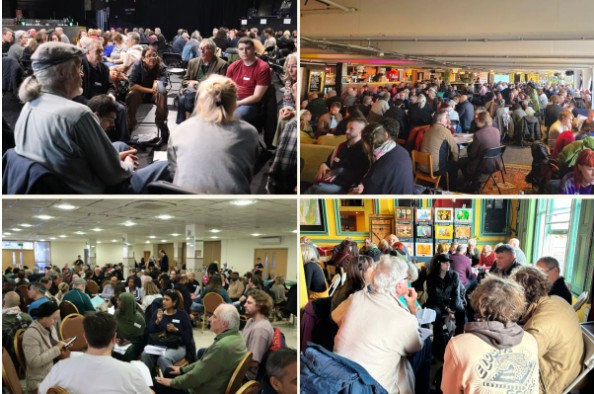
part of the consultation process.
[photos – Your Party]
The four places on the Executive set aside for MPs and local councillors will now be elected by all members, using “one member – one vote” rather than from among their own number. The mechanism for instructing elected office-holders how to vote by the CEC – a so-called “democratic whip” has been inserted. These are good proposals.
Left Horizons supporters in Your Party would like to have seen a commitment to MPs only taking the wage of a skilled worker, but that is, sadly, not included.
The two-thirds rule to alter the constitution has been altered to 50% +1 for the first national conference, and two-thirds after that. That is sensible.
North of Ireland / Northern Ireland
One error, in our opinion, is to categorically rule out, in the constitution, the possibility of standing candidates in the north of Ireland (six counties). Workers in the north are crying out for the chance to escape the sectarian electoral blocks and to vote on the basis of class politics. Standing candidates would not, in itself, imply support for the union with Great Britain. This is an opportunity missed, just as it was in the Labour Party under Corbyn. Members in Northern Ireland are campaigning to change it. Sadly, this is unlikely at this conference but their efforts should be supported where possible.
Leadership
A number of constitutional issues that were particularly contentious or divided opinion in the consultation process have been listed as debates where two or more options are presented to members at conference and in a wider voting process.
The first of these concerns the leadership. Both options envisage a review process in the first two years to decide between different models of leadership but Option A proposes a leader to be elected by February 2026 who will serve until late 2027, until the review is complete. Option B proposes a collective leadership vested in officers of the CEC while the review is ongoing.
Both proposals have their advantages, and they will both be temporary arrangements. However, on balance, having one nationally-recognised leader will allow the party to establish a national profile, avoid the divisive mixed messages of the last few months, and attract more members. Collective leaderships are rarely as effective as they promise to be.
Dual membership – no to witch-hunts!
One vital issue is that of “dual membership”, ie allowing members of Your Party to belong to other socialist or left parties or groups. Option B rules this out totally and should be opposed. Option A is as follows:
Members shall be permitted to hold membership in other national political parties where they have been approved by the CEC as aligning with the Party’s values, to include those with whom the Party cooperates electorally. The approved list shall be subject to ongoing CEC review and annual ratification by National Conference.
This will ring alarm bells regarding the CEC keeping lists of “approved” other parties, especially those who were previously members of the Labour Party or who have been expelled for being on this or that list. However, of the two options, Option A is by far the better one, and may be improved in future. Option B would condemn the party to years of internal witch-hunting of socialists – which is both wrong in principle and a pointless and self-defeating waste of time.
Branches
Two sets of options are proposed. Regarding the inaugural founding meetings of new branches, a range of different quorums for the are suggested, from 20% to 50%. All the these are too high, given the normal quorums in the labour movement as a whole, but 20% is the best, for this special first meeting. It should be lowered for more routine branch meetings in future.
On branch finances, branches should have control of their local finances (Option A) rather than “the spending of these budgets shall be determined by democratically-elected Party representatives a regional level.” (Option B)
CEC elections – Regional or national
One proposal (Options A) is for CEC members to be elected from English regions and Scotland and Wales, while Option B is to elect all English CEC members in one election with places reserved for Scotland and Wales. Again, each system has its virtues, but with a relatively small number of CEC members elected by the membership (16), regional-based elections would make gender balance very difficult, and detract from the proportional representation of members as a whole, as each region could only have one or two “seats”. Option B is therefore better, on balance.
STANDING ORDERS
During the consultations, it was clear that internal elections by single transferable vote (STV) were preferred, to make the various levels of the party representative of the views of different members. Other minor issues regarding the running of meetings, speaking times (3 minutes), how long officers are elected for (one year), hybrid meetings and length of motions (400 words) were generally uncontroversial.
The issue of local “community assemblies” open to the community as a whole, and how they relate specifically to local branches based on paying members is still not clear. Of course, holding meetings to engage with the community can only be good for a political party, but policy cannot be determined ultimately by such assemblies where they conflict with the aims of the party or local members. There is no debate or choice of options on these matters, unless an online amendment is tabled in some way.
Delegates, sortition or online participation
The main disputes seem to be regarding those who want a system of elected, accountable and recallable delegates throughout the party structures and those who want elements of sortition or interacting with the party online.
In Amendment Option 1 – proposals to have conference delegates in future appointed by “sortition” should be rejected. True democratic engagement does not consist of isolated individuals representing no one but themselves and accountable to nobody. It is based on proper delegates who can be held to account for their voting record and actions.
For the same reasons, under the Amendment Option 2 – calls for online voting of all members should be rejected in favour of decisions taken only by delegates attending the conference, who represent others, have participated in the discussions and can be held accountable for their actions.
Again, under Amendment Option 3 – motions should only be sent by branches or other party bodies, not by any individual member via online systems. That would be chaotic and, again, unaccountable. The same goes for local and national policy development, which should be dealt with at party meetings, not via ideas or suggestions sent in online by individual members (Amendment Option 5).
Amendment Option 4 is a little different as it concerns term limits and how many times one person can stand for a post, both internally and an outside elected position. One proposal is for a limit of two terms, whether for branch chair or MP, though a two thirds vote can override the limit of an MP etc.
This rigid and inflexible approach should be rejected. Someone should be allowed to serve as long as they still have the confidence of those who elected them. An excellent officer or MP should not be forced to resign due to some artificial term limit, and in reality, it may lead to some officer posts remaining unfilled for want of a new volunteer! Of course, all officers and elected representatives should face regular election or mandatory reselection as set out in the rules.
ORGANISATIONAL STRATEGY
The national organisers acknowledge that a lot of the points raised regarding this are concerned to make the process faster. In the light of that, elections of the CEC and (maybe – see above) the leader, have been brought forward one month to the end of February.

Branch formation has been prioritised as a strategic aim, based on founding local branches who can then be given membership lists for their area. It is still not clear how quickly this will actually happen. More trust should be given to local activists where “proto-branches” who could help to expedite this vital process, but we may just have to try to keep local groups going until we can be declared official and can call an inaugural meeting.
Between the November conference and the election of the CEC, it is now proposed to have a “Members’ Oversight Committee” appointed by – yes – sortition again, to “work with” the Independent Alliance MPs in the process of steering the party and implementing the decisions of the founding conference. This is much better than relying on the Independent Alliance MPs alone (now reduced to just three, in any case!) but some way of widening this group at conference would have been preferable.
The new document has clarified the issue of already-existing Independent party groups or community activists who can be “Affiliate Party Groups” for up to two years until they later “fold into the party”. This is a bit messy but probably an inevitable compromise with groups such as Jamie Driscoll’s Majority Party in the North-East and other groups of existing independent councillors.
Election candidates
There are just three options to be presented to conference. The first (Roadmap Amendment 1) relates to whether (only in the 2026 elections) “Your Party” will endorse independent socialist candidates or only candidates standing under our own party banner. Given how close the elections are, there is no practical alternative to endorsing independents, just for 2026. It is quite likely that, in many areas, “Your Party” will have very few candidates in place in time.
Roadmap Amendment 2 offers a choice between standing in as many council seats as possible or to rather focusing on where there is a candidate who can be, “in a position to meaningfully contest for their seat.” The latter option is preferable. Standing a myriad of paper candidates just to “fly the flag” is a strategy that has been tested to destruction by TUSC and others and it has brought it into disrepute. It is best to stand in areas where a legitimate campaign can be run, either for a Your Party candidate or a socialist independent.
Last but not least – Trade Unions!
Roadmap Amendment 3 is very much “last but not least”. It reads:
The CEC shall appoint a Workers’ Movement Commission, consisting in senior trade union movement figures, for the Party’s first two years. The WMC shall be tasked with deepening the Party’s relations with trade unions, laying the ground for national affiliations, and drawing up a political and organising strategy to more deeply root the party in the workers’ movement. The Commission, should resources permit, shall also be staffed.
Of course, such work is vital, and could be a deciding factor in the success of the party in future. Placing so much emphasis on “senior trade union movement figures” is regrettable and there are legitimate concerns about not replicating the Labour party-style trade union leader block vote in the new party but these are issues that can be considered during the process. It is essential that this amendment is passed, however imperfect.
Summary
The revised documents are certainly not perfect from a socialist and democratic point of view but they are clearly better that the originals, in (almost) every respect. They can lay the basis for an effective party, explicitly anti-capitalist and committed to socialism, if the correct options are selected at the conference and on the online ballot.
The willingness and goodwill at local level is there to build and succeed – not a moment should be wasted to get the party and its structures formally established and working well.
[Featured image – Your Party website]