By Andreas Bülow
While Donald Trump has said he intends to pardon former Honduras president Juan Orlando Hernández, convicted of drug smuggling, a so-called ‘war on drugs’ has been the pretext for US miltary threats against Venezuela. A huge the US naval presence has been built up and it has been suggested that a military attack may be imminent. Here, Andreas Bülow analyses the situation in and around Venezuela and asks if a war of nerves will turn into a hot war.
………………………………………………………
On Monday, November 24, the U.S. State Department officially declared the so-called solar cartel – and thus the government of Venezuela – a ‘terrorist’ organisation. They have also started “Operation Southern Spear“.
These two developments provide the US administration with a quasi-legal framework to justify future attacks against targets inside Venezuela. The moves had already been announced a week in advance as a kind of ultimatum from Trump to Venezuela’s President Maduro, as part of a war of nerves.
Trump’s offensive has now been running for nearly four months. It is a war of nerves in which the USA has tried all along to pressurise a part of the leadership of the Venezuelan government to overthrow Nicolás Maduro and introduce a more government more obedient to the USA.
American mobilization in the southern Caribbean
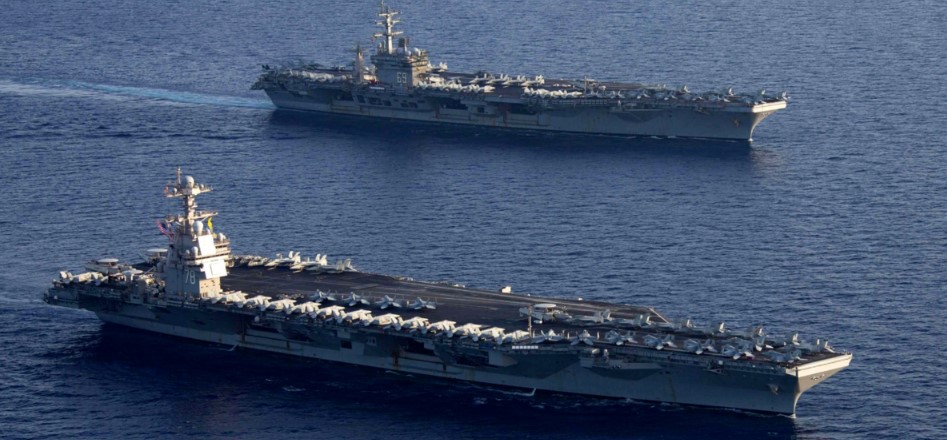
The United States has now mobilised an enormous strike force off the coast of Venezuela. This includes the huge aircraft carrier, USS Gerald Ford, the largest ship in the US navy and one of the world’s largest warships. It has about 4,500 crew members a carrying capacity of 75 fighter-bombers.
Not only that, the US has also sent missile carrying craft to the area, such as the USS Gravely, USS Jason Dunham and USS Stockdale. Estimates of the number of troops in the strike force vary between 15,000 and 20,000.
There have already been several provocations where American F35 fighters have flown extremely close to the Venezuelan mainland and some sources even suggest that there have already been violations of Venezuela’s airspace.
At the same time, the United States, with Trinidad and Tobago (the latter a neighbouring island, just 11 km from the coast of Venezuela) are conducting joint military exercises. These are all deliberate provocations intended to put pressure on the Venezuelan government.
“The war on drugs”
So far, the United States has attacked at least 21 boats and killed 83 people in the so-called “anti-drug offensive.” Only two people have survived the American attacks. The attacks are de facto illegitimate killings. No evidence has been presented that the small boats smuggled drugs, nor that they posed an imminent danger to U.S. national security.
One of the victims, Alejandro Carranza, was allegedly an ordinary Colombian fisherman. His family is now in the process of suing the US government for his murder.
The enormous US military mobilisation in Puerto Rico, on St. Croix, in Trinidad-Tobago and in the waters off Venezuela is completely disproportionate to the very idea of an ‘anti-drug mission’, and as, most of the US media openly acknowledge, there is absolutely no evidence that Venezuela is the largest drug transit country.
On the contrary, the anti-narcotics unit of the US Department of Justice recognises that the vast majority of drugs transported into the US go through the Pacific route. The pretext of a ‘war on drugs’ is therefore extremely weak – and that is part of the reason why Trump has talked about migration in recent weeks and claimed that Venezuela has emptied its prisons and sent bandits to the United States.
Trump’s zig-zag course
Trump constantly fluctuates in his statements. One day he claims that he has “made a decision” and the next day he says that Maduro should talk to him, but that Maduro’s days are numbered.
His zig-zags reflects both his personal doubts, but also a greater uncertainty with the American ruling class, which divided on the issue. While Marco Rubio, Cuban exiles and parts of the Florida community want a showdown with Maduro (and with Cuba after that), large parts of the MAGA movement are deeply critical.
Trump went to the election, after all, on a promise to stop wars, not start new ones. And more and more voices – even in the Republican Party – can see how dangerous a war would be for the United States itself, because it would not be so easy to withdraw from it, once started.
There is no doubt that Trump is influenced both by the different factions in his administration and in Congress, but also by his changing whims. But it would be wrong to see the whole exercise as an irrational undertaking. There is actually a rationale behind what Trump has been doing in the last few months.
In a wider perspective, it is about Trump having a different perception of the United States in the world than previous American administrations. He believes that the United States should concentrate more on its traditional spheres of influence – and Latin America in particular has been regarded by the Americans as their “backyard”. China’s trade in Latin America has grown enormously over the past three decades, and this worries Trump.
In addition, of course, there are Venezuela’s immense oil and mineral riches. Even in a hugely tense situation, Trump has allowed licenses for Chevron to trade with Venezuela. For the White House, greater access to the oil market in Venezuela – for example via a regime change in Caracas and the establishment of a softer and more submissive regime – is also a strong motivation.
The situation escalates
Over the past few days, the situation has escalated. Trump has declared the air space around and above Venezuela to be a no-fly zone. There are many airlines which have suspended its flights to Venezuela, although a few companies, such as Avior, continue to operate.
So far, the war of nerves has not succeeded in undermining Venezuela. Neither Maduro nor others in government have succumbed to the pressure. In the American capitalist media, there are stories about negotiations that were supposed to include Qatar and the Maduro government. But even if they have taken place, they are stranded. Three months have passed without any announcements.
That could mean Trump will have to move on unless he wants to lose face. His next options are selective attacks with missiles or drones on the Venezuelan mainland, presumably against barracks and government buildings.
But even that will be difficult to proclaim as a victory. What will he say if Maduro continues in power despite a few bombings? Is he prepared to go even further and deploy ground troops? It will be an enormously difficult and dangerous mission, from which the Americans will not find it easy to withdraw, once begun.
The situation in Venezuela
Nicolás Maduro has weakened the defence of Venezuela enormously, because the revolutionary spirit and elan, which characterised Venezuela during the Chávez period, has been replaced with harsh repression. Collective agreements have been repealed. Nationalisations have been replaced by privatisations.
Trade unionists are imprisoned. Venezuela’s left is deprived of its opportunity to run in elections. Young people have been thrown into prison without trial. Election results are canceled (as in Barinas) or hidden away, as in 2024.
These changes have undermined the defence of Venezuela against an imperialist aggression. There will be a backlash against any US attacks, but the passivity and disillusionment created by Maduro’s authoritarian course have paradoxically made it more difficult to develope an active anti-imperialist movement.
Venezuela’s right has once again exposed itself, this time by openly cheering on a war against Venezuela. Opposition leader Maria Corina Machado, who has apparently left Venezuela, is a staunch advocate of a US attack. Only a small part of the opposition, led by former presidential candidate Henrique Capriles Radonski, has distanced itself from a US intervention.
War resistance in Venezuela’s neighbours
The situation today is different from 2019, when Trump – especially guided by cold warriors such as John Bolton, Elliott Abrams and the Cuban exiles around Rubio attempted the first major coup against Maduro.
At that time, the right wing was in power in both neighbouring countries, Bolsonaro in Brazil and Duque in Colombia. It was Brazil’s army that had to stop Bolsonaro, putting him in his place and stop any talk of Brazilian participation in a war.
Today, both countries are led by social democrats, or what you might call moderate centre-left governments. Both Lula in Brazil and Petro in Colombia have vigorously rejected Trump’s war threats, so an Americans attack will have to come from the sea or by air.
Moreover, a war would have a terrible consequences for the working class of both Venezuela and the surrounding countries and Latin America. Trump has no moral or political right to go into Venezuela and the labour movement must build up strong opposition to any US war on Venezuela.
Updated and edited from an article in the Danish socialist website, Solidaritet, on November 25. The original is here.
Andreas Bulöw is the author of the book “The Venezuelan Revolution – Eyewitness Account and Analysis” (2010). He is active in Hands Off Venezuela and the Red-Green Alliance in Denmark.
Feature photograph, showing the US aircraft carrier, USS General Ford, is from Wikimedia Commons, here.