By Greg Oxley. [The first part of a two-part article]
Against a backdrop of chronic economic stagnation, France has entered a period of social and institutional crisis. The machinery of government is largely paralysed. The lack of any parliamentary majority has caused the fall of three governments since Macron’s re-election in 2024. The fourth, known as Lecornu II, has survived so far only thanks to the treacherous complicity of the Socialist parliamentarians.
Three massive mobilisations in September and October 2025 testified to the growing popular anger at social injustice and Macron’s reactionary policies. At the same time, the nationalist and xenophobic tendencies embodied by the Rassemblement National (RN) have gradually strengthened. A series of polls on voting intentions indicate that the RN would win the next presidential election and could well obtain a majority in the National Assembly, with the help of the Republicans, should they need it.
The parliamentary crisis, the rise of the RN and the scale of the union mobilisations all reflect an increasingly marked polarisation of French society. In relative decline compared to its main rivals in Europe and in the world, French capitalism offers no other perspective than a gradual deterioration in the living conditions of the mass of the population.
The austerity policies imposed by successive governments have worsened social inequality, with a greater concentration of wealth and power in the hands of a minority, on the one hand, and a deepening and spreading of insufferable poverty, on the other. Inflation is undermining the value of wages, pensions, and social benefits. Public health systems and national education are in crisis. All branches of the public services, scuttled by chronic underfunding, downsisng, closures and privatisation, are deteriorating year after year.
Economic Stagnation and Austerity
The French economy has been stagnating, posting GDP growth rates of less than 1% for several years. In Europe and in the world arena, French capitalism is losing ground. While France accounted for 3.0% of the value of world exports in 2019, it is only at 2.7% today, continuing a downward trend of over 25 years. In the European Union, France has fallen from 18% of eurozone trade in 2002 to only 13% in 2024 (far behind Germany, at 24.3%).
The contraction of its market share is a major factor in the economic and social perspectives for France in the years to come. Investment projects, whether of French or foreign origin, are declining in number and value. Job creation is declining in virtually all sectors of the economy. Chronic underfunding and job cuts in public services and the elimination of employment subsidies have contributed significantly to the deterioration of the labour market.
Reluctant to invest in the modernisation of production and job creation, the capitalist class has long seen no other way to maintain and improve the profitability of capital than through a regime of permanent austerity, of low wages and rising prices, a regime of increasingly blatant exploitation and intimidation in the workplace.
Inflation is eating away at households’ purchasing power. According to a study carried out by Que Choisir, the prices charged in supermarkets for common household products (food, hygiene, health products, etc.) have increased between 20% and 25% since 2022. This massive increase far exceeds increases in wages, allowances and pensions, meaning a significant drop in the standard of living of working-class households.
A struggle to keep head above water
Among those who were already struggling to keep their heads above water, it has pushed hundreds of thousands more people into poverty. Never, for more than 30 years, has the level of poverty in France been so high. Between 2003 and 2023, France has 1.4 million additional poor people. In one year, from 2023 to 2024, it had 650,000 additional poor people, bringing the total figure to 9.8 million (National Institute of Statistics and Economic Studies – INSEE – July 2025). Today, 15% of the population lives in a household whose standard of living is below the poverty line. The fear of debt, family bankruptcy, poverty, which already underpinned the mobilisation of the “yellow vests” (gilets jaunes) in 2018, has become even more widespread since then.
As ultra-rich capitalists amass unimaginable fortunes and tighten their grip on government policy, the mass of the population finds itself at an impasse. An increasingly wide gulf is opening up between governments and the governed, between the exploiters and the exploited. The social situation in France is becoming explosive, galvanising trade union organisations and “anti-capitalist” forces, on the one hand, but also giving a virulent and aggressive impetus to nationalist, xenophobic, and fascist tendencies and organisations, on the other.
This polarisation of society, in which the left and right are radicalised while the “centre” collapses, combined with widespread distrust and hostility felt towards the “political class” and the institutions of the state, cannot be resolved peacefully. In the long run, a major extra-parliamentary confrontation between the opposing camps will prove inevitable.
Public Debt: a pretext for vicious cuts
Macron says the government must make savings to “balance the nation’s accounts”. But the measures in the proposed budget are all for the benefit of the rich and to the detriment of workers, young people, pensioners and the unemployed. At the end of the second quarter of 2025, according to INSEE, public debt reached €3,416.3 billion, or 115.6% of GDP. This debt continues to worsen because, year after year, public spending exceeds state revenue. In 2024, for example, state spending amounted to 1670 billion euros for 1501 billion in revenue.
So there is a real debt problem. But what is the explanation for this massive shortfall? Emmanuel Macron and his successive governments have used the deficit to justify drastic reductions in public spending. All public services are under attack. Regarding Health Insurance, the Lecornu II government wants to make savings of 5.5 billion euros, restrict access to care and double medical costs. They want a freeze on retirement pensions and other social benefits such as the RSA (a minimum survival payment to jobless young people), housing benefits and family allowances, despite the context of sharply rising prices. They want to cut a further 3000 jobs in the civil service.
However, as far as state revenues are concerned, the government refuses to implement even the modest “Zucman Tax” demanded by the left, which would impose a 2% floor tax on assets of more than 100 million euros. This refusal underlines the fact that the management of public finances cannot be reduced to a simple accounting exercise. It is above all a political question, a matter of conflicting class interests. For Lecornu, as for Barnier and Bayrou before him, the most important thing is to protect the capitalists and the ultra-rich and to reduce, by all possible means, the share of national wealth allocated to workers and their families.
As the CGT revealed, in 2023, no less than 211 billion euros of public money was paid to companies, without any conditions attached. This colossal sum, which is equivalent to more than three times the national education budget (64 billion euros for 2024), has greatly contributed to widening the public deficit and alone represents 4 times the amount that the government is seeking to save through austerity measures in its budget project.
Let’s not forget the problem of “tax havens” either. According to the work of Gabriel Zucman, 39% of corporate tax revenues in the Netherlands come from profits (about 80 billion dollars per year) artificially relocated from countries such as France where taxes are higher. In addition to the Netherlands, the European Union has four other tax havens: Ireland, Luxembourg, Malta and Cyprus. In France, tax evasion by the ultra-rich and the biggest companies means a loss of between 80 and 100 billion euros per year to state revenue.
What is at stake here, with the massive deficits in the finances of the state, are antagonistic class interests. As on the eve of the revolution of 1789-1794, the starting point of which was the need to refinance the state, the fundamental question is: who will pay? The state debt can only worsen and will occupy a central place in the development of the class struggle in the months and years to come. In the end, it can only be solved by dealing a devastating blow to the interests of one side or the other.
The rise of nationalist “populism”
In recent decades, capitalist “globalisation” has produced an integration and interdependence of “national” economies to a much greater degree than in the previous period. The expansion of the European Union and the introduction of the euro have been part of this general process. The increase in the volume of world trade has led to an intensification of competition, including competition between workers.
On the one hand, globalisation has created gigantic companies, with enormous economic – and therefore political – power, and on the other, it has considerably weakened the position of workers, thrown as they are into competition, more directly and immediately than ever before, with workers from the four corners of the planet.
In France and in Europe, the social conquests of the past are incompatible with the imperative need to defend and increase the capitalist profitability. That is why the capitalists and the governments that represent them are working to destroy them. The “cost” of wage labour and social spending (Social Security, pensions, benefits, etc.) must be reduced by all possible means. Public services must be demolished. All spheres of social and economic activity must be subjected to the unbridled law of profit.
Despite the differences in the economic, social and political conditions of European countries, they have all seen, without exception and for many years, a significant upsurge in nationalism, protectionism, xenophobia and authoritarianism. Everywhere, in all social strata, people are feeling exposed and vulnerable to the destructive effects of “free trade” and threatened by migratory flows perceived as out of control, and that they live under governments powerless in the face of external pressures.
At bottom, this is a “national” reaction against “international” capitalism, a reaction that goes hand in hand with resentment against “elites.” This explains the emergence of the Rassemblement National as a major political force. In France as elsewhere (Trump in the United States, Farage in the United Kingdom, Meloni in Italy) the “populism” of Marine Le Pen and Jordan Bardella [leaders of the RN- ed] has echoed and sharpened this popular sentiment in order to make its way to power.
The RN unquestionably has a mass electoral base. It obtained 7,765,936 votes (31.37% of the votes cast) in the 2024 European elections and 9,379,092 votes (29.25%) in the first round of the legislative elections. Thus, a victory for the RN in the next national elections, though not inevitable, certainly cannot be excluded.
Flattering the “people” by castigating the “elites”, nationalist populism seeks above all to divide workers, to set them against each other, according to their origins, their colour or their beliefs, thus diverting their attention from the real culprits of the economic and social stagnation. To do this, its propaganda aims to plant in the minds of the “real French” that they are more deserving than the “others” who are not. By placing them higher than others in a contrived racial hierarchy, by promising them “national priority”, the RN poses as their protector against of the encroachment of “foreigners”.
RN offers workers nothing
Materially, the RN offers them absolutely nothing. Under a Le Pen or Bardella presidency, even more so than under Macron, they can only expect a constant deterioration of their living conditions. But they will be rewarded by imagining themselves to have a higher social status, fed with the notion that even if they suffer, there are others who suffer even more! This is just a huge political swindle, which the astute sociologist William Du Bois (1868-1963), referring to the American context, called the “psychological wage of whiteness”. It is a strategy of division, and a powerful weapon against the solidarity and unity of the exploited.
If Le Pen or Bardella ever takes over the presidency of the Republic and obtains a majority in the National Assembly (without or with the help of the Republicans), what should we expect? It is one thing to flatter the “people” and denounce the “elites” in opposition. Once in power, however, the RN’s absolute priority will be to convince the ruling class – the big capitalist groups, the MEDEF [employers federation – ed] and the Stock Market – that it will defend its interests even better, more fiercely and with greater concrete results than the Macronists, the Republicans, or the other right-wing parties.
RN will attack the interests of all workers
The ruling RN will relentlessly attack the interests and rights of all workers, including those who, duped by its populist rhetoric, brought it to power. It will use migrants and other “foreigners” more blatantly and outrageously than its predecessors as scapegoats for the social and economic problems created by capitalism. The number of deportations may not be much higher than under previous governments. This is the case of Meloni in Italy and also of Trump in the United States, but everything will be done, in the media, to stoke up racist prejudice and hatred and give the impression of a more draconian policy on immigration and right of residence.
Moreover, we can expect that an RN government will apply a policy of brutal police repression against demonstrations and strikes. However, austerity policies and the persecution of “foreigners” will not feed anyone. Sooner or later – and we think this could happen quite quickly – the new regime will find itself confronted with massive union and popular opposition. Without minimising the danger that the advent of an RN government would represent, it cannot and will not mean a definitive defeat of the left, of trade unionism and of the anti-capitalist movement in general.
In some left-wing circles, the RN has been described as “fascist”. In and around the RN, there are certainly fascist elements. However, this characterisation is false. Fascism is a specific type of regime bent on the total physical destruction of all oppositional parties and organisations, of all democratic rights and all independent means of expression. This result cannot be achieved by state repression alone, but only by the mobilisation of an armed mass movement.
An RN government will be a reactionary, authoritarian and repressive regime, certainly, but will have to co-exist with parliamentarism and the general features associated with democracy. The left-wing parties, the trade union organisations and other forms of social and political protest will be intact, capable of resisting, and even of sweeping away the government.
On the other hand, the frustration in far-right circles with the RN will undoubtedly spur the growth of existing organisations that are genuinely fascist, posing a serious and potentially deadly threat to those engaged in the struggle against capitalism. It is all the more imperative to engage in a vigorous and wide-ranging struggle against nationalism and racism.
This challenge brings us to the crucial question of the program and strategy necessary to succeed in the struggle not only against the RN and the right, but also to put an end to the capitalist system they represent.
Greg Oxley is editor of the French socialist website, La Riposte, here
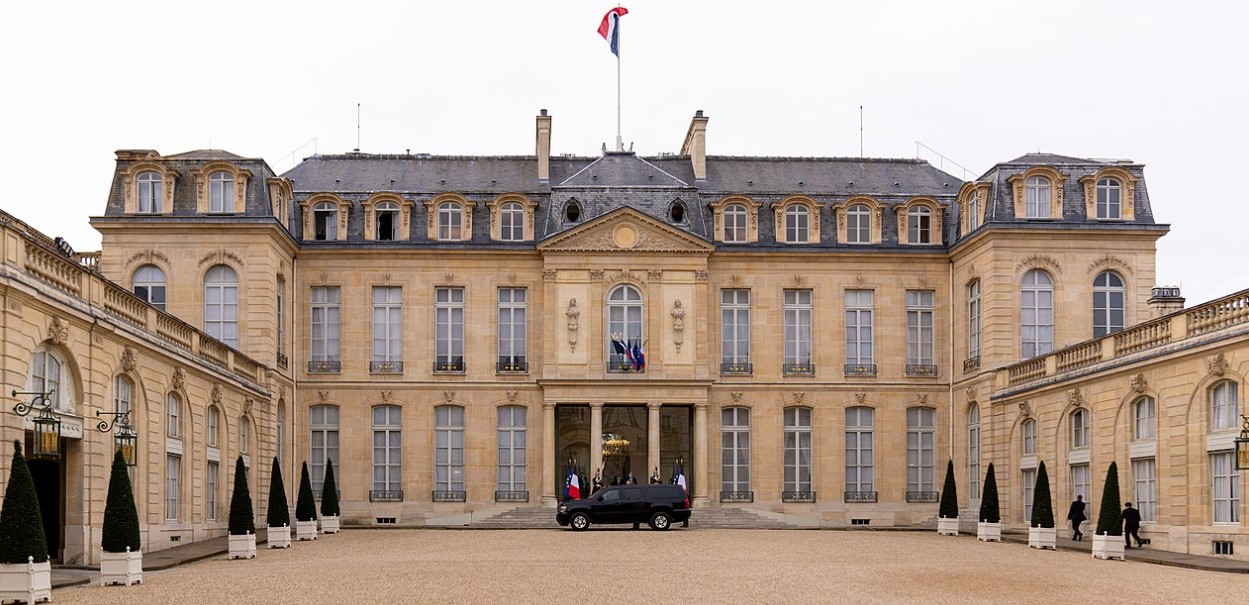
[Feature photograph of the residence of French president, the Élysée Palace, from Wikimedia Commons, here]