
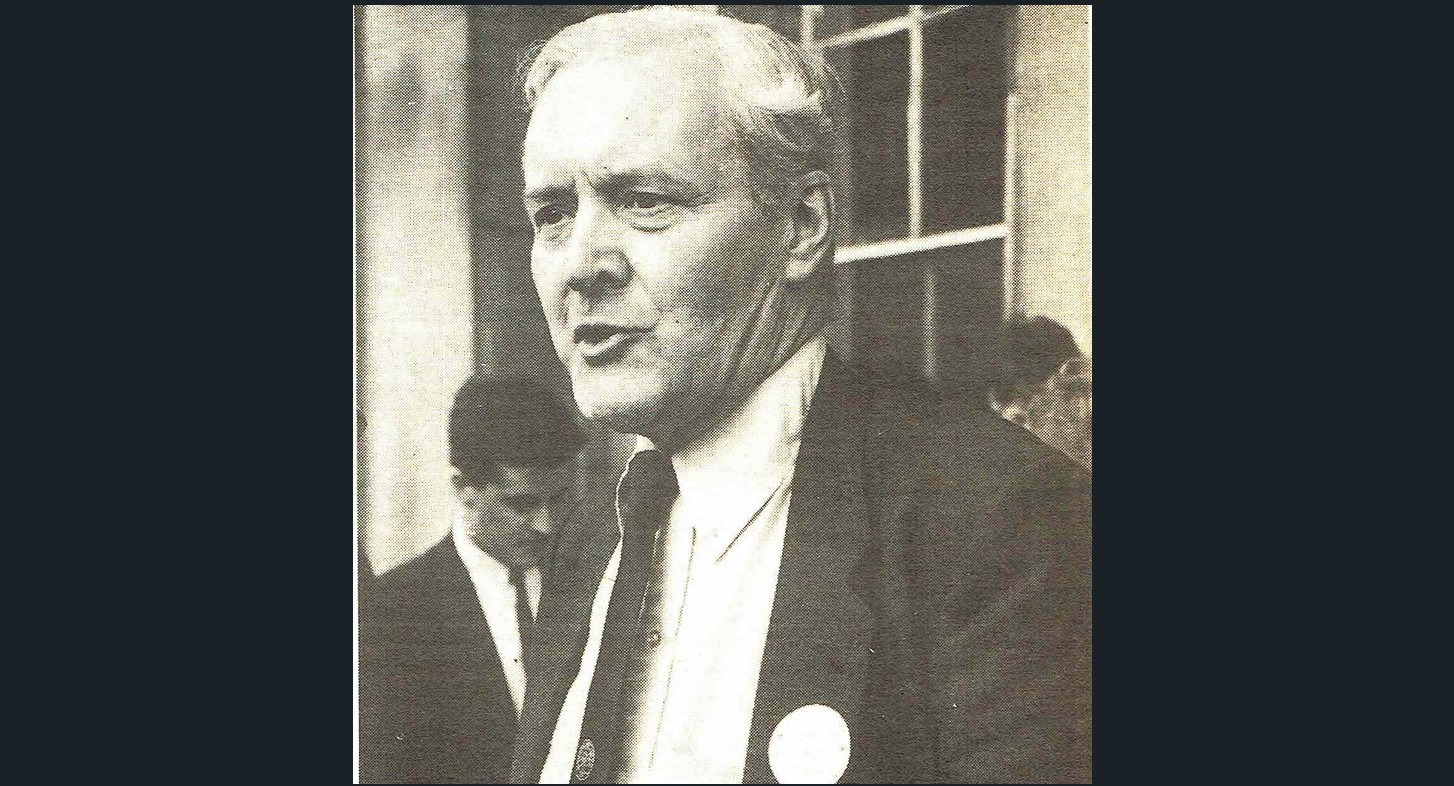
Left Horizons introduction. Under the influence of left-wing Labour MP, Tony Benn, Chesterfield CLP published a policy statement that was, in effect, a ‘manifesto’ of the Labour Left. Left Horizons published this in full last week, here. This is the first part of a reply from the political editor of Militant, Ted Grant, exactly as it was published in Militant forty years ago.
Grant’s reply (the second part is to follow), is an excellent summary of the Marxist critique of what might be called the ‘Corbynite’ left today and for that reason deserves careful reading and study.
Explanatory notes to the text:
Eddie Shah was a newspaper entrepreneur who established a newspaper away from Fleet Street, where most London papers were printed, and in so doing he broke the grip of the National Graphical Association (NGA), then the most powerful print union, on newspaper printing.
Two of the biggest newspaper moguls then were Rupert Murdoch and Robert Maxwell (now deceased), the former owning The Sun, the latter owning the Daily Mirror.
Nye (Aneurin) Bevan was a left Labour MP who, as Health Minister, founded the NHS in 1948.
The 1974-79 incomes policy was a government promoted restriction of pay rises, applied by the Labour government, supposedly as a quid pro quo for holding down price rises. In practice, wages were held down but prices weren’t.
………………………………………………………………………………………………………….
A reply to Chesterfield Labour Party’s statement of aims
With the participation of Tony Benn, Chesterfield Labour Party has adopted a programme, published in Militant last week, which they want to give the widest circulation, throughout the Labour movement. This is a praiseworthy effort, as there is not sufficient discussion and debate on the issues facing the working class in Britain and internationally and on the programme that must be adopted to serve their needs and interests. Therefore Chesterfield Labour Party has done the whole movement a service by adopting this programme.
However, while the programme is a step forward in comparison with the right wing of the movement, and even of the official left of the Labour Party in the past, there are many gaps and inconsistencies in the document. Therefore, TED GRANT, political editor of the Militant, in a two-part article offers a criticism of the policy offered in certain parts of the document, while of course agreeing with many of the points.
The programme maintains: that there are certain rights which should be won and maintained” including “the right to expect that any government in power will work for peace and justice.” The working class might as well talk of the right to expect that pigs might fly,
The class struggle to which Chesterfield Labour Party commits itself arises because of the role of the ruling class in peace and war. Their aims are the monopoly of power and the ownership pf the means of production and life. The Tories are working for “injustice” in the interests of their class. Their policies are dictated by the interests of capital and capitalism which they try and disguise as the “national interest”.
Workers can expect only blood, toil, tears and sweat while the ruling class maintains itself in power. Power, profits, privileges, income and prestige of the ruling class determine the policy and actions of any capitalist government.
Intent to deceive
The pretence of the ruling classes in capitalist countries to be interested in freedom and democracy either at home or abroad is intended to deceive the workers and the middle class.
When there is a threat to their rule and their profits, they would oppose democracy and instal a military police dictatorship if they could get away with it.
The Tory government has introduced legislation limiting the rights of trade unions. This is to weaken them and let the employers put the boot in against their employees. They want to reduce the real wages of the working class.
Through this legislation they gave the possibility for Eddie Shah to smash the NGA at his firm in Warrington. Thus the rapacious millionaire Murdoch is now prepared to try and smash the print unions. Maxwell is also using this legislation passed by the Tories.
The anti-trade union laws are an example of how far the ruling class is prepared to go in defence of their system. ‘Democracy’ and ‘freedom’ are very concrete things: the right to strike, organise, freedom to print, free speech and freedom of assembly were not given to the working class graciously by the ruling class but were won by the class struggle of the labour and trade union movement.

These rights are threatened by the laws which the Tories have passed and the new ones they are preparing to introduce. In addition the Tories have taken advantage of the stupidity of the terrorists to militarise the police. The deprivation they have presided over because of the crisis of their system and the inevitability of protest movements and strikes, led them to prepare brutal repression as the attacks on the miners and the mining areas showed when they were on strike.
The police are stock-piling riot shields, water cannon, rubber bullets, CS gas, armoured vehicles and other instruments of ‘argument’.
The abolition of trade union rights was enforced at Cheltenham GCHQ. There is no measure which the Tories are not prepared to take in defence of profit and privilege. They only hesitate because of the inevitable resistance of the labour movement.
All the liberties which the population possess are guaranteed only by the power and strength of the labour and trade union movement. ‘The price of liberty is eternal vigilance’.
The rights defended in the statement of Chesterfield Labour Party, are in reality elements of the new society of socialism. Democracy and freedom can on be guaranteed in a planned economy when industry and state are controlled by the working class. This will begin with an eight hour day, four day week with a £120 minimum wage for all. It will rapidly pass to a six hour day, four day week and so on. This would really provide a genuine basis for democracy, when workers in every section would have time to run industry and the state.
Four-day week
The mass of the population would participate in the accounting and control of society. That would be real democracy, not the position today, where as Trotsky said: “Everyone can say what they like, so long as the real decisions in society are taken by monopolies and big business”. When this is threatened, they can, as all history shows, dispense with all the trappings of democracy.
Asia, Africa and Latin America demonstrate this tragically. There capitalist democracy has largely disappeared, because the contradictions caused by the crisis of world capitalism became unbearable and because of the poverty inflicted on the masses by the ruling class. The ruling class can switch from “democracy” to dictatorship as easily as they would transfer from a non-smoking to a smoking compartment on a plane or train so long as the decision would depend on them.
Capitalist democracy is only the cheapest and most efficient method of deceiving the working class into believing that they decide the issues in society. Only the working class can guarantee and extend all the liberties wrested and won over centuries of struggle. The “equal rights for women and ethnic minorities” can only be gained inside and outside the labour movement by the active workers standing firmly for these rights. They can never be guaranteed by capitalist laws, nor artificial rules which separate black workers from white workers.
The ruling class pretend they stand for freedom while limiting the rights of workers and trade unions. They pretend this is to benefit the individual workers. In reality it is to defend the monopoly capitalists against the workers. It is to benefit the Eddie Shahs and Murdochs, to reduce their workforce to serfs at their command. This applies to both white collar and blue collar workers. It applies also to small shopkeepers and small businesspeople, who big business pretends to support and help.
On the pages of Business News and the Financial Times, the Economist and other financial papers sometimes they blurt out the crude calculations of the capitalists and the Tory government, which is nothing but the executive of the ruling class and big business and finance capital. In the editorial of The Times Finance and Industry section of the 13 January they say: “…what this means is that a doubling of unemployment, other things being equal…will be associated with a drop in real wages of 10 per cent.
“The problem is, how to cut real wages? The standard view, certainly in the Conservative Party, is that excessive growth in real wages is closely linked to the exercise of monopoly power by the unions…”
Thus the government pass anti-trade union laws to try and cripple the unions to make them tools of the employers and the government.
The rights which were gained by the labour movement were gained by the struggle of the working class in a period of the upswing of capitalism. When capitalism was in the downswing, they turned to the maniacs – Hitler, Mussolini, Franco and in Britain Mosley – for the purpose of trying to smash the workers’ organisations.
Headlong growth
There was an economic upswing between 1950 and 1975 probably greater than any in the history of capitalism. This, for the workers in the developed countries though not in the undeveloped countries, meant that the ruling class could afford certain reforms in conditions, wages and living standards. This was on the basis of a headlong growth and development of capitalism. Now with capitalism in decline, the ruling class can no longer afford to give concessions to the workers. The system is in a state of crisis even when conditions of so-called “boom” are taking place.
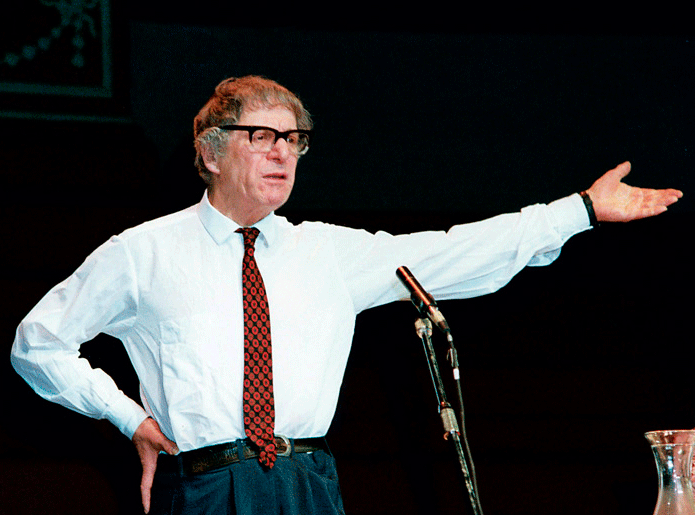
Photo – RCI
These reforms were gained, but only within the limits of capitalism. The capitalists even tolerated measures of nationalisation because they thought that through the “mixed economy” it would be possible to avert the slumps of the past. The illusion is maintained now only by Labour leaders of the right and unfortunately also the left.
Under conditions of capitalist decline the capitalists have been looting the state with denationalisation and cutting down the reforms which were gained by a seventy-five year struggle of the labour and trade union movement. British capitalism is under a condition of irreversible and terminal decline. The continuation of the system offers a nightmare prospect in front of the working class and the mass of the population. Far from granting new reforms the capitalists are already trying to take back the old reforms and will continue on those lines.
Even in France which is one third richer in industry, and has one third more wealth than Britain, French capitalism was incapable of allowing a programme of reform as put forward by the Socialists and Communists even though they nationalised all the banks in France. Very rapidly the Socialists in France had to do a somersault in policy and carry out the opposite to the programme on which they won the elections.
The Socialist/Communist government attacked even more severely the conditions and the rights of the workers than the previous Tory government had done. This followed a year of initial reforms. Not being able to maintain these on the basis of capitalism, they had to turn to counter-reforms. A similar process has taken place under a left socialist government in Greece and the right-wing Socialist governments in Spain and Sweden.
What this proves is that it is impossible partially and gradually to reform capitalism and prepare the way for socialism. Most of the left Labour leaders have had the untenable position that it would be possible over a period of 50 years of Labour governments to transform capitalism into socialism and achieve the nationalisation of the commanding heights of the economy. It was always utopian to believe so, but under conditions of capitalist crisis it is absolutely impossible.
In fact, none of the rights itemised in the Chesterfield statement are fully enforced today and were not under the Labour governments of the past.
Any government which accepts the basic system of society as it exists at the present time is compelled to obey the laws of capitalism. In addition, as in France and other countries they faced the sabotage and implacable hostility of big business, which uses their control of the economic resources of society for the purpose of forcing Labour governments to carry out Tory policies rather than carry out even the reformist policies which they are putting forward at the present time.
This is not because of the wickedness of the capitalist class. It is because of the nature of class society and the insane contradictions long ago predicted by Karl Marx, in which society finds itself at the present time. Thus we get cuts in living standards because society can produce much more than was ever possible in the past. We must tighten our belts and eat less because too much food can be produced. They cut clothes production because they produce ‘too much clothes’. Steel production which goes into six per cent of products has been slashed by almost 50 per cent. Contradictions of this type could take up the whole of the pages of Militant.
Insane logic
This is the economics of the madhouse, but it is the insane logic of capitalism which we are facing. Because he is caught in the constraints of accepting the basic economic domination of big business and finance capital, Neil Kinnock [Labour leader 1983-92 – Ed] has refused to guarantee full employment in advance for a new Labour government. This is because he accepts the basis of capitalist society which can no longer give full employment and the right to work.
Of course, it might be said that in the paragraph in the statement of the nationalisation of the commanding heights of the economy the document recognised this. However, while the formula is a creative one and a good step forward, nevertheless Nye Bevan also put forward vaguely the demand for the nationalisation of the commanding heights of the economy. But the commanding heights of the economy include the 200 monopolies, banks and insurance companies (now even less with mergers, making the job of taking over the economy even easier) which control over 80 per cent of the wealth of Britain.
The nationalisation of these 200 monopolies must be under workers’ control and management. This would involve a plan of production involving trade unions, shop stewards committees, small business people, and the entire population in the running of industry and the running of the state. Without the nationalisation of these 200 monopolies, it is not possible to control or to plan the economy, it is not possible to guarantee even the minimum reforms which are being put forward by the labour movement.
Despite Thatcher’s phrase-mongering about the importance of small business, in reality there has been an enormous concentration and centralisation of capital which was spoken of by Marx in the past and which has been enormously speeded up in the course of the last five years. Not a single right put forward in this document could be guaranteed for any length of time unless there is a complete transformation of society.
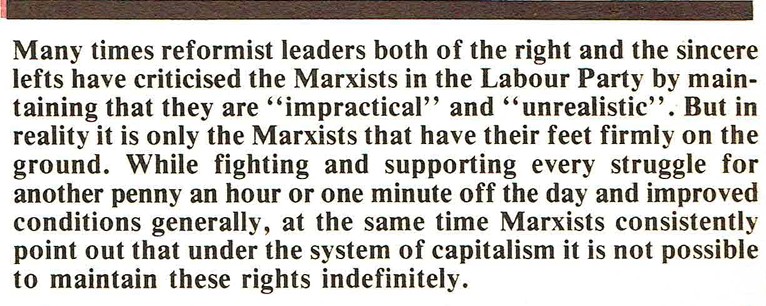
Capitalism works by taking the surplus created by the working class and ploughing it back into industry. In this way over a period of more than a century they developed industry, technique, science and the economy as a whole. Now the productive forces have grown beyond the limits of private property and the nation state the capitalists can no longer take the surplus extracted from the workers and plough it back into industry because already they can only use 70 per cent of productive capacity in slumps and 80 per cent of productive capacity in booms. What capitalist in his right senses is going to invest to create further capacity when he cannot sell the goods which he already produces?
In Britain under the Tories in reality they are not even investing in new machinery to make up for the depreciation of the machinery which has taken place over the last ten or fifteen years. They are destroying steel plants, chemical plants, textile plants, shipping and shipbuilding facilities, which could have been used to enormous advantage with a plan of production.
In different ways both the right wing Labour leaders and the Tories have the same policy. The Tories have the policy of aggressively trying to bind the unions hand and foot in order to give the capitalists a free hand in destroying the gains of the workers. But the policy of right wing Labour leaders for a future Labour government is not much different. They are advocating an incomes policy, which means cutting the share of the workers while increasing the profits of the capitalists.
This is in the vain hope that the profits of the capitalists will be increased while a market is provided by state expenditure and then the capitalists will then invest. In the Labour government od 1974-79 where an incomes policy was in force it did not result in a massive increase in investment as Healey and the Labour leaders believed.
The capitalists refused to invest because the market was further cut by the measures taken by the Labour government in reducing the workers’ share by incomes policy. The wages of the workers did not go up in accordance with the increase in prices. The cut of state expenditure of £8,000 million introduced by the Labour government meant that the market was also cut and therefore, although their profits were increased the employers did not invest in industry, but on the contrary invested in anything else but industry.
They have turned capitalism into a gambling casino. The capitalists have become completely reactionary. They are pure parasites not investing more than a minimum of the surplus produced by the workers in industry while the greater part is invested in service industry, in tourism, in currency exchange speculation, stock exchange speculation, horse racing, land and antiques – everything but the development of industry and the production of real wealth in the form of machinery, buildings and consumer goods.
One glaring example is that there are 500,000 building industry workers rotting on the dole while the demand for decent housing has never been greater. Bad and insanitary conditions, slum housing, inner-city decay and disease, a rotting infrastructure where roads, railways, sewers, bridges are decaying and yet the capitalists are not prepared even to invest in this necessary basis of capitalist society.
Many left trade union leaders and Labour leaders, together with the Stalinists, in spite of the experience of other countries where majority Labour governments have been established refuse to recognise the reality of the situation. They will not face the facts. A Labour government not taking over the 200 monopolies would inevitably become an instrument of big business for the purpose of holding down the wages and conditions of the workers.
The Chesterfield document calls for “The right to useful and satisfying work,” but it would be impossible to abolish or even ameliorate unemployment except for a very temporary period, possibly the first 12 to 16 months. Then the crisis would catch up with them and unemployment would increase enormously. Unfortunately in the five years of the last Labour government, unemployment doubled, from 750,000 to one and a half million.
Thatcher of course has more than doubled it again.
No government which is not prepared to tackle this problem can hope to change the economic situation or to give all workers a job to which they should have an inalienable right as the Chesterfield document says. Such a right is impossible under capitalism. It is not only under Tory governments that unemployment has increased. It has increased in Greece, Spain, France and Sweden – all countries which have majorities and in most cases big majorities for the socialist parties.
The only way to deal with this problem is to understand its root causes and convince the working class of these causes. It is necessary to put forward a whole series of demands such as the TUC have formally adopted for a 32-hour week, a minimum wage and the other demands carried by Labour Party conference and the trade unions but not a single reform can be maintained for any length of time so long as capitalism has control of the economic basis of society.
[This article was first published in Militant– 24 January 1986 and is republished here in full, edited only for typos and spelling]
[Featured photo – Tony Benn in Liverpool. Photo – Dave Sinclair, from Militant 24 January 1986]