
By Steve McKenzie – Unite Community (Lewisham, Greenwich and Bexley)
Establishing the true nature and position of the British working class today is not an easy, and certainly not merely an academic exercise.
For far too long, for at least the last 40 years, the prolonged retreat of the working class in Britain has demoralised genuine union activists and socialists. It is a retreat that has lasted for at least two generations, since the defeats suffered in the last quarter of the twentieth century.
These defeats include the repeated electoral defeats to the Tories, at first under Thatcher and then under Major; Thatcher’s fanatical adoption of economic neo liberalism with its dogmas of cuts in public services, privatisation and deregulation; the introduction of anti-union legislation; and the industrial defeats of the miners and the printers.
Then there are changes in the nature of industries themselves. There is the increasing use of new technology in industries like vehicle manufacturing and the containerisation of the docks. All the time, there was a conscious policy of deindustrialisation and turning Britain into a rentier economy based on financial services. These were the objectives being actively pursued by successive Tory governments.
Labour governments, first under Blair and then under Brown continued these policies. When asked what her greatest achievement was, Thatcher is said to have replied ‘Tony Blair’.
All of this had a profound effect on the working class. There were no more mines or shipyards. The print unions had been destroyed. Union membership halved; the shop stewards movement was obliterated. Where once there were secure, relatively well paid jobs, now there is only insecure low paid work, bogus self-employment, temporary contracts and employers who hire and fire at will.
Rebuilding the movement
There is a job of work to be done in rebuilding the movement. That will not be done by looking backwards with rose tinted glasses with a romanticised and false view of the working class of yesteryear. It involves hard work and sacrifice – organising and building in the workplace.
While studying theory and learning history is an absolute necessity, every socialist in employment should be attempting to put theory into practice by organising in the workplace.
With this in mind it is best to start by having an honest look at the working class in Britain in 2026, and its relationship to trade union organisations in its different sectors
THE NHS – Today, many British workers are employed in the health service, which, in some areas of the country is by far the biggest employer. Many NHS workers are either in a union, such as UNISON or UNITE or a so called professional organisation such as the British Medical Association (BMA) or the Royal College of Nursing (RCN).

[photo – Antonia Berelson]
LOCAL AUTHORITIES – Throughout the country there are still some services provided by local councils. However most council services have vanished or have been privatised. Whatever work is left is now undertaken mainly by those employed by the private sector companies.
Incredibly this includes social care, a caring service which as a result of it being in the private sector is also provided based on the profit motive, with fewer staff, higher costs and inevitably a poorer service – all in pursuit of the priority, profit, just like all other privatised services.
Union membership in local authorities is very patchy. Some services like refuse collection is very strong in some areas. On the whole social care services like residential and nursing homes, and home care services are very weak.
EDUCATION – There are still hundreds of thousands employed in education. Many teachers are relatively well organised in the unions by today’s standards, although many of those employed in higher education have taken a battering as a result of short term contracts and other attacks on employment rights.
PRIVATISED UTILITIES – These include those employed by the privatised water and energy industries, not to mention those in what is left of Royal Mail.
TRANSPORT – This includes rail, buses, shipping and road haulage. Like the teachers these workers are relatively well organised.
THE BUILDING INDUSTRY – This employs tens of thousands of largely unorganised workers. (With the exception of some sites and of course the likes of the electricians).
DEFENCE AND CIVIL SERVICE – There are hundreds of thousands employed in this sector, some well organised, some not.
REMNANTS OF HEAVY INDUSTRY – There are the remnants of some of the old heavy industry and manufacturing. The steelworks, are to a large extent, on their last legs. The docks have been containerized. The numbers employed have been dramatically reduced and much of the work is now highly skilled. The same is true of vehicle manufacturing. The mines are now extinct and the print industry has also been torn apart and de-unionised mainly as a result of new technology.
AMAZON – Then there are the newer industries, like the Amazon distribution centres, that are fighting to get organised. The employers are rushing to introduce new technology to counter this.
RETAIL – This is largely unorganised, unless a sweetheart deal exists, (Tesco’s and USDAW, Asda and the GMB, Sainsbury and USDAW and Unite). Even with such deals union membership in general is still pitifully low and genuine union organisation virtually non-existent.
[Photo – Left Horizons]
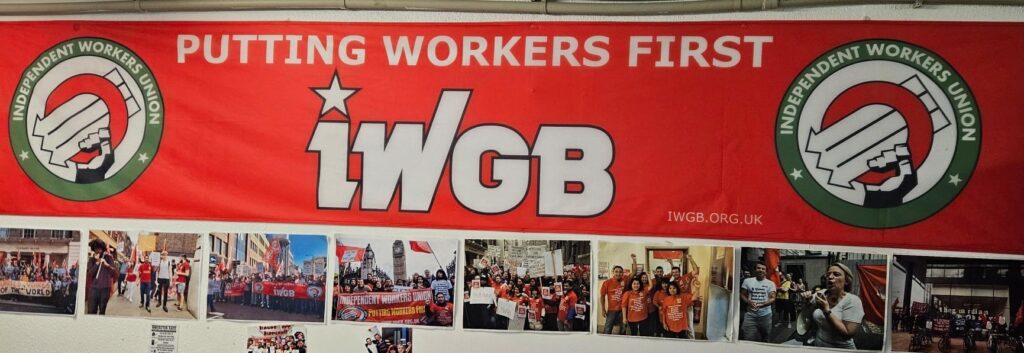
GIG ECONOMY – In these jobs (Uber drivers, couriers, food delivery etc), levels of union membership and organisation are even poorer.
HOSPITALITY – This sector i.e. pubs, clubs and hotels, is notoriously poorly organised with one or two exceptions.
Perpetual change
This is a very different situation to the one that existed in post war Britain which, while in decline, still had heavy industry like the mines, shipbuilding and the docks. In addition there were hundreds of thousands if not millions employed in manufacturing in factories up and down the country.
This is also different to the situation that existed between the two world wars in the twentieth century. For example there was the proliferation of the armaments industry as a result of the frantic preparation for the second world war. This again was different again to the situation that existed between the birth of new unionism at the end of the Victorian era and the start of the first world war.
The situation is always changing, the real and only question is, can genuine trade unionism and, even more importantly, genuine socialism adapt.
The trade union bureaucracy has always, and will always act as line of last defence for the ruling class. Nothing proved this more clearly than the TUC betrayal of the General Strike, one hundred years ago in 1926. They operate by putting forward the mildest demands possible in any given circumstance, and pouring cold water on genuine rank and file organising. It is crystal clear that the fightback will take place despite them and not because of them.
Lessons from Minneapolis
I believe that the resistance being shown in Minneapolis in the US is an example for us and shows the way forward.
Most of the protesters on the streets, in the freezing cold, confronting the armed murderers of ICE, are not in a union, although the nurse assassinated by these killers, Alex Pretti, was. That has not stopped them calling for, and taking part in a general strike, that was endorsed by the unions.
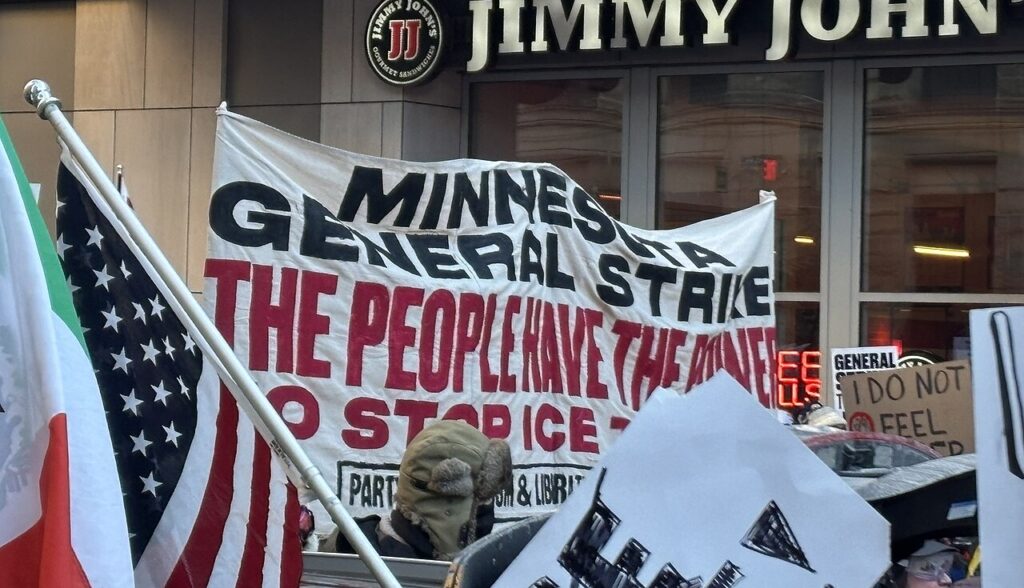
23 January 2026 [photo Wikimedia Commons, here]
The extreme provocation of the ICE thugs, the murder of protesters and the mass arrests and detention of thousands of immigrants has given rise to this movement, and it is beginning to spread to other cities like Chicago. Movements like the one in Minneapolis will happen with or without effective union organisation or a conscious socialist leadership.
Anyone who thinks that couldn’t happen here is in for a rude awakening. The pound shop Trump, Farage, could end up being the prime minister after the next general election. Robinson and a motley conglomeration of right wing street thugs are waiting in the wings.
Nostalgically looking back to how the unions were organised previously, in a one sided manner is neither useful or helpful. Preparing for the reality of forthcoming events by getting organised is. It is a question of being in the right place at the right time with the right arguments and correct methods.
Studying historical Labour movement events and the unfolding events in Minneapolis is important. There is no point in reinventing the wheel.
A fightback is inevitable, the outcome isn’t, that depends on leadership. Don’t get demoralised, adapt, get stuck in and fight for change!
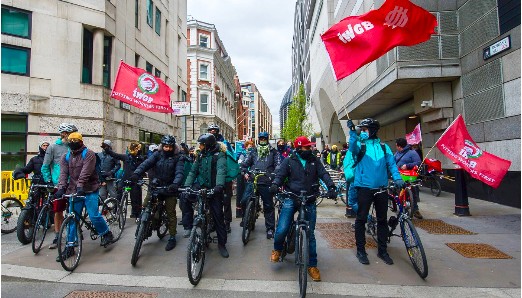
[Featured photo – striking delivery workers in the IWGB – photo from IWGB – https://iwgb.org.uk/]