
By Michael Roberts
This blog was originally published by Michael Roberts on Saturday, 7 February 2026. The original article can be found here.
**************
The south-east Asian country, Thailand, is holding a general election on Sunday. Of the 72m Thais, 53m are eligible to vote. They will vote for the 500-seat House of Representatives. While 400 seats are filled through constituency races under a first-past-the-post system, the other 100 are distributed to the contesting parties based on proportional representation. Then those elected to the House will vote to pick the next prime minister with a simple majority needed for the prime minister to win.
This election takes place amid a tumultuous period of political instability, economic stagnation and an ongoing border crisis with rival neighbour Cambodia. The election will test whether the country can finally break a cycle of political instability that has lasted more than a decade, marked by a succession of short-lived governments each toppled by the military and the courts.
A history of political instability and military rule
Since the latest transition from military rule in 2019, It has already held two elections. The Move Forward party won the last election, after a mass protest against military rule, but parliament manoeuvred a coalition of the military backed party and Pheu Thai, the party of billionaire ex prime minister Shinawatra; and his niece became prime minister. Only after a year, a scandal erupted that apparently showed that she been phoning the Cambodian leader and making concessions in the border conflict. The Constitutional Court then ousted her and the military-backed party leader Anutin Charnvirakul took over. In December, Charnvirakul finally dissolved the lower house of the parliament for a snap election as his Bhumjaithai Party was set to lose a no-confidence vote.
This election is seen as a three-way fight between the royalist-military establishment represented by the Bhumjaithai Party, the progressive opposition led by the People’s Party, and the populist Pheu Thai Party linked to the powerful Shinawatra clan.
Opinion polls suggest that the largest opposition group, the People’s Party, is in the lead with 36% of those asked, compared to 22% for the Pheu Thai Party and 18% for the currently ruling Bhumjaithai party. The Peoples Party is really the successor to the disbanded Move Forward party and is led by Natthaphong Ruengpanyawut, who is only 38 and appeals to Thai youth. The party’s election programme is vague and its so-called policy ‘blueprint’ merely talks about fairness, efficiency and clarity. The party may win the largest number of seats but it is very likely that the other two parties will band together to ensure that NR does not become prime minister – and the traditional rule of the rich families, the military and the monarchy will remain.
Thailand’s economy used to be called an ‘Asian Tiger’
Whoever wins faces serious economic challenges. The Thai economy, which used to one of the so-called east Asian ‘Tigers’ in the 1980s and 1990s, is now close to slump.
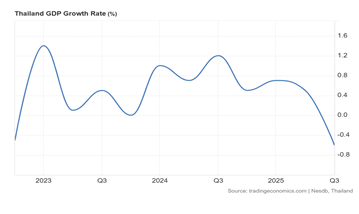
The economy suffered badly in the infamous Asian debt crisis of 1998 and the relative recovery since has been patchy. Overall, there has been a secular decline in real GDP growth to an average of under 2% a year compared to 4-5% a year before the global financial crash of 2008-9. The economy shrank by 0.6% in the third quarter of 2025 and indicators point to ongoing weakening.
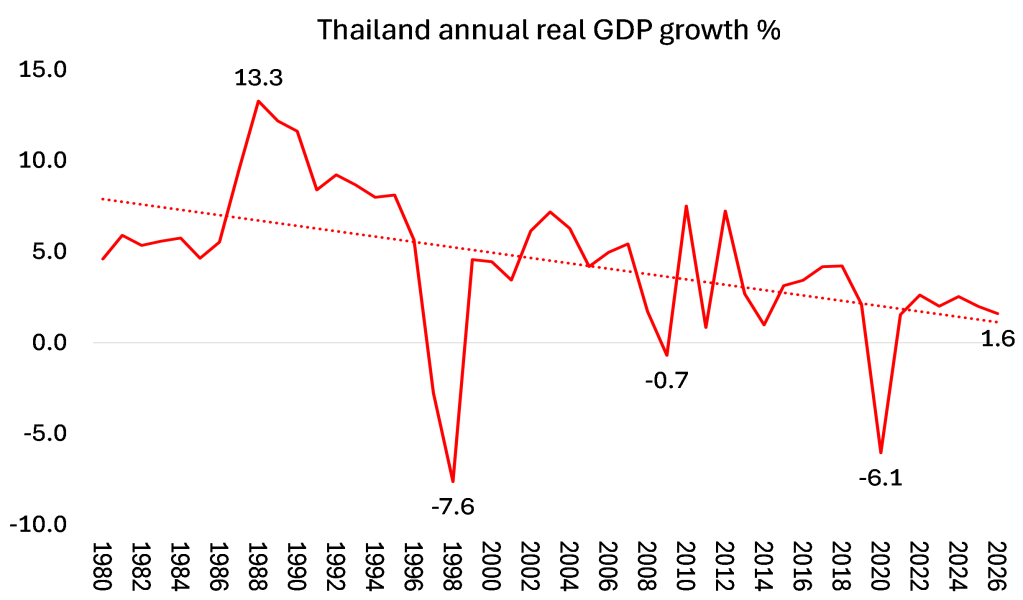
Thailand’s economy is losing ground to Vietnam, Malaysia and China
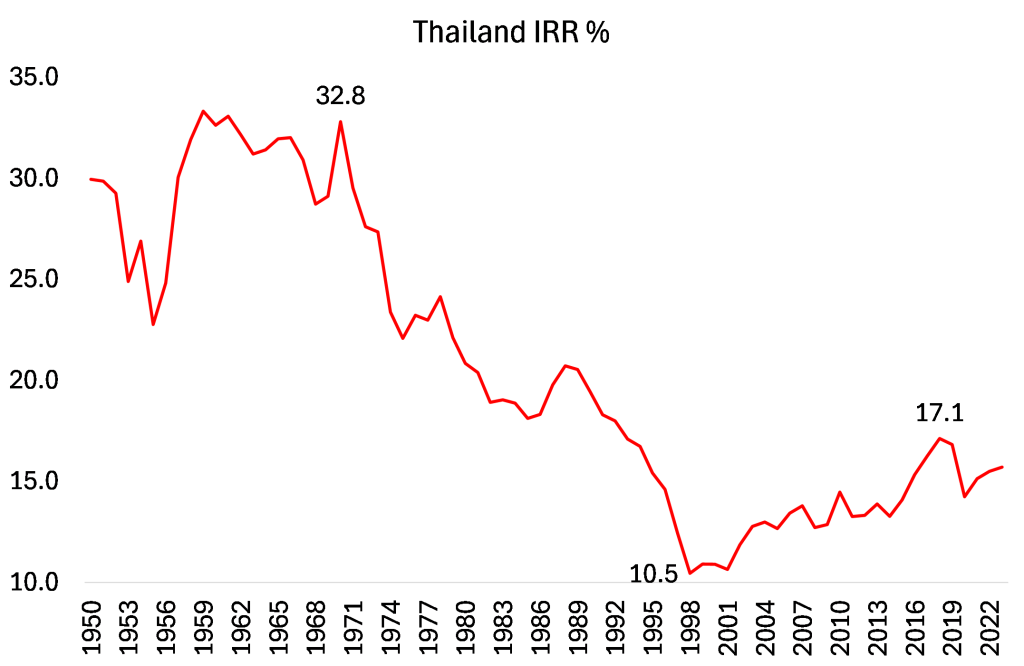
Once the envy of its neighbours, the country is increasingly being referred to as the “Sick Man of Asia.” The nation now finds itself grappling with a severe economic paralysis across its three primary pillars: consumption, manufacturing and tourism. Failure to invest productively has meant Thailand has rapidly lost its competitive advantage to regional rivals like Vietnam and Malaysia. While the profitability of Thai capital rose after the 1998 debt crisis, it is still well below the level of the 1980s and has dropped back since the pandemic slump of 2020.
The manufacturing sector—long the heartbeat of the Thai economy—is under siege from an influx of cheap Chinese goods and fierce competition from Vietnam. Nissan, Honda, and Suzuki in Thailand have responded to the downturn by either shuttering factories or significantly reducing production capacity. Constant coups and leadership changes have delayed critical budget allocations and stalled essential infrastructure projects, leaving the country without a clear path to recovery.
The population has declined for four years in a row
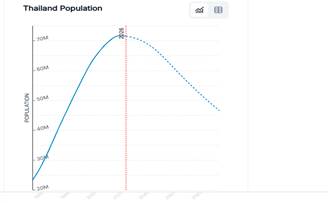
Thailand’s population has shrunk for four consecutive years, with 2025 birth rates hitting a 75-year low.
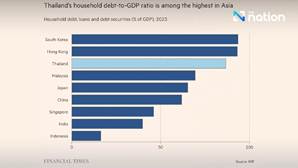
Household debt is now approaching 90% of GDP, the highest ratio in south-east Asia, stifling domestic spending.
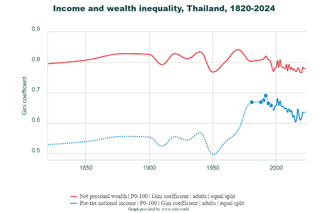
Meanwhile, inequality of wealth and income remains at very high levels even by Global South standards, with gini coefficients of 0.78 (wealth) and 0.64 (income) respectively – and little changed in 150 years!
Thailand’s poverty reduction has slowed since 2015, with poverty increasing since then, as the transition from low-productivity agriculture to higher-productivity jobs began to lose steam in 2015. A stagnant economy, weak manufacturing investment, falling population and employment, high consumer debt and governments formed to sustain the rule of the military and monarchy: that’s the situation that Thai voters face in this election.
From the blog of Michael Roberts. The original, with all charts and hyperlinks, can be found here.
The featured image at the top of the article shows Anutin Charnvirakul of the Bhumjaithai Party, Natthaphong Ruengpanyawut of the People’s Party and Yodchanan Wongsawat of the Pheu Thai Party. (Source photos by Ken Kobayashi and Yuka Konishi).