By Greg Oxley
In this multi-part article, Greg Oxley looks in depth at the revolutionary period of 1917-1919 in Germany, and draws out some of the key lessons for the workers’ movement today. Part 2 looked at the impact of the war on the masses and the ant-capitalist stance taken by Karl Liebknecht and Rosa Luxembourg. Part 3 looks at how privations in the war led to increased opposition and ultimately to the development of a revolutionary situation.
**************
After the initial patriotic wave, which seemed to sweep away all in its path, a change in the mood of the population was clearly underway. Already, in 1915, demonstrations for peace took place in Berlin. Other “non-political” demonstrations – or rather riots – broke out in front of empty bakeries or grocery stores.
In 1914, in the aftermath of the declaration of war, groups of hysterical patriots frantically searched for spies. Twelve months later, things had changed. Now, women’s groups were searching for bread and other basic necessities.
In the Social Democratic Party, voices were raised, demanding that the party’s deputies vote against war credits. In the Reichstag, Liebknecht was no longer alone in his opposition to the war. In December 1915, 20 Social Democrat MPs voted against the credits.
Demonstrations and strikes in 1916
On 1 May 1916, the International group led by Luxemburg and Liebknecht were able to organise a demonstration of several thousand workers and young people in Berlin. Liebknecht was arrested as soon as he began his speech. On the day of his trial, 55,000 workers went on strike in solidarity with the defendant.
In the meantime, the war aims of German imperialism were becoming increasingly clear, so that the “national defence” argument, which served as a justification for rallying the Social Democratic leaders, no longer held. The General Staff assured the big German industrialists that Belgium and north-eastern France would be annexed and that Austria-Hungary and Poland would be under German hegemony. As for the struggle against Russian despotism, it was soon to lose all credibility with the revolutionary overthrow of the tsarist regime in March 1917.
Growing opposition to the war
Opposition to the war grew. On 16 April, between 200,000 and 300,000 metalworkers in 300 factories went on strike against a big reduction in bread rations. That same morning, the editorial staff of Vorwärts, firmly in the hands of the right wing of the Social Democratic Party, didn’t go so far as to formally condemn the strike, but they wrote: “The insane hope of seeing events like those in Russia might well cost the lives of hundreds of thousands of men on the battlefields.”
On the same day, a rally of 10,000 workers in Leipzig demanded an increase in rations, but also put forward a series of political demands, calling for an end to the hostilities, without any annexations, and the ending of censorship, the state of emergency and the mobilisation of workers. It also called for the release of political prisoners and for universal suffrage.
In the ports of the north-west, the decrease in rations pushed sailors to revolt. “Food committees” were created. Hunger strikes and walkouts broke out. Several sailors were arrested, provoking brief but larger protests.
Hindenburg’s portrayal of the strikers as “our worst enemies”

General Groener issued a communiqué in which he urged the workers to reread a recent speech by Hindenburg, in which, he said, they would recognise their worst enemies, who “are not over there in Arras, on the Aisne, or in Champagne. They are not in London either. Our worst enemies are among us, [they are] those who are pushing for strikes. Anyone who strikes while our soldiers are facing the enemy is a dog.”
On April 27, Vorwärts published a text along the same lines: “Strikes must be avoided. Peace in the short term depends on Germany’s ability to resist.” After a new wave of arrests among the sailors, two of the ringleaders were shot and others were sentenced to forced labour. Clearly, it was going to take much more than protest “committees” to overcome the power of the military authorities. The metalworkers’ strike ended, while massive strikes broke out in Vienna and Budapest. The working class of Central Europe was at last raising its head.
State repression is ramped up
However, the methods of struggle, the slogans and organisational forms that may have been effective in peacetime were no longer valid in a state of war. Demands were no longer predominantly economic. All questions were inextricably linked to the war, but strikers had no practical way to end it. To defeat the strikers, the government tightened the repressive restrictions of the state of emergency and increased the number of police officers.
There were also weaknesses in the leadership of the strike. In the name of “the greatest possible unity”, the action committee had included three representatives of the right wing of the SPD who were in favour of the war, including Friedrich Ebert, who were consciously striving to limit the scale and effectiveness of the movement. Later, Ebert would boast of his “salutary” role: “I joined the leadership of the strike with the intention of ending it as soon as possible so as not to harm the homeland. If we had not joined the committee, the established order would no longer exist today.”
The impact of the 1917 Russian revolution
The Russian Revolution had overthrown the Tsar in March 1917. In November, the organs of struggle of the workers, soldiers and peasants that had taken shape during this first phase of the revolution, the soviets, took power under the leadership of the Bolsheviks. For the first time in history, if we leave aside the ephemeral episode of the Paris Commune in 1871, the working class has taken power.
For many years before the revolution, Lenin, Trotsky and the other leaders of the revolution had been fighting under the banner of revolutionary internationalism. But now internationalism was truly a matter of life and death for the Soviet Republic. The new regime had to fight against internal counter-revolution and also against the mortal threat of foreign imperialism. From the outset, the Bolsheviks proposed an “immediate peace, without annexations and without reparations” between the belligerent countries. However, this appeal was not only directed at the imperialist governments. It was addressed above all to the workers and soldiers of Europe, to incite them to carry out this programme by revolutionary means.
The Bolsheviks immediately published a German-language newspaper, Die Fackel, with a circulation of 500,000 copies, for distribution in the trenches. When, in December 1917, Leon Trotsky and Karl Radek arrived in Brest-Litovsk for negotiations with the German General Staff, Radek, under the noses of the military leaders and diplomats of Imperial Germany, distributed a revolutionary leaflet to German soldiers. Still in prison at the time, Liebknecht wrote: “Thanks to the Russian delegates, Brest-Litovsk has been transformed into a revolutionary tribune!”
Splits in the Social Democratic Party and the creation of the USPD
The emergence of mass movements against the war in Austria-Hungary, the revolution in Russia and the entry into action of the workers in Germany had an impact on the Social Democratic Party, in which important developments had taken place since the beginning of the year. For a good part of the party’s leaders, opposing the war head-on was not an option. This would lead to a wave of repression which, they feared, would lead to the confiscation of its press, its premises and its funds, in short, to its total destruction.
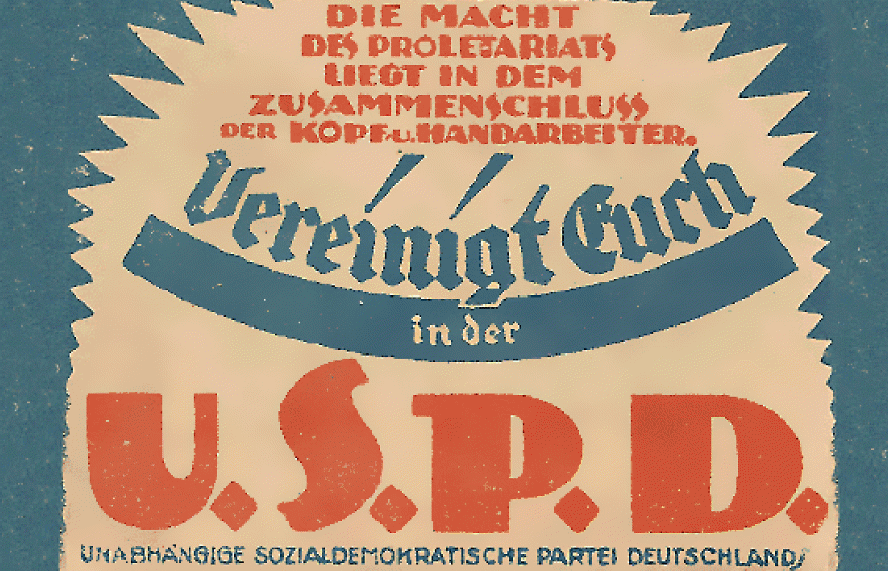
Unlike the right wing of the party, these elements were not in favour of the war, but were also opposed to any “excessive” or revolutionary opposition. They wanted the war to end through a diplomatic means, without the active and militant intervention of the masses, without endangering the capitalist order. This “centrist” position thus occupied an intermediate place between the pro-imperialist right of the party and the revolutionary left around Luxemburg and Liebknecht. Against all “sedition”, the action of the centrists did not go any further than the formation of a separate parliamentary group. They did not want to break with the SPD.
However, for pro-war leaders, even this moderate opposition was unbearable. At the beginning of 1917, the supporters of the opposition were expelled from the SPD en bloc. Their newspaper, Vorwärts, was confiscated by the military authorities and handed over to the party leaders. This is how the Independent Social Democratic Party (USPD) was created in April 1917. The new party was far from homogeneous. Among its leaders were Karl Kautsky – the “pope of Marxism” – and also the theoretician of reformist gradualism, Edward Bernstein. The main leader was Hugo Haase. The new party had relatively large resources at its disposal. From the outset, the USPD had dozens of full-timers, offices in many cities, members of parliament and several daily newspapers. Before the end of the year, its membership would rise to 120,000 members – compared to 150,000 for the SDP. It included many of the frontline leaders of the April strikes, as well as a network of sailors and sympathisers in the army.
The challenges facing the revolutionaries of the Spartacus group
On the left of the new party were the supporters of Luxemburg and Liebknecht. The latter, especially, enjoyed a certain notoriety. He was known for being the first deputy to publicly oppose the war. But both were still in prison as a result of their revolutionary activity, and had virtually no contact with the outside world. The other leaders of the Spartacus group (formerly the International) were surrounded only by small circles of more or less isolated militants. As soon as a worker openly associated themselves with their ideas, they risked being sent to the front.
Pierre Broué, in his remarkable book The German Revolution, 1917-1923, gives an idea of the numbers of the revolutionary left at the time. He tells us, for example, that in Bremen, it had a group of militants, but it no longer had any presence in the shipyards or in the city’s factories. In the whole of southern Berlin, it had only seven militants. In addition, its small numbers did not even agree among themselves on several important issues.
Until the spring of 1917, Rosa Luxemburg, Karl Liebknecht, Leo Jogiches, Franz Mehring and Clara Zetkin considered it absolutely indispensable to form a cohesive revolutionary grouping, regardless of its size, but as part of the broader workers’ movement, so as not to be isolated from the masses. Otherwise, they argued, the Spartacists would be an isolated and sterile sect. Their idea was that when the masses begin to take action on a large scale, they would be unable, at least initially, to distinguish between the different currents opposed to the war, and that in order to convince them of a genuinely revolutionary programme, it would be necessary to fight alongside them, within a common mass organisation.
What approach to take regarding the centrist USPD?
Given that the exclusion of the centrists had led to the creation of the USPD, the question arose as to what attitude the revolutionary left should take towards this new formation. Leo Jogiches defended the need to work in the USPD. He wrote that it was necessary to fight to win over “the still confused and vacillating masses who follow [the centrist opposition]. And we can only do this if we fight within the party, instead of forming a completely separate organisation outside.” Rosa Luxemburg and Karl Liebknecht supported this approach. But their point of view was not shared by all.
The Bremen group around Paul Frölich and Johann Knief, for example, thought that it was necessary to break with the USPD in order to help the masses to distinguish between revolutionaries and reformists. This position was also endorsed by Karl Radek. Finally, there was another tendency among the Spartacists called the Revolutionary trade union delegates, based in particular in the metalworkers’ union in Berlin. This latter movement did not want to cut ties with the USPD.
The impact of the October Revolution caused many Spartacists to reassess their position. Thus, on June 3, 1918, Franz Mehring sent an open letter to the Russian leadership in which he declared his total solidarity with the policy of the Soviet government and criticised the opportunism of the USPD. He writes: “We were wrong on one point: we joined the USPD when it was formed, in the hope of pushing it forward. We had to give it up. It was impossible.”
On the verge of military defeat and the outbreak of revolution
In total, the revolutionary left probably had about 4,000 members in 1918. But as evidenced by the divergent attitudes towards the USPD, they did not necessarily agree among themselves and did not have an organisational structure enabling them to discuss and settle these differences. The course of events was now going to accelerate. Tragically, with the approach of final defeat on the military front, the outbreak of the revolution was to occur before the revolutionaries could get into marching order.
Part 4 will look at the revolutionary actions of the sailors, soldiers and workers in 1918, the fall of the Kaiser, and the desperate attempts of the German establishment to save their system from being overthrown.