By Andy Ford, Warrington Trades Council
The Government taking control of the Scunthorpe steel plant has once again exposes the sorry record of British capitalism. The hysterical briefing by Labour spin doctors that this was not nationalisation once again exposed the pathetic deference of the Labour leadership to the logic of ‘the market’, even at the moment that logic has demonstrably failed, and over a long period of time.
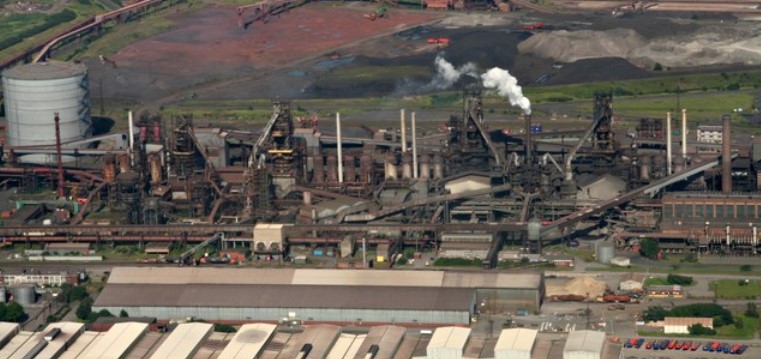
Iron working in North Lincolnshire goes back to the Domesday Book, using the plentiful local deposits of low-grade iron ore. But iron and steel production really took off in Victorian times, as the new Bessemer and open-hearth processes allowed mass production of relatively cheap but good quality steel, and it was boosted again by arms production in the First World War. By the end of the war there were three steel furnaces in the area and Scunthorpe’s population grew from about 1,000 in 1851 to 12,000 in 1918.
Over the course of the 1930s, the multiple steel firms in Scunthorpe consolidated into just three, to deal with over capacity in the industry, despite the industry’s protection by the tariff barriers around the British Empire. But once again steel production was boosted by the advent of war. Government aid helped pay some modernisation and new furnaces from 1938/39 onwards, and the population of Scunthorpe rose again to over 50,000, with production again increasing.
However after 1945 the British steel industry struggled to compete in the world market due to a chronic lack of investment. As was the story in so many British industries, the private owners took the profits but put very little back in. By comparison, the German steel industry, which had been all but destroyed in the war, was rebuilt and retooled to become a formidable competitor to the venerable British industry. At the time of nationalisation, in 1967, Scunthorpe was still working on the Victorian open-hearth process.
The Labour government of 1964, as part of Harold Wilson’s ‘white heat of technology’ programme, nationalised the steel industry to form the British Steel Corporation, and £3bn was put into re-equipping and rationalising the industry. Steel was rationalised, to be based on five main sites – Port Talbot, Sheffield, Scunthorpe, Redcar and Ravenscraig in Scotland. Most smaller steel works located inland near the coal fields were closed and the workers offered jobs in the five main hubs. At Scunthorpe public money was used to convert some of the open-hearth production to the more modern Linz-Donawitz process, to install a 2-million tonnes per annum slab steel mill and to create a modern iron ore terminal at the nearby port of Immingham.
At the time, the leading British Marxist Ted Grant wrote in 1968:
“The re-nationalisation of steel has been revealed as a colossal rescue operation for capitalism in its most inefficient and profiteering form…nationalisation was conceived as a lovely ramp for the owners and stockholders of the steel industry. Having taken over for a song the new plants erected with government money, they proceeded to run the industry down from a technical point of view, to the detriment of their fellow industrialists.
“Now the state undertakes a rescue operation by over-compensation to those sections of the steel industry which will not pay and which require huge sums for modernisation in order to compete with the steel industries of Japan and America. The most profitable 10 percent remains in the hands of big business.
“At the same time, the Tories have announced that after the resuscitation of the industry they will again hand it in good order—at knock-down prices of course—to private enterprise together with any tit-bits from road transport which remain under state control, which show any signs of profitability.”
At the point of nationalisation the steel industry employed a quarter of a million people. Then, in 1979, Margaret Thatcher was elected and her government set about a vicious campaign of steel closures, using them to instigate detrimental changes in terms and conditions on the plants that remained. Consett in Durham was closed in 1980 and Corby in Northamptonshire the same year – both towns left facing unemployment rates of 30%. The Specials song Ghost Town describes the devastation caused.
Public loss, private gain
The Tory manifesto in 1987 decided that following all this public investment, the steel industry was profitable and ripe for privatisation again. Productivity had doubled under state ownership. Tory minister, Kenneth Clarke, declared in the Commons, that:
“Government are committed to returning successful state industries such as steel to the private sector as soon as practicable. It is quite apparent that the British Steel Corporation has now reached the stage where it would benefit from a return to a fully commercial environment.
“I am therefore pleased to announce that I am setting in hand the work necessary to privatise the corporation as soon as possible, subject to market conditions…I believe that early privatisation and full commercial freedom will enable the company and its work force to be best placed to go on to further achievements and to secure a firmly based competitive industry with a long-term future.”
The aim of the Thatcher privatisations of the 1980s was more than simple robbery of the taxpayers; as evidenced in the memoirs of Tory ministers like Michael Heseltine, they were designed to set up a series of ‘national champions’ who would use a secure monopoly at home to generate the funds to invest worldwide and become global players in their industries.
Needless to say, in steel, this plan did not go well; yet again the private owners too the profits, but failed to invest, and found themselves out-competed in the world and European markets. British Steel was forced to merge with the Dutch steel maker Hoogovens just eleven years later to form Corus. One indication that the privatised British Steel saw itself primarily as a financial outfit rather than a steel company, was that the new HQ was located in the City of London, far from the steel plants of Wales and the North.
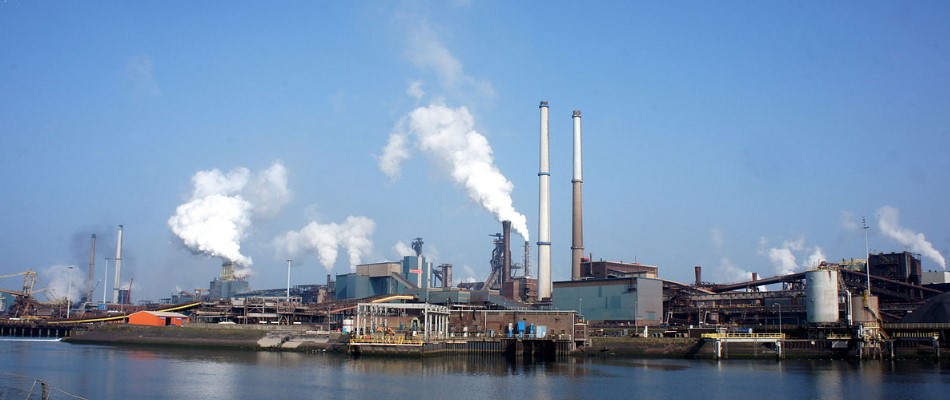
At its formation in 1999 Corus became the largest steel company in Europe, and third in the world. Hoogovens had one of Europe’s most modern steel plants in Ijmuiden, Netherlands, but needed access to the British market (and to government money given to the company on privatisation), while British Steel needed access to modern steel technologies and the European market.
But the merger foundered on over-capacity in the world market, the dominance in the ‘partnership of equals’ of its poorly managed British component, and the confused decision-making of a company with two head quarters and two conflicting corporate cultures. In 2006, Tata Steel of India and the Brazilian company CSN launched competing bids for Corus, and in January 2007, the company was acquired by Tata, who financed the £5bn purchase mainly through debt. During Tata’s ownership, thousands of jobs were cut in the UK; Teeside was mothballed and then sold to a Thai company, and the pension scheme closed.
But Tata Steel was being out-competed by Chinese firms, which they blamed on Chinese ‘dumping’ and state subsidies, but in fact was made possible by the huge levels of investment in the Chinese steel industry as well as infrastructure and vocational training.
The debt taken on to buy Corus began to weigh heavily on the company balance sheets and in 2013 news outlets started to report the proposed sale of the UK steel business. Business intelligence outlet ‘Mint’ reported that capacity in Europe was then 210 million tonnes of steel a year, but that demand was only around 150 million, and that Tata shares had fallen by 33% in a year, reducing the value of the company to just $5.5bn. Naturally, capitalist investors were wondering how Tata could repay the $5bn of debt due by 2016.
In 2016 Tata sold their smaller Scottish steel plants to the Scottish government for £1 just to get out of the business; the Scottish government then sold them on for another pound to Liberty Steels – along with taxpayer-funded indemnities for past liabilities.
The same method was applied to Scunthorpe, which was ‘sold’ to Greybull Capital for just a pound in 2016. The 4,000 workers at Scunthorpe accepted a 3% pay cut to help the deal go through. It is at this point that the Scunthorpe plant entered the murky world of the modern steel industry, where the companies involved make more money by extortion from governments to ‘save jobs’ than from actually making steel.
Quite how murky this can get is shown by as recent court case where Pramod Mittal, former steel tycoon, is being sued by Global Steel Holdings (based in the Isle of Man) for £167mn. The allegation is of “fraudulent and schematic asset stripping”.
Court papers allege that while still a Director of Global Steel, Mittal and his family siphoned away $180mn of a $496mn settlement from the Nigerian government. $81mn is alleged to have gone directly to Pramod Mittal’s wife and children, who had been “inserted into the Mittal corporate structure” to enable the money transfers.
Tellingly, none of them live in India, obviously preferring the conducive environment of London with its schools, law and order and healthcare all provided by British tax payers, to the ‘free enterprise’ hell of modern India. Amazingly, Pramod Mittal has claimed bankruptcy and was paying just 0.18p (0.2%) out of each pound owed, despite his brother Lakshmi Mittal still heading up the steel giant Arcelor-Mittal with a personal fortune of £14bn.
The record of Greybull is very revealing of the parasitic nature of modern capitalism. First of all, Greybull is not a manufacturing company; it is an LLP (Limited Liability Partnership) which is a peculiar corporate structure put in place by New Labour in 1996 as part of their ‘light touch regulation’ of the financial world, which blew up in their (and everyone else’s), faces, in the financial crash of 2008-09.
An LLP with partners based off-shore in jurisdictions like Belize, the Cayman Islands or the Isle of Man, will not need to pay tax in the UK; but as a UK-incorporated body, it will not need to pay tax anywhere else in the world either! A Private Eye investigation found 750 LLPs based in one abandoned kitchen interiors shop in Cardiff, and many LLPs are owned by other companies based in tax havens or tiny Pacific islands.
The record of Greybull in the real economy is hardly impressive: they bought Comet Electrical for £2 in 2011, but it collapsed in 2014 owing taxes of £26mn, and costing tax payers £23mn in redundancy costs; they acquired Monarch Airlines in 2014, but by 2017 it had failed leaving tax payers to repatriate thousands of holiday makers; and in 2015 they bought Morrisons ‘M Local’ corner shops only to place them into administration nine months later. Morrisons were stung for about £20mn in post-sale guarantees and liabilities.
For anyone who cared to look the red flags were there when Greybull bought Scunthorpe for £1 in 2016. And so it came to be. In May 2019 Greybull placed British Steel into administration, paying the last months wages for May, and then passing the responsibility for the pay roll over to the government. During Greybull’s ownership of the plant, they had charged it £6mn in ‘management fees’ and £34mn in interest on loans, which went to a Greybull company based in Jersey. All perfectly legal.
Once in administration the government were desperate to find a buyer, to save the jobs of the workers, but also to maintain some shred of British manufacturing. But desperation does not lead to good deals. Just about every government in Europe is trying to protect ‘their’ steel industry, but not by nationalisation as the fiction of the free market must be maintained.
This leads to the steel giants shopping around for the best subsidies, forcing the capitalist governments to provide them with more and more free money. In the fiasco over Port Talbot Tata Steel began by demanding £1.5bn of the British government to pay for 50% of the cost of conversion to the modern electric arc process for making steel; the government offer started at £300mn. Laughably, Tata Steel suddenly discovered a deep love of “our communities, our people” and a concern for the competitiveness of the UK. Not their profits?
Quite truthfully, Tata pointed to the massive state aid on offer in Italy, Spain, Germany and France. Even Joe Biden’s ‘Inflation Reduction Act’ contained subsidies for US steel companies. But if the subsidies were actually commercial, not political, all these governments would have taken shares in the steel companies in return for the millions and billions of tax payers’ money they are giving to these rapacious steel monopolies. But then Europe would end up with a publicly owned steel industry.
But nationalisation is a closed book to these capitalist stooges: the fiction of free enterprise must be maintained. Under Corbyn, at least Rebecca Long-Bailey argued for nationalisation as the solution to the last crisis of the British steel industry.
In March 2020 British Steel was sold to the Chinese steel firm of Jingye for an undisclosed amount, but industry sources said it was between £50mn and £60mn. They also pointed out that British Steel probably had about £50mn in working capital! The press releases said that Jingye would be investing around £1bn into Scunthorpe and it was the “dawn of a new era of steel making in the UK”
The reality was somewhat different; Jingye only invested £156mn of the promised £1bn, and even that was in the form of a loan from the parent company. Instead, they commenced ‘negotiations’ with Rishi Sunak’s government for state aid – more free money.
When that fell apart, Keir Starmer’s government was faced with three choices: to allow the free market to operate and see the death of steel-making in Scunthorpe; to nationalise the company and run it in the public interest; or finally, to place it under state ‘administration’ but not ownership. This is what happened in a single sitting of parliament on April 12.
The story of the British steel industry is the story of British capitalism: from innovation, growth and market domination in the nineteenth century, to decades of complacency and under-investment behind the tariff walls of the British Empire, followed by being out-competed in the European and world markets, finally eking out an existence as the plaything of financiers ripping off the taxpayer and dependent on state aid.
The answer staring everyone in the face is nationalisation, not the bureaucratic form implemented by Harold Wilson, but democratic public ownership, with the industry democratically managed by representatives from unions as well as government. Having said that, the only time after 1945 that the industry made progress was in the late 1960s and 1970s when it was under public ownership.
But, as the old saying goes, “there are none so blind as those who will not see” – and that is true of Keir Starmer, Rachel Reeves and the rest of the crew who have seized control of the tops of the Labour Party.
On the basis of private ownership, the steel industry has a very limited future in Britain. Already we have the dubious honour of seeing the biggest fall in steel production in the whole world, apart from Venezuela. The losers have been the workers and the steel communities, and the winners have been the steel companies and their owners who have made billions of pounds, even as they were running the industry into the ground.
The success of the Chinese steel industry shows what can be done with state ownership, even in the distorted form we see in China. The Labour Party needs to radically change its approach and leadership and get back to its socialist roots. There is no other way forward. The steel industry should be nationalised without compensation to those sharks who have bled it dry for so long; it should be managed democratically to the benefit of workers, the communities and industry as a whole.
Clause IV of the Labour Party constitution, removed by Tony Blair, read as follows:
“To secure to the workers by hand and brain the full fruits of their labour through the common ownership of the means of production, distribution and exchange, and the best obtainable system of popular administration and control of each industry or service” That is what should be applied to steel.
[Feature picture from Wikimedia Commons, here]