
The elections taking place tomorrow, May 1, will mark the lowest point so far of the worst leadership the Labour Party has had in its history. Even though the elections have limited scope, it will become clear by Friday that Keir Starmer is throwing away public support and Labour seats like there is no tomorrow. And indeed, some would say that it is questionable whether the Party has a future under his leadership.
Many of the local elections that would have taken place this year were postponed by Angela Rayner, on the grounds that forthcoming local government reorganisation would have made the results irrelevant. Nonetheless, there are still over 1600 seats being contested, as well as six mayoralties. There is also the important parliamentary by-election for the Runcorn and Helsby seat, won by Labour last year. Even though the local polling is skewed towards Tory shires, it will still represent the biggest ‘live’ opinion poll since the general election.
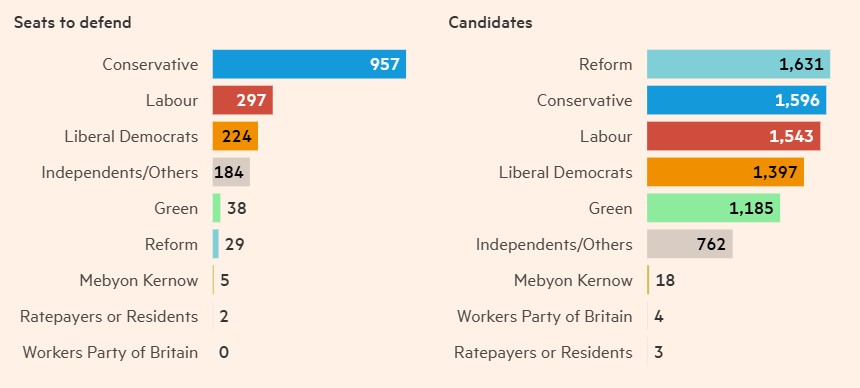
The big majority of the seats being defended are Tory seats – with 957 being contested, as opposed to only 297 Labour and 224 Lib-Dems. Only 29 held by Reform are in the mix. Yet Reform are fielding more candidates than any other party and they are the bookies’ favourite to win in Runcorn, at least two of the mayoralties, and possibly hundreds of council seats.
Starmer is the worst leader Labour has ever had, because at least previous leaders, even though committed to capitalism, put forward a modicum of a reform agenda, if for no other reason than to keep affiliated unions on side.
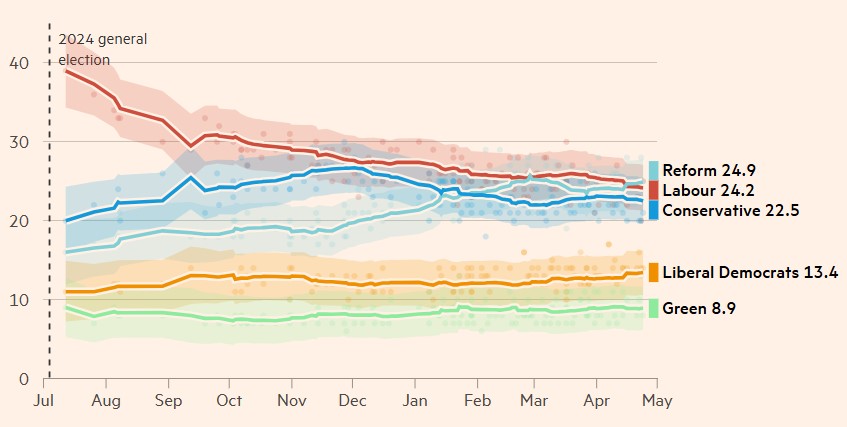
Starmer’s personal ratings are the worst of the four main party leaders
But Starmer has somehow developed a unique ability to combine political ineptitude with a total absence of charisma and is utterly disconnected from the ordinary voters who put him in office. Starmer’s personal standing in the polls is below all three other party leaders: Badenoch, Farage and Davey.
But it is, above all, in policy terms that he is alienating millions of working class people. Like Labour’s right wing as a whole, Starmer and Chancellor, Rachel Reeves, cannot see beyond the most orthodox mainstream capitalist ideas. Socialist and even ‘radical’ ideas are a closed book to them.
Since being elected, Starmer and Reeves have gone out of their way to alienate one group of voters after another: students, parents with more than two children, elderly people, the disabled. Their polices offer nothing positive for working people. They may pretend otherwise, but they are carrying on the austerity of the previous government, with real attacks on living standards, particularly for those already least well off.
The promised improvements in workers’ employment rights – the only real sop offered to right-wing trade union bosses – have yet to be implemented and there is a widespread fear that they may be watered down or weakened, under pressure from business, to a point where they have little real value.
The shocking complicity of this government in Israel’s genocide in Gaza has led to a haemorrhaging of support among many sections of the population, but particularly in larger urban areas with a younger demographic and a higher percentage of Muslim voters, previously a mainstay of Labour’s electoral support.
Disgraceful capitulation on trans rights
This leadership has even abandoned New Labour’s limited commitment to progressive socially liberal policies, as can be seen by their disgraceful capitulation on the issue of trans people’s rights. They have proposed savage cuts to the international aid budget. They have also tried the suicidal tactic of trying to woo Reform voters by adopting chunks of their anti-migrant messaging.
The main message of the ‘Labour’ candidate in Runcorn, for example, was to close a hotel housing asylum-seekers. Keir Starmer has become the first prime minister to host a St George’s Day event in Downing Street – and that is no coincidence. Pushed by right-wing policy wonks like Morgan McSweeney, he is tilting the party towards Reform. “We cannot be under any illusions”, he told the Financial Times, “that there is a never-ending fight for our flag and what it represents.” He might as well have said, “We are more like Reform than Reform!”
There is a growing fear, not only within the Corbyn left or the Marxists in the party, but also among mainstream centre-left members – many of whom look like losing council and parliamentary seats – that Starmer is walking the party into electoral disaster. Worse still, he is paving the way for a right-wing government in the future, composed of Reform and the worst right-wing elements of the Tory Party.
The austerity of fifteen years of Tory government saw living standards savaged, on a scale not seen for generations. Public services on which working families depend – notably the NHS – were brought to their knees. The hopes and aspirations of an entire generation were crushed.
But by failing to offer a clear alternative to these Tory years – indeed, continuing the austerity and compounding the sense that the housing shortage, poor services, a threadbare NHS, low pay and poverty are all going to get worse – Starmer is offering a gift to the far right.
Farage keeps his policies on privatising the NHS under wraps
Reform UK is a party led by political frauds, a party which breeds on disillusion and cynicism, but which pretends to offer “change” or “hope”, but at the expense of the most divisive and oppressive right wing agenda. Nigel Farage obsesses about ‘small boats’ and migrants – ably supported by most of the gutter press – but keeps hidden up his sleeve his policy of privatisation of the whole NHS.
The dreadful policies of what is masquerading as a ‘Labour’ government will have put many traditional Labour voters in a quandary. Despite Keir Starmer, and by no means because of him, Labour will still get the support of a large section of working class voters.
It still has 300,000 members, most of them inactive and utterly disgruntled, yet no other left party comes anywhere near it in size or reach in working class communities. Crucially, it still has the organic link with the affiliated trade unions, albeit currently only at regional or national level, with local branch affiliations rarely taken up.
Many workers will still vote Labour from traditional loyalty, hoping forlornly that the government might deliver on real changes that would will benefit them in the coming years. Some – and we’d guess, an increasing number – will draw a distinction between the Party and it current leadership, hoping that Starmer can be removed and the party set on a different direction.
In most areas of the country, in seats and councils where the only real choice under the present electoral system is between Labour and the threat of Reform UK or a Tory party veering wildly to the right, many will vote Labour for fear of a worse alternatives.
In most areas, party members will probably reduce their electoral activity to a minimum, maybe leafleting rather than door-knocking, as the campaigns (including the parliamentary by-election) are increasingly carried out by full-time Labour officials, councillors and their friends and family. A few “wannabe careerists”, hang around them. Most members will do nothing at all to help Starmer.
There is no alternative mass party on the left
Left Horizons’ general position is that we call for a Labour vote. There is simply no alternative mass party that can meaningfully challenge Labour on a national basis. No such viable party, with links to the trade unions seems likely to emerge, at least in the foreseeable future.
However, in many parts of the country, especially, but not only, in larger metropolitan areas, Labour has faced local crises and splits, with councillors either being expelled, or deselected by underhand undemocratic methods by council leaderships and/or regional Labour officials. Others have been bullied out of the party or have left in disgust at Starmer’s policies. In some places councillors or groups of councillors have left, taking with them a number of active members.
In such situations, especially where the threat of splitting the vote and allowing the parties of the right to win is much reduced, many good local socialists and working class activists will see these candidates as more legitimate than the official Labour candidates, and they may achieve a degree of electoral success, benefiting from anger of workers at the performance of the Labour government, and of complacent Labour local councils.
In that regard, they are different from the normal array of sectarian micro-parties that routinely stand and humiliate themselves. George Galloway’s mis-named “Workers’ Party” shifts ever further toward the populist right and deserves no support whatsoever from socialists.
Many disillusioned Labour voters will go elsewhere
Other disillusioned voters may desert to vote for, or even join, the Green Party, which in big cities campaigns on a more radical programme, both economically and socially, than it does in the shire counties. Especially in areas with a large Muslim population, independents rooted in the local community, incensed by Labour’s failure to support the people of Gaza, and the racism and Islamophobia that implies, will garner widespread support, just as they did, to an unprecedented and surprising degree in the general election.
The overall impact of Thursday’s elections will be clear: Keir Starmer is handing Reform victory on a plate. It will be up to the membership in the affiliated unions to assert their authority within the party. Bleating complaints from disappointed right-wing union leaders are not enough. Clinging doggedly to the coat-tails of Reform – as so-called “blue-Labour” proponents argue – would be a disaster.
These elections will also be a pointer to the shape of things to come. Calls for a pact between Reform and the Tories are likely to get louder and more common. A major factor in Boris Johnson’s victory in the 2019 was the fact that the forerunner of Reform, Farage’s Brexit Party, effectively had a pact with the Tories, standing aside in all of the 317 seats that the Tories were defending. A Tory/Reform government, therefore, is a possibility and it would be a direct legacy of ‘Starmerism’.
The election results should be a signal for trade union lefts to stir their organisations into a prolonged, concerted and thorough campaign to win back the Labour Party from the right-wing infiltrators and carpet-baggers who are destroying it. Opinion polls have consistently shown that radical and socialist ideas have never been more popular, but they have to be fought for in the Party.
These elections will be a milestone. But it will be the trade union members and their leaders who will decide whether it points towards the further destruction of the Labour Party or hope for its renewal.
[Feature photograph from Wikimedia Commons, here]