By: Umar Shahid
[Editorial note: this article was written before the ceasefire agreed between India and Pakistan, a ceasefire that has been fragile at times, but nonetheless largely observed by both sides]
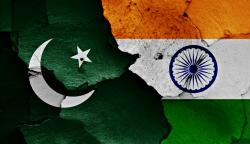
The increased tension between the Indian and Pakistani capitalist ruling classes is yet another black page in the decades-long, brutal cycle of militarism and reactionary nationalism in the sub-continent. It is a cycle which expresses only the interests of the competing capitalist elites on both sides of the border.
As these lines are being written, Pakistan and India are employing their advanced war machinery in full measure to spread savagery on both sides of the Redcliff line, which demarcates the two parts of Kashmir held by India and Pakistan in the 1948 war. The propaganda “missiles” fired at the masses one by one are not weapons of emancipation but instruments of oppression held by Indian and Pakistani capitalist states, to divert attention from their own organic and internal socio-economic crises.
In fact, the military are fine tools of class oppression, intended to prop up the decaying capitalist order that benefits only a tiny elite and pauperises hundreds of millions. The Indian ruling class is promoting Hindu majoritarianism with the Modi regime, while the Pakistani military-bureaucratic elite employs Islamist populism to stay in power.
Because time has proven that India and Pakistan act as stooges of bigger imperialist powers, their fight is not on behalf of their own citizens, but also for the political interests and revenues of global arm dealers.
Disastrous failure of the ruling class
It is evident looking at the living conditions of people in South Asia that capitalism in the region is taking humankind to the edge of barbarism. In spite of glittering GDP figures flaunted by governments and corporate media, human development indicators tell the true tale of a system in terminal crisis.
Over one-third of the world’s total poor live in South Asia—around 389 million, according to the 2023 Multidimensional Poverty Index Report. The Current Human Development Report 2025 shows damning statistics of disastrous failure and a complete lack of competence in the leadership of region.
It is a verdict on the neoliberal policies that enriched oligarchs at the expense of the immiseration of hundreds of millions. South Asia remains the second-lowest ranked world region for Human Development Index, India at 132 and Pakistan at 161 out of 191 nations.
The living situation is more unbearable than ever before, such that currently over 400 million people are living in abject poverty in the region. Since 2020, 230 million people joined the poverty ranks in India, and after brutal IMF-enforced austerity in Pakistan, the poverty rate there is increasing to 40%.
Mass deprivation is accompanied by wealth concentration, as India’s richest 1% now have 58% of national wealth, while in Pakistan, the 20 wealthiest families now own 90% of industry assets. Even during the period when workers went through record levels of inflation and stagnated incomes, stock prices still rose and the income and wealth of the richest 1% increased exponentially.
The price of essential foodstuffs has risen, adding to the struggle for existence of working-class families. At the same time, governments continue a relentless drive towards privatising all the remaining fragments of the public sector. The so-called economic ‘wonder’ of the Modi administration has become a ruthless lie for the working classes.
Unemployment, especially amongst youth, has become catastrophic. Recent demographic statistics indicate that roughly 65-70% of South Asia’s population is 35 years or younger, which makes it one of the world’s youngest regions. According to the governments’ own data, India’s youth unemployment rate is 28% and that of Pakistan is 35%.
Those who find work face brutal casualisation, as 90% of jobs in both countries offer no job contract or benefits and many young workers are trapped in modern-day slavery in the gig economy. The statistics show there are millions of angry, educated young people, but with no future under capitalism. South Asian youth are in the position of a “reserve army of labour” but as material conditions worsen, they can also become the vanguard of revolutionary change.
The ruling classes are trembling at this population time bomb, which can explode at any moment. The capitalist-induced global warming is unleashing one more genocide on poor people, as heatwaves and crumbling infrastructure cause thousands of workers to be killed annually, and forcing many to migrate to other areas.
The education systems are disintegrating, as out-of-school children are on the rise and neoliberal austerity measures in social services are forcing woman to go back to domestic servitude and gender violence is skyrocketing in both countries.
Role of Imperialism
According to recent updates, it appears that a war will become a killing full-scale war because both countries are nuclear nations, and any further escalation can lead to a nuclear crisis in the region. The Modi-led Hindutva regime in India is pushing South Asia towards a suicidal war.
In this game of blood spilling the USA and China are also involved. Both are utilising the regional conflicts to enhance their geopolitical and economic interests. Far from being spectators, these powers are instigating aggression to secure their dominance as South Asia is being turned into a zone for their stratagems, while working people pay through blood and pauperism.
Donald Trump is militantly pro-Indian, just as he is pro-Israel when it comes to Gaza. In the middle of tariff wars, Trump is pressurising China, via India and alliances like Quad (US, India, Japan, Australia) and military pacts like COMCASA.
Pakistan was a very close ally of the USA after its formation, and it played in favour of the US against the Soviet Union, then influential in India. Now the tables have turned after the US withdrawal from Afghanistan.
Although the G7 issued a statement which said “further military escalation poses a serious threat to regional stability“, in the background the opposite is happening. China is arming Pakistan to counter India, by shipping JF-17 combat aircraft, warships, and missile technology, putting the region on a dangerous arms race.
The share prices of weapons manufacturers in China are skyrocketing according to news reports, and they are actually basking in glory about the success of their fighter, against Indian weaponry. This is total madness and nothing else. But the people of South Asia are being pulled into the cross-hairs of two crises: economic devastation and war.

War hysteria
The Indian and Pakistani elite are not concerned with educating or employing their youth, or raising the living standards of the masses. But they are determined to lay them down on fields of war for the sake of business, even if the society of region is devastated.
India spends an estimated $72 billion on weapons, while 35% of its children are malnourished. Pakistan spent roughly $12 billion a year on the armed forces while 40% of its citizens live in food insecurity. But ruling classes of both countries follow the art of Clausewitz, pursuing the continuation of their politics ‘by other means’. These regimes are waging war abroad to reinforce exploitation at home, and every missile, every border confrontation, every hyper-nationalist TV debate serves to sustain their home-based class war against South Asia’s workers and peasants.
They have even devoured intellectuals and leftists as well. The majority of leftists on each side are belting out nationalist songs and asking workers to mobilise in support of ‘their’ governments against their ‘belligerent enemy’. Everyone now seems to be patriot, supporting ‘their armies’.
As we have seen in last Lok Sabha [lower House of Parliament] elections, India’s ruling party, the BJP, did not have an absolute majority but still managed to come into power. It has already it lost in major states like Uttar Pradesh, Maharashtra, Rajasthan, Haryana and West Bengal. The Bihar elections are now at our doorstep, and this is a major Indian state with a massive population but a high poverty rate of 33.7%.
Workers strikes and struggles
Modi is opting for aggressive privatisation and corporatisation in India and it has been confronted by stiff resistance from the working class. In Punjab, farmers won against contentious farm laws after a four-year long struggle. Since 2023, railway workers have been agitating again and again against proposed railway privatisation. At Maruti Suzuki (Manesar) and Toyota Kirloskar on struggles on unionisation, wages are continuing. Indian trade unions are going give a call for country-wide general strike on May 20. Unfortunately, ethnic and sectarian violence are raging in most states of India.
The scenario in Pakistan is not different. Last year, a great mass movement in Pakistani-administrated Kashmir managed to win concessions from the state. Further, in Sindh a mass movement forced the federal government to back off from digging new canals on Indus River. Health and education sector workers in Punjab staged a protest against wage cuts and privatisation. But with war hysteria, the ruling class is trying to divert attention from these real issues into nationalism.
What is the way forward?
But a war is not the responsibility or in the interest of workers of either country. We know that the enemies of workers are not each other but their own exploiters: they are our own landlords, capitalists and generals – those who spread hatred and war as they suck our blood.
The Kashmiri labourer’s blood in Muzaffarabad is the same as that of Srinagar’s farmer, just like the Punjabi labourer’s blood in Lahore is the same as that of a Dalit labourer in Bihar. The pain of a Kashmiri farmer under Indian occupation is one and the same as that of the Baloch under Pakistani oppression.
The calls for war are a front for the failure of both groups of capitalists, and war-fever conceals what would be the ensuing economic devastation – inflation, economic dislocation and famine.
There is only one path ahead for the working class, and this is revolutionary class unity: soldiers’ solidarity across borders, workers’ walkouts against the war industries, and the oppressed South Asian masses uniting as one in protest against their common exploiters.
After all the triumphalism and hysteria there is a choice: either socialist revolution or the complete ruination of our subcontinent. The embers of this next war must bring forth a new, undivided South Asia, free of the twin curses of nationalism, communalism and imperialism.
Marxists should stand together with the working class and the oppressed of India and Pakistan against all exploitation and tyranny. We should also call upon the revolutionary and progressive forces of both countries to unite under the banner of class struggle to launch a joint move towards socialist liberation.
We should advance our demands and program against this reactionary war;
- Immediate stoppage of war frenzy on both sides and mobilise to raise people’s living standard.
- Affirm the right of the people of Kashmir to self-determination to free them from Indian as well as Pakistani state repression.
- Mobilise for a joint workers-peasants-students struggles against militarism and capitalism.
- Reject the ruling classes’ media that tries to divide us.
- Revolutionary working people’s solidarity alone can break the chains
For a Socialist Federation of South Asia
Long live international socialism!
Down with imperialist war and capitalism!