As we mark the eightieth anniversary of the first dropping of an atomic bomb, Gray Allan reviews the first episode of a new Netflix series, Turning Point, the Bomb and the Cold War, looking at the origins of that first bomb and the arms race that followed.
On August 6, 1945, eyewitnesses later reported, a lone aircraft was seen flying high over the city of Hiroshima, at around eight in the morning. A small object was seen to separate from the aircraft and for some seconds flew alongside the plane before curving downwards. At 08.16 a blinding flash was reported “so bright that it washed all colour out of the scene”.
The flash was accompanied by a searing pulse of heat, which vapourised anyone caught outside at or near ground zero, and causing appalling burns to those exposed farther away. Then came a deafening explosion and a wind “like a tornado”.
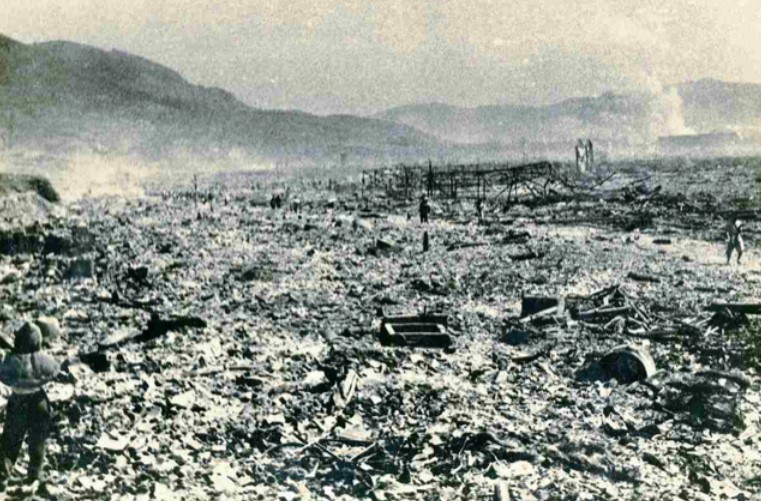
Thousands of small fires started by the heat pulse quickly merged and kindled into a firestorm. Between 70,000 and 80,000 people were killed instantly. By the end of 1945, total casualties from injury and radiation exposure had risen to between 90,000 and 166,000.
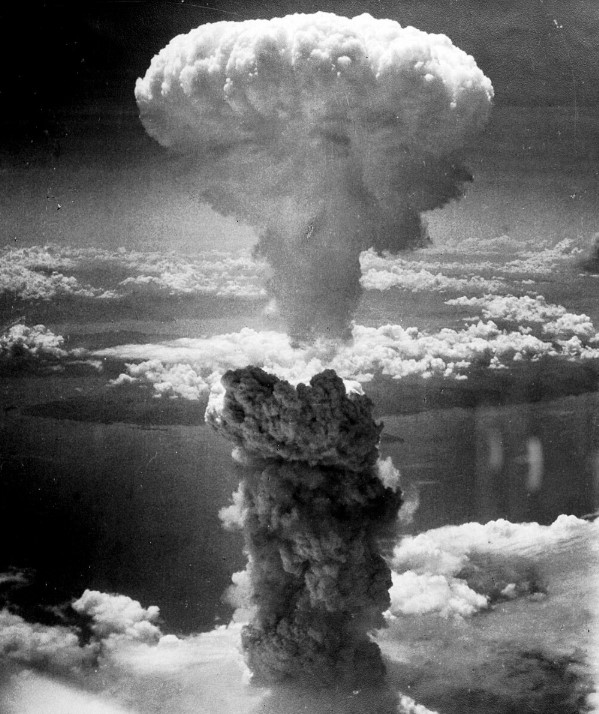
Three days later the city of Nagasaki suffered the same fate. Casualties at Nagasaki were lower, with a total of 70,000 by the end of 1945. There was no firestorm in Nagasaki as there were fewer wooden buildings in the target area. The area targeted included industrial sites, like Mitsubishi factories. It lay in the Urakami Valley and surrounding hillsides contained the blast.
First ever use of a nuclear weapon
Nuclear weapons had been used in conflict for the first time in human history. On the September 2, 1945 the of Japan surrendered unconditionally.
The creation and use of the atomic bomb is a key moment in human history and it was inextricably linked to the rise of fascism in Germany and the outbreak of the Second World War. The use of the bombs was and remains mired in controversy.
Episode one on the Netflix documentary series Turning Point deals with the discovery of nuclear fission and the drive to weaponise the technology.
Two German chemists, Fritz Strassmann and Otto Hahn, along with a physicist Lise Meitner, were working in 1938 Berlin on the bombardment of uranium nitrate with neutrons. They discovered that when a neutron penetrated an atom of uranium it splits, emitting further sub atomic particles and a large amount of energy. So much energy that the splitting of one atom would cause a grain of sand to visibly jump.
Their discovery was published in the English language science journal Nature on February 11, 1939. This was surprising in itself because by this time the Nazis were in power in Germany. Within a week of reading the paper, J Robert Oppenheimer, later director of the Los Alamos Laboratory, calculated the possibility of a chain reaction and had drawn a rough schematic of an atomic bomb on his blackboard. All physicists immediately saw the possibilities springing from the work of Strassmann, Hahn and Meitner in Germany.
Albert Einstein already in USA
The British Government quickly started research into nuclear fission, including a secret weapons project called Tube Alloys. The outcomes were brought together in the Maud Report, which specified that a only small amount of uranium-235 would be needed to create a very powerful bomb.
Had the discovery been made in a time of peace, events may have taken a different turn. But by September 1939, the Nazi war of aggression had begun and the prospect of Hitler armed with nuclear weapons was seen as a very real threat. Albert Einstein, who had emigrated to the USA because of the growing Nazi persecution of Jews, wrote to Roosevelt, saying that he believed that in a very short space of time weapons of incredible destructiveness could be produced.
Indeed, the Hitler regime was working on the design and building of a nuclear weapon. While they had made big advances, it is uncertain how close they got to building a functioning device. There was also the view that in wartime conditions in Germany the time and resourced required to develop a bomb could not be justified.
Otto Hahn, one of the discoverers of nuclear fission, was held by the British in England following Germany’s defeat. When he was told of the attack on Hiroshima he was astounded. He had been convinced that the development of a practical atomic bomb was at least twenty years away.
After the war, German physicists maintained that they had deliberately “sand-bagged” their work on the atom bomb, and slowed it down to prevent Germany getting a weapon. This is unlikely, given the circumstances in Nazi Germany. A more plausible account is that physicists down-played the importance of the project with Hitler in the fear that the Führer would get over-enthusiastic and commit enormous amounts of manpower and cash to the project. A project in which the physicists were not confident of success. As one said later, “failure would have had very bad consequences for us”.
Intelligence from within the Third Reich
So, with hindsight, the threat of a Nazi bomb may have been overblown. But with lack of intelligence coming from within the Third Reich and with the urgings of prominent refugees from Germany, the die was cast.
Following the entry of the USA into the war, the Manhattan Project was set up, which took over the work of the British Tube Alloys project. Work proceeded at pace to develop a weapon, now well known to all though films such as Oppenheimer. Work on developing a bomb was moved to Los Alamos in New Mexico.
Franklin D Roosevelt was fully briefed on the project. In the documentary, he is portrayed as having issues with the building of an atomic bomb. Some doubt whether he would have approved the bombings of Hiroshima and Nagasaki. However, during the Ardennes Offensive, where American casualties were very high, Roosevelt asked if atomic bombs were ready to be used on German cities. They were not. At that time the Trinity test was months away.
The work on the atomic bomb was of the highest secrecy. The population of New Mexico were told absolutely nothing about the project or the impending test. The test site at Alamogordo was supposedly chosen for its remoteness. 500,00 people lived within 115 miles of the test site. There was some concern about radioactive fallout reaching populated areas but they proceeded with the test anyway
Forty miles from the Trinity test site, a group of ten young teenage girls were attending a summer dance camp. The documentary describes in graphic detail the events; the girls were thrown from their bunks by a powerful explosion. They all ran outside to see what has happened. One of the girls later described the sky as being so bright that it was painful to look at it. “The sun came up tremendous” she said.
Some hours later, a white ash began to fall from the sky. Thinking that it was snow they put on their swimsuits and went to a nearby pool to play in it. The ash was hot but the girls thought that was because it was summer. Only one of them survived to thirty.
Government covered up atomic test
Farther out, household pets started to die. Farm animals developed white patches on their hides. The US Government cover story was that an ammunition dump had exploded. No steps were taken to evacuate the local New Mexicans. This disregard for the civilian population was multiplied a hundred times when it came to using the bomb on Japan.
When war with Japan broke out the US Government had problems motivating the American people to fight with the necessary determination to defeat Japan. The internal propaganda used was blatantly racist, depicting the Japanese as sub-human. Along with the atrocities committed by the Japanese military, there was very little sympathy of or indeed empathy with the Japanese civilian population.
The experience of the Pacific War and above all the experience of the invasion of Okinawa, the only Japanese home island to be invaded by the Allies, convinced the military that they needed to find a way to strike such a heavy blow the Japan would agree to unconditional surrender. Two atomic bombs were made ready for use. Thin Boy, a Uranium-235 weapon, and Fat Boy, a plutonium device.
Five cities were initially chosen as potential targets; Kokura, Hiroshima, Yokohama, Niigata and Kyoto. All contained strategic targets but also had large civilian populations. These cities had not been damaged by the heavy bombing raids of he previous weeks. This was seen as an advantage as, chillingly, it would help better assess the effects of an atomic bomb. Kyoto was later removed from the list by Secretary of War, Henry Stimson, due to its historical religious and cultural significance. Nagasaki was listed instead.
A third bomb had been prepared and was ready for use but Harry Truman, shocked by the reports from Hiroshima and Nagasaki, ordered that there be no use of nuclear weapons without the express permission of the President, an order that stands to this day.
Some considered a ‘demonstration’
A demonstration instead of a live attack was considered and rejected due to fears of a successful interception by the still capable Japanese air force, or that allies prisoners would be placed at the demonstration site. The main reason was that the bomb may have been a dud and a failed demonstration would have the opposite effect to the one intended. There was some basis to this as the bomb dropped on Hiroshima did not fully explode. It was still devastating but only 1.38% of the uranium-235 underwent chain reaction. The rest was simply vapourised. Had all the uranium fissioned the explosion would have been much larger. The delivery aircraft, Enola Gay, would certainly have been destroyed.
The question remains whether there was indeed any need to use the two atomic bombs at all? The desire to end the war quickly and limit casualties was widely held. But Japan was in a very weak position by August 1945. The Allies had total control of the air and sea. Conventional bombing was devastating cities without resistance. The Japanese economy was in ruins and the population was suffering from lack of food. Factions within the Japanese Government were arguing for surrender as long as Emperor Hirohito could keep his throne.
The Soviet Union had declared war on Japan and was advancing quickly into Manchuria,which had been under Japanese occupation. Small Japanese islands were already being occupied by the Red Army. The prospect of at least the northern party of Japan being occupation by the USSR would have been anathema to the conservatives and monarchists – but also to the USA, which was fundementally opposed to the state-owned, planned economy of its ‘ally’. The USA and its allies did not want the Red Army occupying half of Japan in the same way that it occupied half of Europe.
It is hard to avoid the alternative, opinion that the military-industrial complex set up at enormous expense to build the bomb was determined to use it, come what may, and that the atomic bombings were a war crime: a deliberate experiment in a real situation to measure and assess the effects of nuclear weapons. And with the added advantage that is presented a warning to the Soviet Union, which by that time had already been identified as the future enemy of the United States.
[Turning Point is available on Netflix. Both pictures here are stills from the Wikimedia Commons: here]
Mushroom cloud over Nagasaki