By Mike Kennard
When I was a child in Kent we lived next door to Reg Kerrison. Reg, with his thick Norfolk accent, was a Co-op milkman, an ordinary working bloke. My bedroom was the other side of the party wall between us and Reg and his wife Paddy. Every now and again I would hear Reg screaming in the night, Paddy shouting at him to “wake up, you silly sod”.
Reg had been a prisoner-of-war of the Japanese, and had been a slave labourer on the Burma railway, and suffered many horrible experiences. Even twenty years later later they were burned into his soul. It may be tempting to take a position of moral superiority about the cruelty of ‘those oriental swine’, but contemporary with this episode, the British empire was responsible for the death by starvation of between 800,000 and 3,500,00 poor people in Bengal in 1943-4, through the diversion of food and finance to the war effort.
Today, Israel, a US client state, is engaged in a campaign of genocide matching the savagery of the Japanese empire. How many Palestinian milkmen will spend the rest of their lives waking up screaming from their nightmares?
The two world wars were imperialist wars. World War One is generally acknowledged to be a naked clash of empires, but World War Two has the veneer of justification because of the fight against Nazism. However, it was inevitable, just as the cause of the first war was the constraint of the dynamic, newer German economy by the control of the older established empires of Britain and France over markets and resources.
Germany humiliated as a nation at Versailles
The increasingly strong USA looked on and intervened late, to get the “right result”, in terms of the Versailles Treaty, which imposed harsh conditions on the growth of German industry but also humiliated the German nation, helping to facilitate the growth of fascism. The Second World War in the European theatre was really ‘round two’ of the First.
On the other side of the world, just as Germany came late to industrialisation but benefited from the ability to start with newer technology, so Japanese society was developing from its primitive feudal base to a controlled introduction of new industries. Just as Germany had been constrained in its need for resources and markets by Britain and France, so Japan was held back by the spread of the British and American empires, and to a lesser extent by the weakened Dutch empire.
At the time, China was a fractured and failing state and Japan was able to easily invade the huge province of Manchuria in 1931. It had been under Japanese influence since their defeat of Tsarist Russia in 1905, but this now became full military control and it provided a huge source of coal to power a rapidly developing Japanese industry, something that was in short supply in the Japanese islands.
Lenin described imperialism as “the highest stage of capitalism”. Dynamic capitalist states outgrow their domestic markets and need to extract resources and sell products beyond their domestic boundaries, leading to the development of powerful war machines to invade and conquer new territory, resources, markets and populations.
French and British empires in decline
Britain’s rapid industrialisation from the late eighteenth century gave it a head start and its empire spread across the world, limiting the potential of the newer industrialised states, with the exception of the United States which had access to its own continental resources.
The First World War was something of a reckoning. The Russian revolution took the Tsarist empire out of the game, but in spite of their global reach, the French and British empires had entered a period of decline. The Second War saw the beginning of the death throes of the British Empire and the arrival of US imperialist hegemony.
However, as with British capitalism, a mature US capitalist class sought to exploit its dominance by moving into new markets. Particularly in Asia, with South Korea a principal target for transfer of technology to counter any economic threat from the “communist” North.
In the meantime, after several false starts, the planned economy of China began to develop very rapidly with its own industrial revolution. US capitalism seized on the opportunity of cheap labour and transferred production of manufactured goods, to the benefit of their profits and the detriment of the American workers.
The inevitable march of history cannot be denied, even by the most powerful empire the world has ever seen. The USA has military bases throughout the world, and has been involved in wars and coups in every continent except Antarctica (as yet), but it is today in a state of decay.
US capitalism is a ‘wounded beast’
The rising power is China, with a huge economy, where capitalism is ‘managed’, and which has been flexing its economic muscles for more than a decade. The election of Trump is a symptom of the sickness of US capitalism and represents a danger to the world. US capitalism is a ‘wounded beast’ and will be willing to use its military power to maintain its dominance, so the danger of a major war is ever present.
There is an alternative. Human society originally developed by co-operation, and we are by nature a gregarious species. The world has major untapped resources but is threatened by unbridled waste and pollution, unnecessarily given that the technology exists to make overcome environmental degradation.
What stands in the way of human development is an economic system which places private profit above social benefit. Capitalism was an essential stage in the human development of productive resources, but those resources have grown to a destructive level. Destructive, because productive resources are in the hands of competing capitalist classes, leading to conflict. Destructive also because the owners of productive technologies resist their replacement by less damaging technology. Thus, ‘Big Oil’ actively resists the introduction of renewable energy.
It is no accident that the planned economy of the Soviet Union, even under the horrors and distortions of Stalinism, managed to beat the USA into space, or that the state-controlled industry of China has outpaced western capitalism.
Strip away the drive for profit, turn productive resources to social benefit under public ownership and truly democratic control, and we could see the end of waste, hunger and conflict. The alternative is an endless cycle of war and the end of human society under floods and fire.
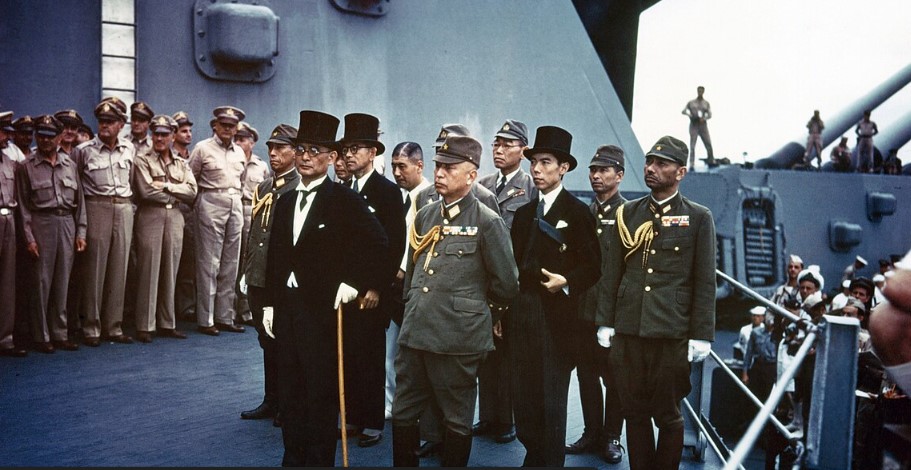
[Feature photograph shows the diplomatic and military representatives on board the USS Missouri, prior to signing the documents of surrender, September 2, 1945. From Wikimedia Commons, here]