
By Andy Ford, Unite rep
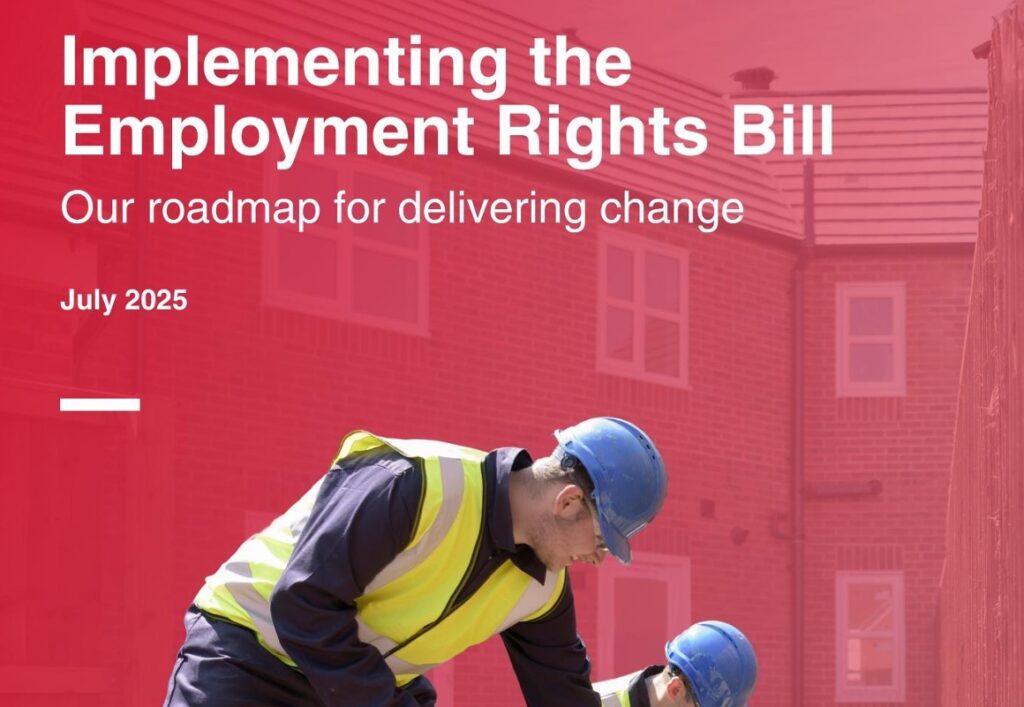
Angela Rayner’s final betrayal of her trade union roots, just before she herself was betrayed by the Starmer clique over her housing and tax arrangements, was to publish a ‘roadmap’ for implementation of the Employment Rights Act – the Labour leadership’s bedrock pledge to the trade unions. (See link below inset)
Even to those who expected no better than delay and dilution from the clique around Keir Starmer, it still makes shocking reading, considering the promise was for implementation “within a hundred days”.
In the introduction, Rayner and her deputy, Jonathan Reynolds, extol the benefits working class people will see – “Measures such as a ban on exploitative zero hours contracts, the end of unscrupulous fire and rehire practices, parental leave and protections from unfair dismissal from day one will be truly transformative for many.”
But WHEN will the “many” actually see this transformation?
The reforms which will immediately follow the Royal Assent to the Bill are truly minimal: repeal of the Minimum Service Levels Act of 2023, and “most of” the Trade Union Act of 2016.
Minimum Service Levels Act barely used
Rishi Sunak’s Minimum Service Levels Act has barely been used, as its provisions to compel trade union members to break strikes are almost unworkable. On the only occasion that an employer tried to use the Act, the ASLEF union cleverly beat them back.
The Trade Union Act 2016 was the one that introduced the requirement for a 50% turnout for a strike ballot, and forced unions to give the details of a named ‘picket supervisor’ for each picket; both measures that left Britain far behind the rights enjoyed by workers across Europe. So, the immediate “transformation” will still leave British unions languishing far below the rights enjoyed in Europe.
But after that initial first step, the roadmap only commits Labour to consult, not implement on giving workers employment rights from Day One; reinstating the School Support Staff Negotiating Body (SSSNB), and on a Fair Pay Agreement for the Adult Social Care sector. This consultation was to begin in Summer or Autumn 2025. And it hasn’t started yet.
In Autumn 2025 (and people who want to wriggle out of definite dates always use seasons instead of months) Rayner promised to consult (not implement)on:
- electronic ballots and workplace ballots for industrial action
- a duty on employers to tell workers they can join a union
- a new ACAS Code of Practice on the rights of union reps
- Fire and rehire
- Umbrella companies
- Bereavement leave
- Ending “exploitative” zero hours contracts
Finally, in “Winter 2025, early 2026” they are planning to consult on blacklisting, tipping regulations, redundancy law and flexible working.
More or less the whole of the promised Employment Rights Bill is to go out for consultation, all over again, into 2026! This did not stop Keir Starmer waxing lyrical at the Labour Party conference about the huge improvements the Act has delivered.
Then, after all that ‘consultation’, Angelas Rayner’s roadmap then builds in more delay:
“Following consultation, Government will develop final policy positions to deliver our measures. In some instances, this will be regulations, in others it will be guidance or Codes of Practice by the Government or others such as ACAS. Some measures may require more than one round of consultation, especially if there is a need to update or develop a Code of Practice.” (Emphasis added)
Apart from the minimal reforms that take effect after Royal Assent, whenever that may be, it is only in April 2026, almost TWO YEARS on from Labour’s election with a huge majority, that anything substantive is promised:
- Collective redundancy protective award – doubling the maximum period of the protective award (which is rarely awarded)
- ‘Day One’ Paternity Leave and Unpaid Parental Leave (which is good but affects relatively few workers)
- Finally establishing the Fair Work Agency to enforce the new, and the pre-existing, legal framework
- Abolishing the waiting period for sick pay (which will benefit millions of low paid workers)
- Making trade union recognition easier (which is really important when dealing with hostile employers)
- Electronic balloting for strikes (which has long been a demand from the unions, as the current law mandates an antiquated paper and post system which impedes union action, and is applied in almost no other forum)
The next set of reforms are set for October 2026, and include one huge measure, to ban fire and rehire, and a lot of niche provisions such as fairer time limits in Employment Tribunals, better regulations around tips in hospitality, and a two-tier procurement code. October 2026 is also the proposed date for establishing the promised ‘Adult Social Care Negotiating Body’ to set pay rates in the Care sector.
Fair pay in the Care industry is a key part of fixing Social Care, which in turn would help fix the NHS. But both services are in crisis now, and October 2026 is a long time to wait. (See this article in Left Horizons). Even then, all that will happen is to set up what is, in effect, a Wages Council, not to actually set wage rates. The earliest that wages could be set would be April 2027, almost 3 years on from Keir Starmer’s election.
Some pledges delivered five years after being made
Finally, some time in 2027, come the big pledges agreed with the unions, five years ago, in 2022. Employment rights from Day 1, regulations dealing with blacklisting, and banning ‘exploitative’ zero hours contracts. That is, if the Labour Party is still in power at that time. Can anyone imagine the Tories, or Reform, taking five years to deliver on their planned attacks on the unions?
The rot began in October 2023, when a watered down version of the ‘New Deal for Working People’ was unveiled at the Labour Party National Policy Forum. This new version had dozens of amendments to the text, supposedly “set in stone” in early 2023, none of which had been discussed or agreed with the unions.
Worse still, the union leaders were supposed to sign up to this, without even seeing the complete text. These supposed expert trade union negotiators were being asked to sign off an agreement without even reading, and in fact, most dutifully did so, apart from GMB – who (briefly) walked out – and Unite, who walked out and then denounced what had just happened. Credit to Sharon Graham for that.
Then, just as the 2024 election campaign was launched, Starmer and his advisers, with the collusion of Angela Rayner, diluted the agreement, now called ‘Labour’s Plan to Make Work Pay’ – yet again. Starmer’s team had even leaked screenshots of the amendments to the Financial Times before the union leaders.
Loopholes added, to the benefit of the bosses
Fire and rehire was to be banned, but now unless necessary for the survival of the company. This was the exact argument used by P&O. Employment Rights would be given from Day One, but would not apply during a probation period…and so it went on.Each agreed protection had had a loophole carefully inserted. Truly the lobbyists on behalf of business had done their job. Again, none of the union leaderships made an effective response, except for Unite, who refused to endorse the election manifesto.
Now the watered-down package is set for another six months of consultation, with the promised rights phased in over the course of 2026 and 2027. As of now, 15 months after Labour’s victory, the unions have no more rights than under Rishi Sunak, and less than under Margaret Thatcher!
The right-wing union leaders pass over this in diplomatic silence, promising their members and reps improvements – eventually. In the meantime, the unions are hamstrung from effectively defending their members from insecure work, TUPE transfers, and privatisation, let alone organising solidarity action to defend sections of their membership under attack. The result is that living standards are still stagnating.
But many of the left union leaders are also part of the problem, pretending that everything is rosy around the New Deal for Workers. Even Mick Whelan of ASLEF wrote in the CLPD ‘Yellow Pages’ for conference: “They also told us that, in the first 100 days, they would bring forward the New Deal for Workers. And they did” – which confuses putting the measures onto the parliamentary order of business, with actually implementing them.
There is no change at present
Further confusing the issue, he wrote: “We haven’t got everything we wanted but this is – and let there be no mistakes or misunderstandings – the biggest step-change for workers in this country in a generation.”
But it shouldn’t be put as “this is” because literally nothing has yet been delivered. There really IS NOT any sort of change at present. Mick Whelan should have said “will be” or at this rate, “might be”.
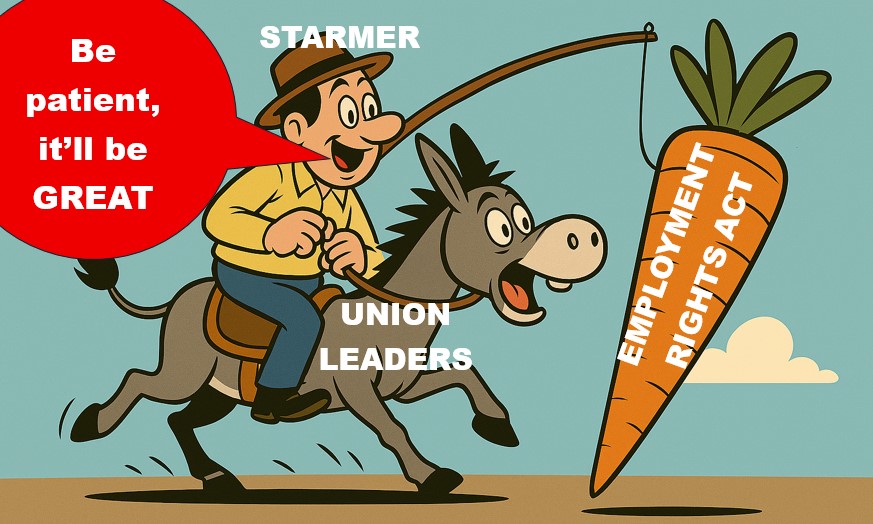
With the exception of Sharon Graham, the union leaders are like the donkey in the old cartoon that is chasing a carrot that its owner dangles in front of it – the donkey keeps hopefully chasing the carrot – but never gets to eat it.
Starmer, and Angela Rayner, while she was still in place, are using the promise of the Employment Rights Act to pacify and mollify the unions, just like they did before the election. The first duty of the union leaders is to tell it like it is, not to pass over the delay (to 2027!) in silence, nor to make out that the Act has been delivered.
They should be calling out the needless delays, and using their considerable influence in the Labour Party to get the Employment Rights Act onto the statute book, without any watering down. If the unions had their rightful freedoms back, they could deliver widespread improvements in wages and job security. We are after all, in a time of a labour shortage. The threat from Reform would vanish in six months.