By Cain O’Mahoney
The mass struggle in Serbia has now reached a critical point, as the youth in particular, in their frustration, have begun to fight violence with violence. One of the reasons for their feeling of frustration and isolation is that the world’s leaders have abandoned them.
In this turbulent world there is one thing that unites Putin, Trump and the European Union – opposition to the mass movement in Serbia.
Putin, predictably, has denounced the movement as a conspiracy by the West, fearful that the former Russophile country is demanding democratic change, and the impact this ‘Little Russia’ could have on Russia itself.
Trump’s Envoy for Special Missions, Richard Grenell has said, without a hint of embarrassment, that President Trump cannot support those “… who undermine the rule of law or who forcefully take over government buildings” (er…January 6, anyone?).
The main stab in the back however has come from the EU, with Commissioner Gert Jan Koopman saying the EU would “not accept a violent change of power in Serbia”.
Corruption and outrage
The fuse was lit in Serbia on 1 November 2024. The canopy of the recently reconstructed railway station in Novi Sad collapsed, killing 16 people. There was outrage in the city, as the corruption and resultant corner-cutting of the project was well known locally. The anger turned to fury when the government of President Aleksander Vucic’s Serbian Progressive Party (SNS) attempted a cover up.
In protest, local students and teachers held a vigil, which included 16 minutes silence in tribute to each of the victims. This respectful, peaceful vigil was attacked by a gang of thugs known to be supporters of the SNS. This, in turn, provoked a mass demonstration in protest by the city’s population, the largest in Novi Sad’s history.
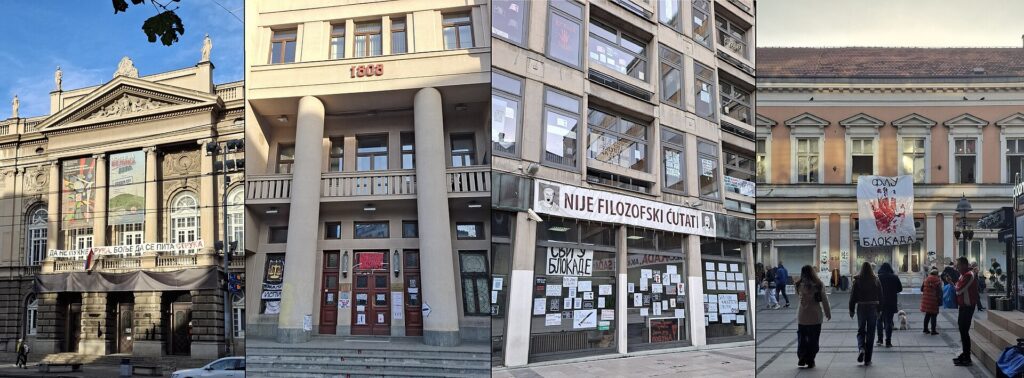
[photo – wiki commons – credit here]
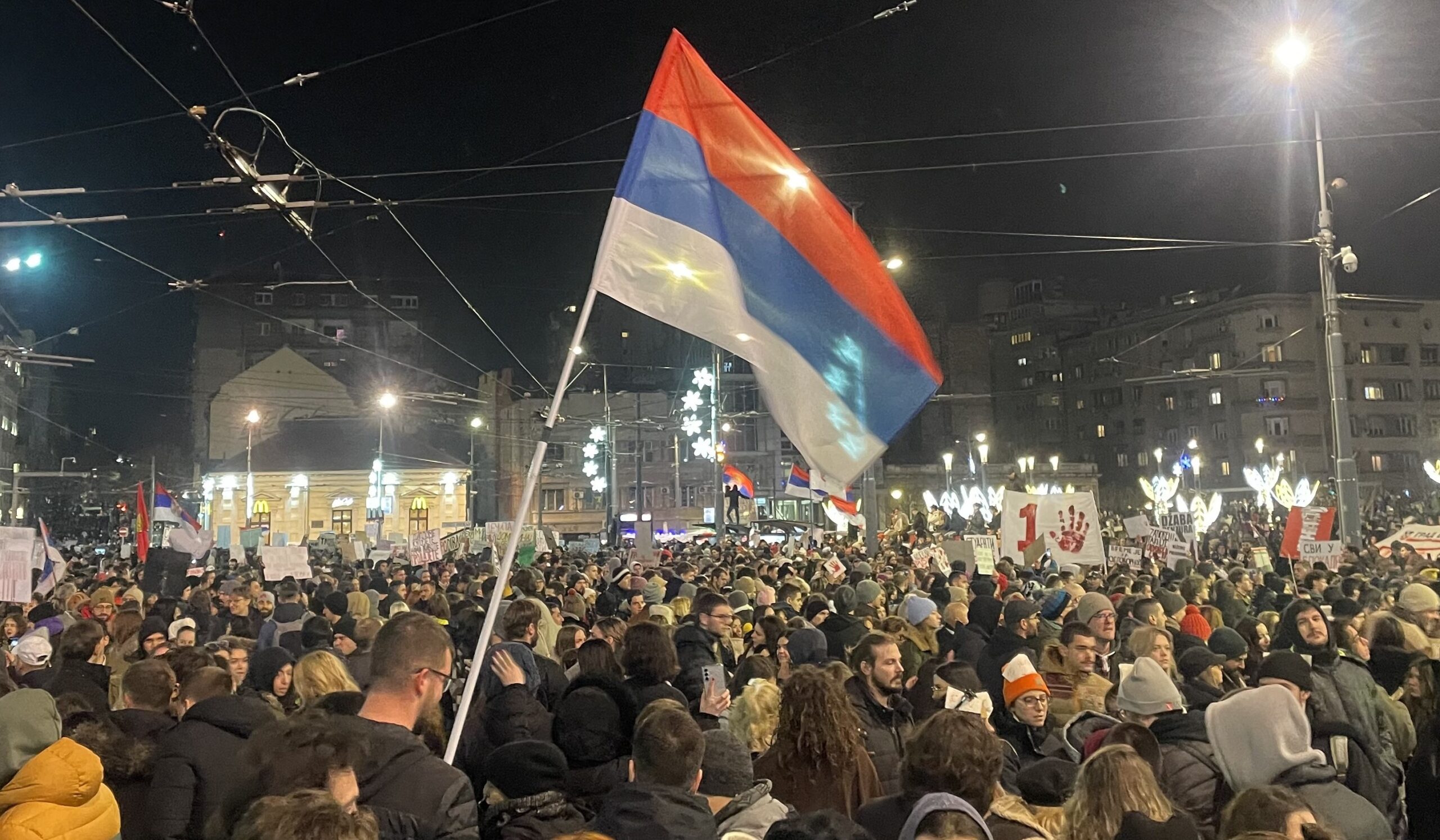
From there, the protests have exploded across the country, with strikes from health workers to power workers, huge protests – one in Belgrade numbering 326,000 earlier this year – and a one-day general strike in Belgrade in January. It has become a generalised movement that wants an end to corruption and new elections. And the protests have never let up.
Neither has the continued repression by the Vucic government. This has now been stepped up as Vucic feels empowered by the red-carpet treatment given to his close ally Putin, by President Trump in the US.
Like many Eastern European ‘strongman’ leaders, Vucic looks both ways at once – they are cut from the same cloth as Putin, favouring authoritarianism, yet having to look West for funding. Thus Vucic refuses to put sanctions on Moscow, but still sells weapons to Ukraine. He often holds out the begging bowl for European Union funding, but then attends the recent summit of Russia, China and North Korea to kiss authoritarian backsides.
But while Trump’s Kremlin-cosy stance may make Vucic feel vindicated on the international plain, back home, he and his SNS party are feeling increasingly vulnerable.
Ballot rigging and intimidation
In June, two key local elections were held in the municipality of Kosjaric and the city of Zajecar, both former SNS strongholds. The SNS only held onto power by blatant ballot rigging and intimidation, with ‘voters’ being bussed in; ID fraud; SNS supporters controlling ballot boxes and not allowing observers to watch the count; and threatening groups of police and thugs corralling polling stations.
Even after all these irregularities, the SNS could only hang on by a whisker in both elections. The people know it is election fraud because they turned out in their thousands to vote against the SNS – there was a 63 per cent turn out in Zajecar, and a staggering 84 per cent in Kosjaric.
This is why Vucic won’t call an election, as he knows he will be trounced, and probably face prosecution. His response to his Zajecar and Kosjaric election scare was more repression. He has sacked over 100 teachers and professors, replacing them with SNS supporters in key schools and universities. He also attempted to close down the independent TV stations, NI and Nova.
But cracks are beginning to appear in the Serbian state, bowing to the pressure from the mass movement below. On 1 August, the Public Prosecutions Office (PPO) for Organised Crime finally arrested 11 individuals, including the former SNS Minister Tomislar Momirovic over the Novi Sad disaster. The noose is beginning to tighten around Vucic, who predictably denounced the PPO – one of his own government departments – as being controlled by the European Union. The people meanwhile celebrated with another mass demonstration of over 150,000 in Belgrade.
On 12 August, peaceful mass protests took place in Vrbras and Backa Palanka. However, it is clear Vucic has decided to step up the repression, and unleashed the now usual gangs of SNS supporting masked goons who attacked the protesters with bottles, rocks and flares. As usual, when the protesters started fighting back the riot police were then unleashed to ‘restore law and order’ and batter the protesters.
Spontaneous protests
But this time, the Serbian masses had had enough of the intimidation. Protests broke out spontaneously across the country, many under the slogan of ‘Let’s show them we are not a punch bag’. Local SNS headquarters, the first in Novi Sad, were attacked and burnt down in many major towns and cities.
The worst violence happened in Valjero, where a virtual pogrom against the protesters took place, with the thugs and riot police not just attacking the protesters but even pulling people out of bars and shops to beat them up, and firing rubber bullets indiscriminately. The local hospital declared a major incident as over 60 injured protesters crowded into the A&E wards. It did the riot police and SNS no good, however – the crowds fought back and the local SNS offices were burnt down here too.

[Photo wiki commons – credit here]
In Novi Sad itself, the masses were further infuriated when Vucic deployed Serbia’s Special Forces unit – COBRA – against the protesters. This is against Serbia’s Constitution, which states that elite military units should not be used against the civilian population.
Not that it did Vucic much good. Despite COBRA officers firing live rounds into the air, several COBRA soldiers were given a good beating for their troubles.
If Vucic thought he could crush the movement during the summer lull, he failed. Rather than intimidate the movement, September saw the return of peaceful mass protests.
High School students in Belgrade, Novi Sad and Kragujevac marked the beginning of the new school term by gathering in their city centres and then marching to their schools in silence. This was not only to commemorate the Novi Sad disaster and the sacking of their teachers, but also in anger: during the Valjero outrage, images were widely circulated on social media of riot police beating up a 15 year old boy.
A further peaceful protest in Novi Sad four days later, however, was yet again attacked, with riot police firing tear gas and batoning the crowds. Vucic’s strategy is clear – provoke, provoke, provoke. As Le Monde put it:
“For the past 9 months, the Balkan country had been swept by a large, mostly peaceful anti-corruption protest movement, but it is now tipping towards violence due to provocations from those in power”
(Le Monde, 23.08.25).
Movement knows it can win
Even so, the movement knows it can win. The ‘Bulldozer Revolution’ of 2000 is etched in everyone’s mind.
In that year, the despot and war criminal, Milosevic, claimed victory in what were clearly rigged elections. There were huge spontaneous protests across the country, culminating on 5 October, when demonstrators commandeered a bulldozer and drove it into the head office of Radio Television of Serbia, the state-owned mouthpiece of Milosevic. Within two days, he was gone.
The mass movement today has made it clear that they will not be intimidated and are not going away. Tactically, concessions have been wrung out of Vucic – he has granted the sop of sacking various Ministers (anyone but himself of course), been forced to release some official documents on the Novi Sad disaster, and promised to increase the education budget by 20 per cent (at the same time as sacking teachers).
These concessions were gained when the strike wave was at its head earlier this year. The movement now must turn once again to the trade unions and begin to organise for an all-out General Strike that runs until Vucic is gone.
Strategically, the mass protest movement has realised that there will be no saviours on white chargers – whether the USA or the European Union – riding over the hill to liberate them. It is ‘ourselves alone’, as the old phrase goes.
This political maturity has seen the movement drawing up a whole charter of reforms that would be expected in a normal, democratic civil society. However, it needs a political programme too.
The movement is a wide spectrum of anti-government forces, but the socialist components of it – in particular those socialists in the Progressive Alliance of Socialists and Democrats – must draw up a socialist strategy that gives the alternative to the root of the problems in Serbia: capitalism, and all the exploitation, corruption, censorship, gangsterism and violence that comes with it. It is time to start constructing the socialist bulldozer to build a new society.
[Featured photo – top – anti government protests from December 2024 – photo from wiki commons credit here]