
By Andy Ford
Ninety years ago, in October 1935, Mussolini launched his invasion of the last independent country on the African continent – Abyssinia (now Ethiopia). As ever, the question of war made a searching test of all the groups and tendencies in the working-class movement.
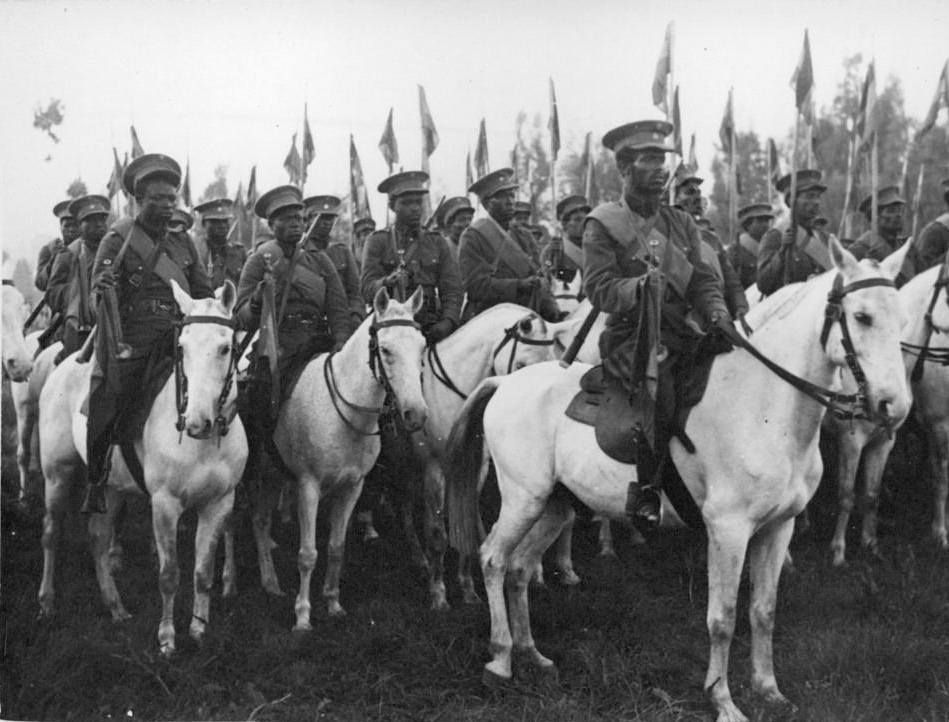
As far as the actual military events were concerned, Italy secured a quick victory over Abyssinia, which was still a feudal monarchy. It was ruled by the Ethiopian Emperor Haile Selassie, known as the ‘Negus’ (or king), and a million of its people lived as slaves.
200,000 Italian troops invaded from Eritrea in the east, and also from Italian Somaliland to the south. The Abyssinians had just 4 tanks and 13 aircraft against an Italian force of 800 tanks and 595 planes. In addition, the fascist air force deployed mustard gas against the ill-equipped Abyssinian armies. By the 5th May 1936 the Italians had occupied the capital, Addis Ababa, forcing the flight of Haile Selassie. The ‘civilised’ Italians then proceeded to massacre 20,000 Ethiopian civilians.
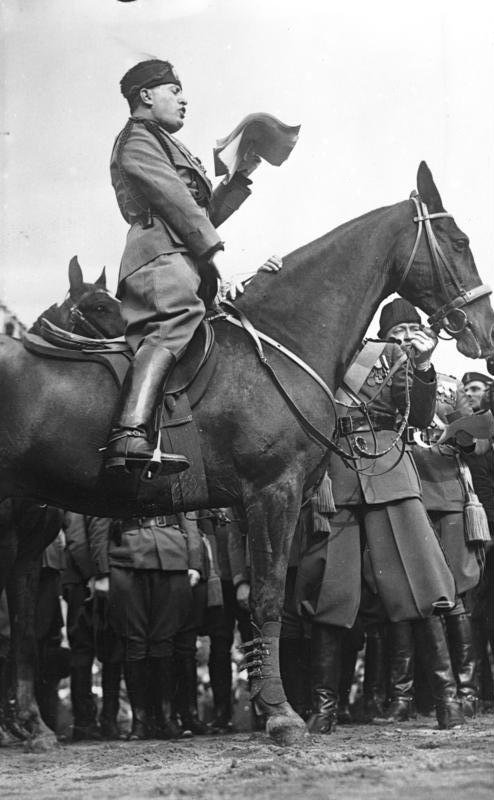
Abyssinia was the last truly independent nation in Africa and had defeated a previous Italian invasion at the Battle of Adwa in 1896, a victory which gave heart to colonised people all over the continent. Now the Italians were avenged, and the imperialist division of Africa was complete. At his victory parade in 1936, Mussolini declared, “So is Adwa avenged”. 750,000 Abyssinians died in the war and subsequent occupation, out of a population of 6 million.
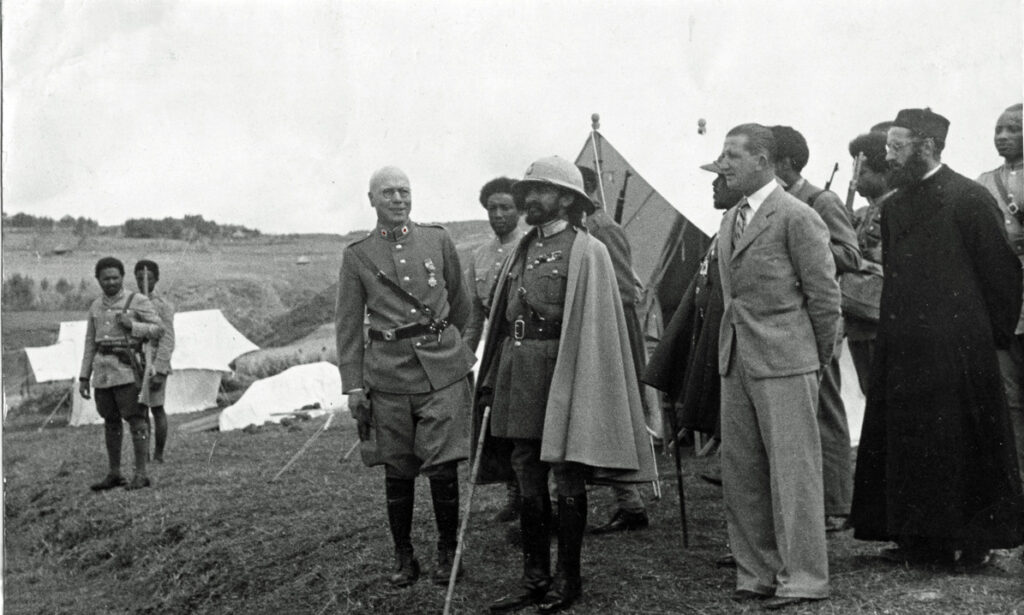
of a humanitarian mission
[photo – wiki commons – credit here]
For the socialists of the time, the war had a double character. It was, firstly, an imperialist aggression against a weaker, independent state. Secondly, the war was part of the developing rivalry between the capitalist nations and empires of the world, as they headed towards World War 2 for a new division of the world and its profits. But at that stage, as Trotsky noted, it was impossible to say who would be on which side.
Up until the crisis over Abyssinia, fascist Italy had been an ally of ‘democratic’ Britain and France, against the expansionism of Germany. But now the Italian seizure of Abyssinia threatened the position of the British and French colonies in Africa.
Imperialist robbers
Their initial response to the Italian threat to Abyssinia was firstly to use the League of Nations (a predecessor of the UN) to offer up a ‘mandate’ over Abyssinian territory to give all the imperialist robbers a slice of the Abyssinian pie. The West Indian socialist, CLR James, then resident in Britain, fiercely denounced the proposal:
“The proposals of the Committee of Five expose the brazen lie that any independence is being defended. The document is short and concise.
The public services of Ethiopia will be divided into four departments: Police and Gendarmerie, Economic Development, Finance, and Other Public Services. As usual with imperialist banditry masquerading under the name of law, the means of repression stand first on the list.
Foreign specialists will organise a corps of police and gendarmerie, which will be responsible for ‘strictly regulating the carrying of arms by persons not belonging to the regular army or to the police or gendarmerie forces’, in other words, disarming the people.
This group of specialists will be responsible for ‘policing centres in which Europeans reside’, and ‘ensuring security in agricultural areas where Europeans may be numerous and where the local administration may not be sufficiently developed to provide them with adequate protection’. Thus the local population being disarmed will be taught the proper respect due by black men to white in imperialist Africa.
Once the gendarmerie has done its work, imperialism can go safely ahead with civilisation. Under Section II, Economic Development, foreigners will ‘participate in land tenure, mining regulations, exercise of commercial and industrial activities’; also public works, telegraphs, etc., all the things imperialism needs for its trade. It will be the same old exploitation that is going on in every part of Africa today.
First, the imperialists called the exploited areas colonies; next, protectorates; then, mandates. Now it is ‘helping a sister nation’.”
(CLR James, ‘Is This Worth a War?’, October 1935)
League of Nations exposed
[photo – wiki commons – credit here]
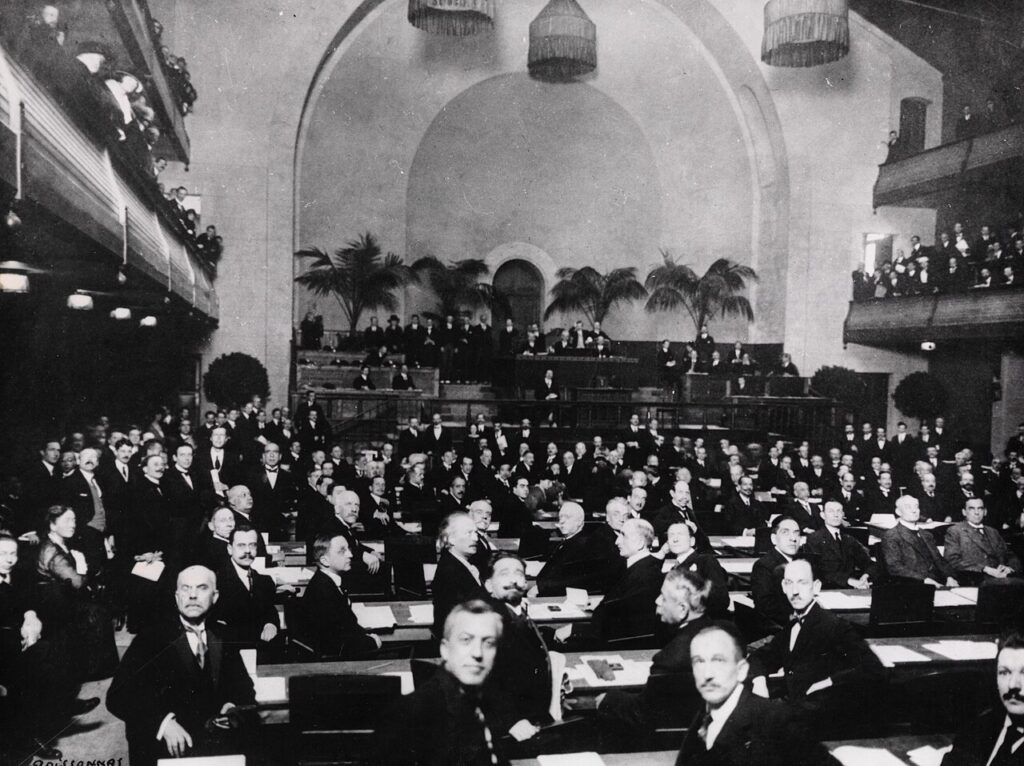
Truly, the League of Nations was exposed as the “den of thieves” described by Lenin. But when Italy ignored the offer of a ‘fair share’ of Abyssinia and tried to take the lot for themselves by launching their invasion, Britain and France, using the League of Nations, imposed ‘economic sanctions’ (the first in the world) on Italy as an ‘alternative’ to outright war.
Trotsky was in no doubt as to which side socialists should support. In July 1935, as the British parliament debated sanctions, Trotsky wrote:
“Of course, we are for the defeat of Italy and the victory of Ethiopia, and therefore we must do everything possible to hinder by all available means support to Italian imperialism by the other imperialist powers, and at the same time facilitate the delivery of armaments, etc., to Ethiopia as best we can.”
(Letter to the International Secretariat, July 1935)
Socialists rejected any notion of neutrality between the feudal monarchy in Abyssinia and an imperialist aggressor, whatever the defects of the regime of Haile Selassie.
The Bolshevik, Karl Radek (later to be murdered by Stalin) wrote:
“The world is already so partitioned among the imperialist great powers that every non-imperialist nation faces the common front of the imperialist oppressors; but every attempt to divide the world differently among the imperialist robbers, sets the thieves of this common front of robbery against each other, and therefore facilitates the task of the international proletariat – the socialist revolution – and by virtue of the rupture of the ‘common front’ of the temporary status quo of the last piratical partition of the world among the imperialist robbers, it promotes the revolutionary struggle of the working class.”
(Karl Radek, ‘Questions of the Italo-Ethiopian War’, October 1935)
New world war
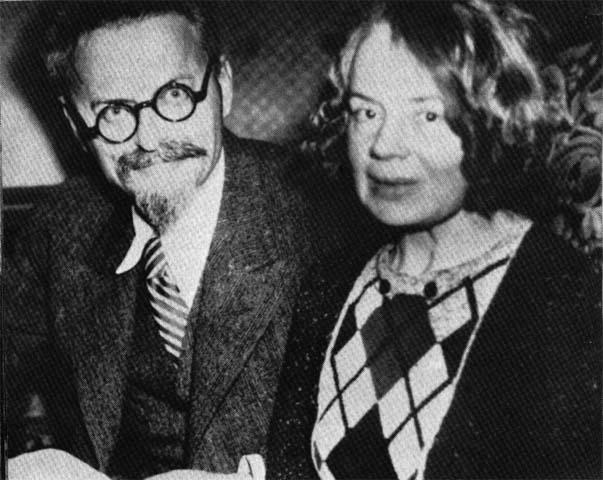
Trotsky, then living in Norway, totally saw the conflict with, and over, Abyssinia as part of the process towards a new world war:
“I believe that the prospective war between Ethiopia and Italy stands in the same relation to a new world war as the Balkan War in 1912 did to the World War of 1914-18.”
(Trotsky, Report in Norwegian paper Arbeiterbladet, July 1935)
In the same article he very accurately predicted a mere five years to a new world war:
“Before there can be any new big war, the powers will have to declare themselves, and in this regard the Ethiopian-Italian war will define positions and indicate the coalitions. It is impossible to say whether it will then take three, four, or five years or more before the big war breaks out. We should be prepared for a short rather than a long time.”
Support for the government sanctions, he thought, was a step towards the working class supporting the government in the impending world war.
[photo – wiki commons – credit here]
He could also see that behind the cries of “Defence of Abyssinian independence!” from Britain and France lay hypocritical calculations to use the war on Abyssinia to advance their own imperialist interests in East Africa and the Mediterranean. Britain, France and Italy had previously agreed, in 1906, to arrange a joint exploitation of Abyssinia. Now Mussolini intended to overturn that ‘gentleman’s agreement’ for the division of spoils between the three imperialist thieves.
Sponsored by Britain and France the League of Nations outlined their proposed sanctions:
- An arms embargo
- A financial freeze
- An import embargo
- Export prohibitions on key commodities and goods
- A mutual support fund.
Splits in the British labour movement
The British labour movement was split on the sanctions. The majority failed to uphold any sort of independence and dutifully fell in behind their own ruling class by supporting the sanctions. There was also a pacifist minority who ‘opposed war’ and refused to support either side and opposed the sanctions. This tendency were to be found in the ILP (Independent Labour Party) who had left the Labour Party proper in 1932. But there were also those who could be won to a policy of opposition to the war and the League of Nations’ sanctions, and to support for Abyssinia, and for workers sanctions.
[photo – wiki commons – credit here]
The Labour left, organised mainly around the ‘Socialist League’, opposed war, and the sanctions, on the basis that sanctions were just war by another means. At the Labour conference that year their position got 102,000 votes compared to 2.6 million for the leadership’s position of support for the sanctions imposed by the League of Nations.
Meanwhile, the ILP opposed war and the sanctions, calling for resistance to the war, predicting that the sanctions were a step towards a new world war. Their stated position was:
“Refuse to support the National Government in imposing sanctions or waging war for British Capitalism and Imperialism! Carry on the struggle against the National Government, Capitalism, Imperialism and War! Carry on the struggle for Workers’ Power and Socialism.”
(Quoted in Cohen, ‘Failure of a Dream’)
The tiny group of British Trotskyists, at that time active in the ILP, took things a step further, urging practical support for Abyssinia and blocking of war materials to Italy. Their work began to bear fruit: in July, the ILP announced that conflict that it was “Up to the workers to do everything in their power to stop war supplies going to Mussolini.”
“Workers’ sanctions”
They urged no confidence in either the League of Nations, or the British government, and counter-posed ‘workers sanctions’ to the official ones set up by the League of Nations. The aim was to win workers and their trade unions away from following their ‘own’ government, which was in fact the government of the ruling elite, and towards a policy of practical solidarity with the Ethiopian people.
Within the ILP, three main groupings emerged. The parliamentary leaders opposed both war and sanctions on principle, as they were pacifists. To justify this position, they painted both Italy and Abyssinia as “two rival dictatorships”, each as bad as the other, choosing to ignore the fact that one was the imperialist aggressor, the other the colonial victim.
The Stalinists in the ILP supported the sanctions and the League of Nations, following Stalin and the Soviet Union’s quest for ‘peaceful co-existence’ with Britain and France in the hopes of preventing a future Nazi aggression against the USSR.
Finally, the Trotskyists in the ILP, organised around the ‘Marxist Group’ opposed imperialist sanctions and instead advocated for solidarity with the Ethiopian people and their fight against the Italian armies, and for a policy of workers sanctions.
From exile, Trotsky wrote:
“Workers sanctions” can mobilize the working class independently in the war and fight pacifist tendencies” and that “…economic sanctions, if real, lead to military sanctions, and so to war”
(Trotsky, ‘Once Again the ILP’, February 1936)
Imperialist sanctions were not an alternative to war; they were in themselves acts of war and could not be supported by the workers’ organisations.
Within the international Trotskyist movement, a German comrade, ‘Erde’ (Karl Friedburg), criticised the position of no support to the League of Nations sanctions, on the basis that the imperialist sanctions were at least something real, pessimistically asserting:
“Since the working class is doing nothing, can do nothing, and for the most part desires to do nothing, the measures taken by the bourgeoisie must serve as the basis for a campaign. Any kind of negative position [i.e. opposition to the proposed League of Nations sanctions AF] serves fascism.”
Trotsky replied that:
“On this basis, Erde rejects the position on sanctions taken by our Italian comrades. What position does Comrade Erde himself take toward the Stalinists and reformists? Since the proletariat is weak at present, it must . . . look to the bourgeoisie for support. The weakness of the proletariat is in fact a result of allowing the bourgeoisie to do as it likes. And, if this passivity toward one’s own imperialist government is raised to the level of a principle, this serves not to strengthen the proletariat but only to undermine the future of its vanguard.“
(Trotsky. ‘Remarks in Passing’, December 1935)
Monopolies and big business interests
[photo – wiki commons – credit here]
Trotsky was saying that a low level of activity and organisation in the workers movement can never been an excuse for the working class and its organisations to rely on the actions of their own government. No matter how much propaganda they pump out for peace, democracy, freedom or the independence of small nations, it is always really about securing the economic position of their backers – the monopolies and big business.
Trotsky explained that workers’ sanctions would not only impede Italian fascism, but also the British and French capitalists, who had carefully chosen the sanctions that would not harm their commercial interests. For instance, at no point did they stop selling oil, petrol, coal and steel to Mussolini – because those were their most profitable lines of business. A serious oil embargo would have made the whole invasion impossible. But that was not the main objective of Italy’s rivals.
The US Marxist, James Burnham, pointed out that the sanctions had had almost no effect on the outcome of the war in Abyssinia:
“What has been the effect of these measures? …their effect on the conduct of the Italian military campaign in Ethiopia has been zero. There is no indication that they have affected the campaign in the slightest… As means of stopping the war or of saving ravaged Ethiopia, sanctions have accomplished nothing”
(James Burnham, ‘After Five Months of Sanctions’, March 1936)
He pointed out that what the sanctions had achieved was to bind the working class in each country, including Italy, to its own exploiters, under the flag of ‘national unity’:
“The outstanding effect of the policy of sanctions has been to aid in bringing to a new high point national unity within both the sanctions-invoking nations and Italy”
In fact, one of Mussolini’s main motives for the attack on Abyssinia was to shore up his domestic support, and the ‘revenge’ for the humiliating defeat at Adwa 40 years earlier went down well in Italy. The popularity of the fascist regime peaked in 1936, when the military victory appeared to validate Mussolini’s claims of having rebuilt the Italian economy and army. In his words:
“Italy at last has her Empire — that Fascist Empire which bears the imperishable signs of truth and the power of Rome’s emblem”
(Mussolini, May 9th, 1936)
Debates in the Independent Labour Party
In the ILP, the Trotskyists succeeded in winning the party to a policy of ‘Workers Sanctions Against Italy” which provoked the Stalinists to leave and join the actual Communist Party. The debate in the ILP then became one of workers’ sanctions versus pacifism. The leadership, who were pacifists, summed up their position as, “The difference between the two rival dictators and the interests behind them are not worth the loss of a single British life.”
Trotsky, who was keenly following the debate in the ILP, as it was allowing his followers to intervene and to grow, took up the false arguments of the ILP leaders in his ‘On Dictators and the Heights of Oslo’ (1936):
“Maxton and the others opine that the Italo-Ethiopian war is ‘a conflict between two rival dictators’… If Mussolini triumphs, it means the reinforcement of fascism, the strengthening of imperialism, and the discouragement of the colonial peoples in Africa and elsewhere. The victory of the Negus, however, would mean a mighty blow not only at Italian imperialism but at imperialism as a whole, and would lend a powerful impulsion to the rebellious forces of the oppressed peoples. One must really be completely blind not to see this.”
The ILP then became paralysed by internal arguments and wranglings in which the parliamentary group refused to accept the democratic will of the ILP members. It was at this point that Trotsky declared the ILP to be “hopeless” and advised his followers to join the Labour Party.
These debates might appear to be of merely historical interest but they very much mirror discussions in the workers movement and trade unions today over Israel and Gaza. How should the unions respond to the complete double standards of western governments over Ukraine and Gaza? Is it OK for the union leaderships to fit their policy to that of the British government, which itself takes its orders from the US State Department? Or do we insist that the policy of each union is determined by its members?
Do we beg the British government to stop arming the IDF or do we support working class boycotts, and potentially strike action, and refusal to ship weapons to Israel? The recent Italian general strike over Gaza, and refusal of Italian and Moroccan dockers to load ships bound for Israel show what is possible.
Trotsky’s principle throughout was to uphold and build the organisation and self-activity of the working class across all the belligerent nations. From that principle flowed all the tactics, arguments and actions of the socialist component of the working class organisations.
[Featured photo – Ethiopian soldiers on their way to the northern front – wiki commons – credit here]