By David Cartwright
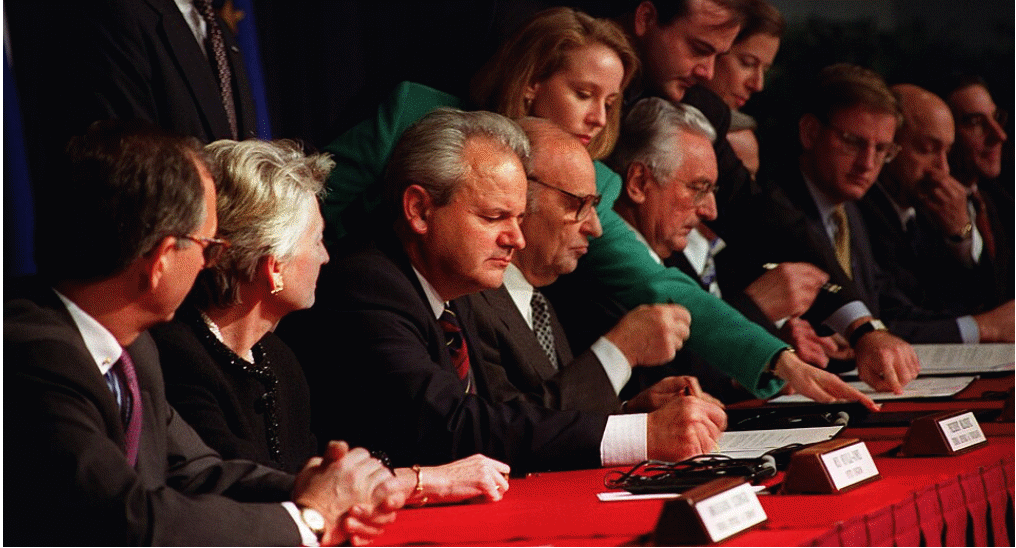
On 21 November 1995, 30 years ago today, the Dayton Agreement was signed by the presidents of Croatia, Serbia and Bosnia-Hercegovina. The agreement saw the end of the Bosnian War but at the expense of a partition arrangement that continues to create constitutional complications for political development in Bosnia-Hercegovina today.
Although the worst fighting from the Balkans War came to an end, the siege of Sarajevo continued for another three months and the status of Kosovo remained an issue, leading to a further war in that republic three years later.
The Balkans War started in June 1991 when the parliaments of two republics, Slovenia and Croatia voted to create independent states, separate from the former united Yugoslavia. The potential breakup of the former Yugoslavia was something that the western capitalist powers hadn’t paid much attention to. For them, the collapse of the Soviet republics including Russia and Yugoslavia was a massive gain for their political ideology. They didn’t prioritise what might come next because a return to capitalism for them was the primary goal.
But in Yugoslavia, the question of what happened next was a matter of life and death in a state made up of several republics and various ethnic groups spread around those different republics.
The pernicious role of the former Stalinist leaders
Yugoslavia had been a federation with a planned economy but instead of workers’ democratic control of that economy, they had bureaucratic control by a privileged elite, along the lines of Stalinist Russia. The leaders may have been facing a transition from state control to capitalism but like the bureaucrats in Russia, Poland and elsewhere they were going to look for any way possible to keep their privileged position in society.
Slobodan Milošević, who was the President of the Serbian republic within Yugoslavia opted to use Serbian nationalism to bolster his position and argue for a “Greater Serbia” including ethnic Serbs in the other republics like Croatia and Bosnia-Hercegovina. The Bosnian Serb leader, Radovan Karadžić had previously shown little interest in Serb nationalism but as Misha Glenny says in his brilliant book called The Balkans 1804-2012, “His decision to found the Serbian Democratic Party (SDS) was motivated less by nationalism than by personal ambition.” The Bosnian Serb leaders claimed that they should have 70% of the territory of Bosnia-Hercegovina, even though they represented just a third of the population.
Similarly Franjo Tudjman, the President of Croatia pushed for Croatian independence and had strong support from Germany. He sold himself to Germany as a defender of Catholicism and a bulwark against domination by Serbia. A big supporter in Germany for the recognition of Croatian independence was the Vice Chancellor, Hans-Dietrich Genscher who spoke out against the threat from “Greater Serbia”. He was a member of the Free Democratic Party at the time but until 1945 he had been a member of the Nazi party.
For his part, Milosević in Serbia looked to Russia for backing and military support. However, he chose to support the Russian Defence Minister, Dimitri Yazov and his co-conspirators in the coup attempt made against Gorbachev in August 1991. When Yeltsin became the Russian President it meant that Milosević didn’t have the reliable ally he was looking for.
The collapse of the Yugoslav Federation
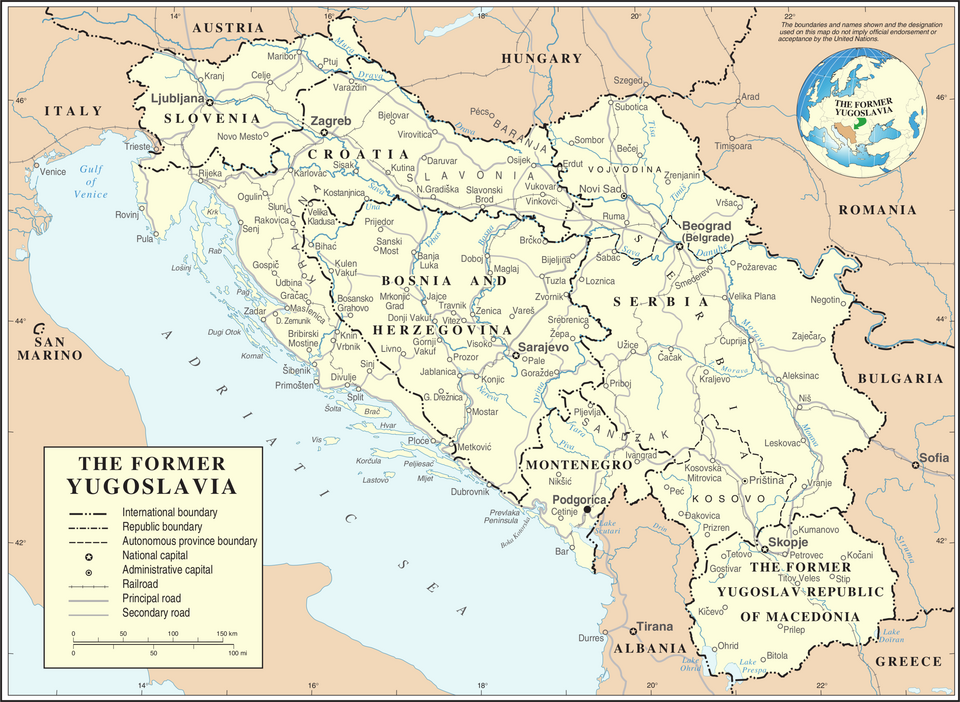
As a clear sign of how ill-prepared the Western governments were for developments in Yugoslavia they had many different ideas about how to deal with the threat of war. Germany was prepared to recognise Croatia but Britain and France were not. The United States initially steered clear of the conflict. They said it was down to the Europeans to sort out. The US were at this time bogged down with the military demands of the Gulf War that had started in 1990 and was still consuming much of their war efforts. The European Union agreed with Germany on recognition and in January 1992 deployed peacekeeping forces in four regions of Croatia that contained significant Serb populations and offered support for independence in the other Balkan republics subject to referendums on the question.
The Yugoslav federation was clearly being cut apart. There were ethnic differences in all of the republics but the most multi-ethnic republic was Bosnia-Hercegovina where Alija Izetbegović had become the President in December 1990. The Republic comprised 43.5% Bosniaks (Muslim), 31.2% Serbs, 17.4% Croats and 5.5% Yugoslav. In February 1992, Serb leaders in Bosnia-Hercegovina set up the Republic of Srpska (RS) in the areas with Serb majorities plus some historically-contested areas. The move to separation based on nationality and ethnicity here and elsewhere in the Federation posed enormous threats to the historic cohesion and unity in Bosnia-Hercegovina.
An attempt was made in February 1992 (the Carrington-Cutileiro plan) to prevent war breaking out in Bosnia-Hercegovina. Under the plan the Republic was to be divided into 190 municipalities and every one would be designated as Bosniak, Serb or Croat, including those with no clear majority for one of the three. After much negotiation and redrawing of the plans, the three parties signed the agreement. But before it came into force, Izetbegović withdrew his signature, going back to his original position that there should be no division of Bosnia.
Violence breaks out
During this period of negotiations Bosnia-Hercegovina had voted for independence in a referendum on 29 February and 1 March. Encouraged by the US, Izetbegović declared independence in April. The Serb minority in the republic rejected the move and violence broke out. The siege of Sarajevo by Bosnian Serb forces started and was to last for over 3 years with children growing up and trying to get an education in a besieged city where they couldn’t even go out on the streets to play for fear of being killed by snipers stationed in buildings on the edge of the city.
There were brutal attacks on Bosnian Muslims. The UN reacted by declaring sanctions on Serbia. But as often happens with sanctions, they affected many people who were not the intended targets. They contributed to the economic decline of the whole area with Serbia’s neighbouring countries no longer able to get access to imports from Serbia.
The Vance-Owen Peace Plan
The second attempt at a peace arrangement came in Spring 1993. It was called the Vance-Owen Peace Plan (VOPP), named after Cyrus Vance from the US and David Owen from Britain. The plan proposed to divide Bosnia-Hercegovina into ten cantons. It was supported by the EU, the Bosnian Croats, President Tudjman of Croatia and President Milosević of Serbia. It was opposed by the US, the Bosnian government, and Radovan Karadžić, leader of the Bosnian Serbs, all for different reasons. Bill Clinton was the US President and he wasn’t prepared to commit the US share of the 15-25,000 troops required for the plan to work. The Bosnian government still held on to the idea of a unified state. The position of Karadžić showed a clash of approach with Milosević. But he accepted that it should be put to a vote of the Bosnian Serb knowing that it would be rejected.
The peace plan was not accepted but further UN peace keepers were provided. Most of the UN peacekeepers came from the UK and France.
The alliance of Croats and Muslims broke down early in 1993. Bosnian Croats started shelling the mainly Muslim town of Mostar with over 1,000 shells a day. In November the bridge over the Neretva River in Mostar was destroyed, breaking a military supply line and damaging a historically significant cultural site. Fighting continued all over the country through 1993 and into 1994.
Escalation of attacks on Sarajevo
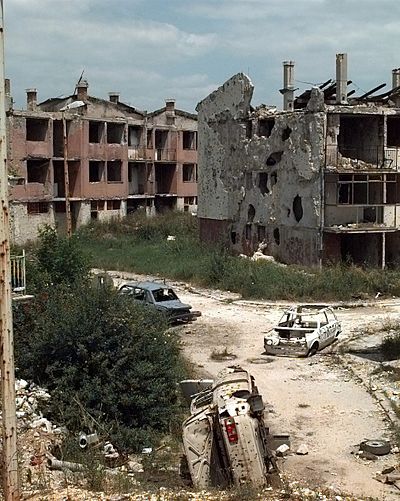
In February 1994 (22 months into the siege), Bosnian Serb forces sent mortars into Sarajevo killing 68 people. An emergency meeting of NATO leaders took place and decided to deliver an ultimatum to the Bosnian Serbs for them to withdraw all their heavy artillery from around Sarajevo. As the date of the ultimatum neared, Russia broke ranks and declared that they would station their own troops around Sarajevo claiming that the Bosnian government would use the withdrawal to carry out an armed break out from the city. A full withdrawal of heavy weapons did not take place but the fighting calmed and both the Bosnian government and Serbian forces started handing in some weapons to the UN forces in the country.
In March 1994, under pressure from the US and Germany, Tudjman and Izetbegović agreed a Federation Agreement that laid the basis for the Dayton Agreement that was signed 18 months later. At this point in time, it amounted to a ceasefire agreement only, providing much needed respite in the areas where there had been fighting between Croats and Bosniaks. But the Federation Agreement included the seeds of the partition that was to come later. As Misha Glenny points out “The new Bosnia-Hercegovina was hailed as a triumph of the West’s commitment to a multi-ethnic state but in reality it confirmed its total partition.”
The UN Contact Group for the Balkans comprised five nations at this time (US, UK, France, Germany and Russia). They put forward a proposal for the division of Bosnia-Hercegovina into two political “entities”, the Federation of Bosnia-Hercegovina with 51% of the territory and the Republic of Srpska (RS) with 49%. The Bosnian Serbs rejected this plan because they still held out the possibility of gaining 70% of all the territory.
Significant fighting in North Western Bosnia
The war continued and in the autumn of 1994 Serb forces carried out a significant attack in a strategically important part of Bosnia, in the North Western region, centred on the town of Velika Taduša. The population of this area was predominantly Muslim and bordered on areas controlled by Croatian Serbs and Bosnian Serbs. The region was run by the rich businessman, Fikret Abdić who had won the popular vote to be president of Bosnia-Hercegovina in 1990 but found himself sidelined within the seven-person Presidency and instead turned his attention to strengthening his position in this area where he lived and where his large food processing business was located. He even declared the establishment of The Autonomous Province of Western Bosnia, which, of course, never gained international recognition.
Up until the attack in autumn 1994, Abdić had played a diplomatic balancing act between the region’s contending forces keeping good relations with them all and with the UN; the only exception being ongoing disagreements with his erstwhile allies in the Bosnian government in Sarajevo. In May 1993 the UN declared the wider area known as the Bihać pocket which had a Muslim population of 250,000 a “safe area”. The Bosnian 5th army corps were based in the area but Abdić didn’t have confidence in them and tried to negotiate directly with the Serbs.
The Bosnian 5th army corps rebelled against Abdić. Tudjman of Croatia was not prepared to let the Bihać pocket become a route to connect the rebel Serb armies of Croatia and Bosnia so he declared that the UN protection of the Serb rebel areas in Croatia should be ended. The pocket was thrown into turmoil that led to some of the worst fighting of the war.
The Srebrenica massacre
The tentative progress made after the intervention of the Contact Group was breaking down. The Bosnian Serb leaders continued to assert their aim to gain nothing less than 70% of the territory. Fighting was stepping up. The Bosnian government started to organise an armed attack on Serbian forces around Sarajevo with the aim of ending the siege of the city. Ratko Mladić, leader of the army in the Republic of Srpska, launched some of the worst atrocities of the war when he started a series of attacks on Muslim safe havens starting with Srebrenica in July 1995 where 8,000 unarmed people (mainly men) were murdered. See an article about the Srebrenica massacre on the Left Horizons webite here. Mladić then sent his troops on to attack Žepa and would have continued on to other villages if it wasn’t for opposition from Milošević in Serbia and NATO declaring that they would carry out air strikes if he didn’t stop.
A significant turning point took place with the “Operation Storm” offensives between May and August 1995. The operation represented the largest land battle on the European continent since World War II (and remained so until the Russian invasion of Ukraine). The Croatian army (HKoV) took over control of four of the weaker Serb rebel areas in Croatia. They later launched an offensive into two crucial Serb rebel strongholds, Kordun/Banja and Knin in Krajina. This led to the movement of 150,000 Serbians out of Croatia, the largest migration of people in Europe since the Sudeten Germans were expelled from Czechoslovakia in 1945. Carl Bildt, an EU negotiator, called for Tudjman to appear at the International Tribunal for War Crimes because of the nature of the shelling of Knin, but this call was never taken up.
The HkoV were supported by the Bosnian Army (ARBiH) and the operation strengthened the Bosnian government’s campaign against Serb rebels in the Bihać pocket and against Fikret Abdić. The tide was turning against the Bosnian Serbs.
The opportunity to push for a peace plan results in the Dayton Agreement
Bill Clinton, the US President would soon be seeking re-election and he saw the chance to boost his standing by initiating a peace deal that might now have a greater chance of success. Milošević was in support but Karadžić and Mladić wanted to keep fighting. After another mortar bomb attack on Sarajevo in August, NATO started a bombing campaign against Bosnian Serb targets including the command centre in Banja Luka in the RS. The Bosnian Serb forces were now severely weakened especially given that Milošević had not tried to defend them from the NATO attacks.
The weakened position of the Bosnian Serb leaders allowed the Presidents of Croatia, Serbia and Bosnia-Hercegovina to come together in Dayton, Ohio to sign the peace deal that became known as the Dayton Agreement or Dayton Accords. The agreement created a constitutional arrangement (Annex IV of the Agreement) that remains in force to this today.
The constitutional legacy of the Agreement
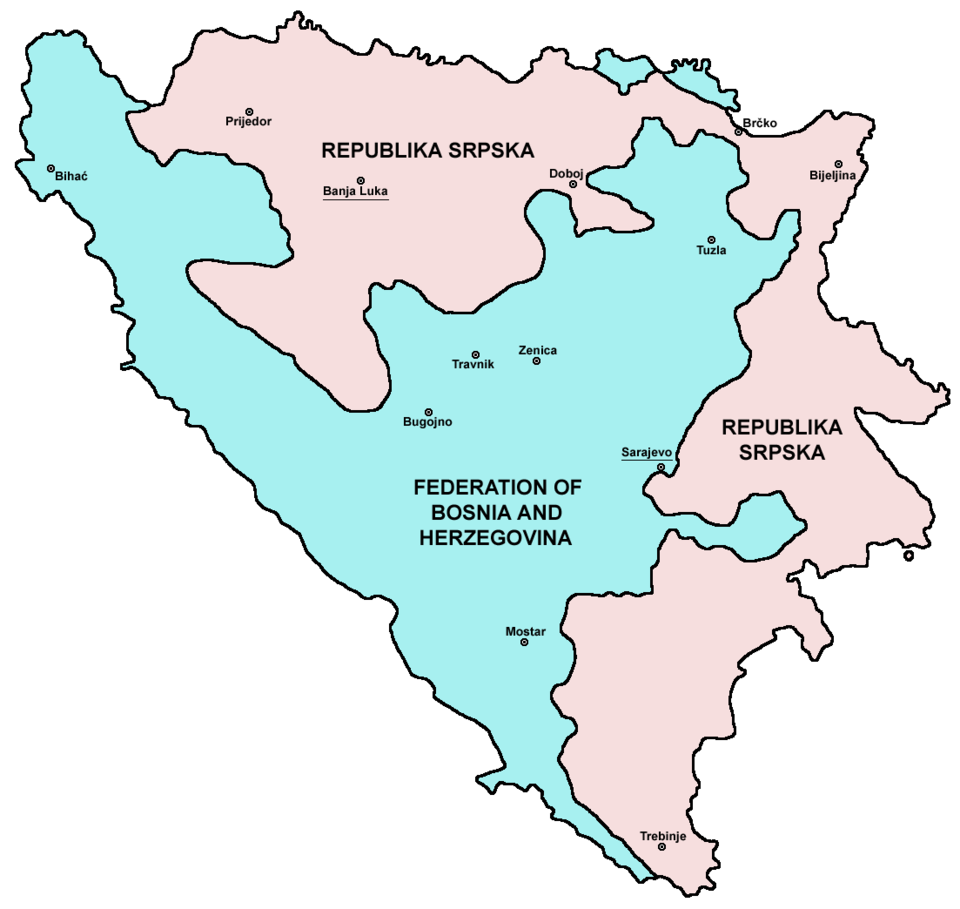
The agreement specified a single unitary state called Bosnia and Hercegovina but comprising two “entities”, Republika Srpska, populated mainly by Serbs and the Federation of Bosnia and Hercegovina populated by Croats and Bosniak Muslims. It included provision for refugees to return to their homes, but that has not happened in any significant way so the ethnic cleansing that happened during the war has actually been cemented in. Several territorial changes were specified in the agreement including the Bosniak Serbs giving up control of Sarajevo to the Bosniaks. Despite this they held territories in the Sarajevo suburbs until they finally withdrew in February 1996. Approximately 70,000 Sarajevan Serbs left the area and resettled in Republika Srpska.
The collective Presidency is made up of one Serb from Republika Srpska plus one Croat and one Bosniak from the Federation of Bosnia and Hercegovina. The upper chamber of the Parliamentary Assembly is the House of the Peoples and it has 15 members. Five must be Serbs selected by the National Assembly of Republika Srpska. Five must be Croats and five must be Bosniaks, both groups selected from the House of the Peoples of the Federation. The lower chamber is the House of Representatives. It has 42 members elected by a party-list system. 28 members are elected from the Federation and 14 from Republika Srpska.
The way forward
Young people searching for political solutions in Bosna-Hercegovina are faced with this complex ethnic-based constitutional set up. The horrors of the war 30 years ago are still fresh in the minds of those who lived through it, and the new generation also doesn’t want to see their country return to those dark days. They will seek and find a route to workers unity, solidarity and socialism. In February this year students in Bosnia came out in protest because nobody has been held accountable for floods that killed 29 people last October. In their protests they showed their solidarity with the worker and student movements against corruption in Serbia. Similar protests have taken place in Montenegro. These are encouraging movements if they can unite workers and students under the banner of socialism in Bosnia and internationally.
The featured image at the top of the article shows Slobodan Milošević, Alija Izetbegović and Franjo Tujman signing the peace agreement in Dayton, Ohio on 21 November 1995. The image is from Wikimedia Commons. The image is a work of the US Federal Government and is in the public domain.