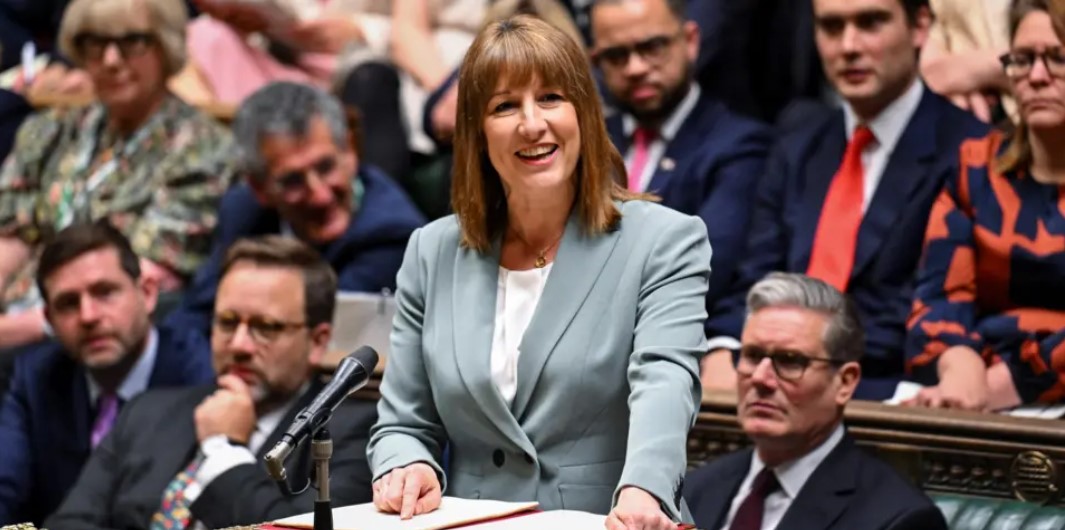
Wednesday’s autumn budget statement was clever politically, in so far as it may have bought some time for the leadership of Keir Starmer. It will have appeased many Labour MPs and the weakest and most craven trade union leaders who have backed Starmer’s push to the right over four years.
But it will do nothing to stop the slide of Labour in the polls, because it is working class people who, despite a few modest reforms, will be paying for the lion’s share of the increases in taxation in coming years.
One Labour MP told the Financial Times that the budget was “red” in so far as it increased taxes for the better off. It is true that most Labour members will be pleased to see increased taxation on unearned income from rent and share dividends, and a modest new tax on the most valuable residential properties. Switching huge pay packets into tax-free pension pots has also taken a hit – and it is another measure aimed at top earners.
The most welcome reform in the whole package and the most expensive ‘give-away’ is one that Labour and trade union members have been demanding for months: the removal of the two-child limit on family benefits. This will lift nearly half a million children out of poverty, according to the government’s own data, but the most important rider has to be the question, why did it take so long?
Overall, even allowing for the removal of the two-child limit, the budget measures are not so much “red” as “pale pink”. There are some welcome reforms dealing with free school meals and the national minimum wage, although these are modest in scope. But while some well-to-do middle class earners will pay more taxes, the super-rich – multi-millionaires and billionaires who “earn” more money every day doing nothing than most workers can earn in a lifetime – have got away scot free.
Nearly £50bn in Covid contracts, a third “written off”
Reeves boasts about recovering the ill-gotten gains of those friends of Tory MPs who benefitted from Covid contracts, especially through the ‘priority’ lane. No-one would argue with that, but she was talking about a few hundreds of millions – even assuming it is actually recovered – when the total haul for private contracts during the pandemic was an astonishing £50bn.
The Department of Health and Social Care (DHSC) has already written off nearly £15bn for PPE, tests and vaccines that were unused or unfit for purpose. Why isn’t the government’s legal machinery going after this money? The few hundred Reeves is looking at is only the tip of the iceberg and it is worth noting that even by her own standards of “fiscal responsibility”, recovering the huge amounts of money corruptly gained from lucrative but useless Covid contracts would plug the economic “black hole” everyone is talking about.
Neither is there mention – yet again – of the industrial-scale tax-dodging that characterises the British Overseas Territories and Crown Dependencies. The government has powers already to recover taxes dodged through these tax havens, but chooses not to use them. Mark Mansour, writing for the Tax Justice Network, make the following observation:
“The £12 billion the UK government expects to raise across 2029 to 2031 by freezing workers’ income tax rates, as announced in yesterday’s Budget Statement 2025, could instead be raised by exercising an anti-tax cheating transparency power the UK has had since 2016 but has never used.”
Workers will pay the lion’s share of tax increase
Which brings us to the issue of tax thresholds. When Reeves addressed the Parliamentary Labour party after the Budget, she told them that she had done three things: “cut the cost of living, cut NHS waiting lists, and cut the debt and the borrowing”. But has she really?
The biggest share of the increase in taxes in the coming years will not be middle-class high earners, and it will not be the rich. It will be ordinary workers, whose tax threshold levels will be frozen for yet another six years.
Inflation, and modest pay rises won to compensate for it, means more low-paid workers are pushed into paying higher taxes, and better paid workers are pushed out of the basic tax-band of 20% into the higher 40% band. Hundreds of thousands of workers will be hit by high marginal tax payments – when a small increase in wage pushes them from one band to the next, higher one.
According to the Office for Budget Responsibility, (OBR) 780,000 more low-paid workers will be pushed into paying income tax for the first time. By 2031, there will be nearly a million more better-paid workers in the higher tax band. How is this going to increase support for the Labour government and undermine Reform in the polls?
There will no “cuts to the cost of living” because workers live and work in a system that is rigged against them. Any new costs passed onto employers – like last year’s higher National Insurance, or increases in the minimum wage – are always passed on to workers through fewer jobs and worse conditions, or they are passed onto consumers as higher prices. Besides which, inflation is not at a fixed level for everyone: for the lowest-paid inflation is higher, because basic elements like food, energy and rent (which have greater price increases) are a larger proportion of their household outgoings.
NHS: cap on capital spending but private sector looting
Far from seeing “cuts”, the cost of living will continue to rise; working class households will continue to feel squeezed and the general malaise of insecurity and uncertainty will continue to push voters towards Reform.
Reeves also made claims about improving the NHS, for example by making vague promises about “more nurses” and “more GPs”. But all of the various organisations of health practitioners, not least the Socialist Health Association, have condemned the budget as giving far too little to the NHS. It will simply not be possible to recruit the required number of new nurses, when the nurses we already have are so poorly paid and so overworked that many of them are on the point of leaving the profession.
As the Health Foundation’s lead economist Hiba Sameen says: “The overall NHS financial position remains precarious, with no additional funding to absorb new cost pressures”. (Financial Times, November 26). The SHA issued a detailed response to the budget, slamming Reeves’s self-imposed rule on public sector borrowing and the widespread (and increasing) use of the private sector in the NHS, which is a huge drain on resources.
“Government constrained by its own political will”
“The government is constrained only by its own political will” the SHA statement says, “and the real resources available in the economy. Present Treasury and austerity constraints are a political choice”. The SHA challenges the arbitrary cap on NHS capital spending, adding that “Local publicly funded and managed building schemes are likely to be much cheaper and more socially useful than the PPP equivalent”.
“We must reverse and avoid private finance use of the NHS”, the NHS says,”There is no place for profit in healthcare”. (Emphasis in the original)
What is true of the NHS, we might add, is true of other important public services, notably education and local government. Teaching unions are rightly up in arms at a miserly pay award this year, which not enough to compensate for the loss of real-terms salaries over the past fifteen years. But what is deepening a very real crisis in education is the government’s unwillingness to fund even that pay award. Right across the country, schools are being forced into making cuts in the provision of books, equipment and support staff because of draconian economies being forced on schools.
The overall flavour of the budget, as one would expect from a Labour leadership intent on propping up the ‘market’ system, is unpalatable for workers. It is all workers, from the unskilled and least-well paid, to the most skilled and highly paid, who are going to foot the bill for the crisis of British capitalism.
This budget will not be the last word in calls for economic ‘sacrifices’. Even the more serious journals of capitalism, like the Financial Times, are demanding bigger cuts in welfare payments and freezes on public sector wages.
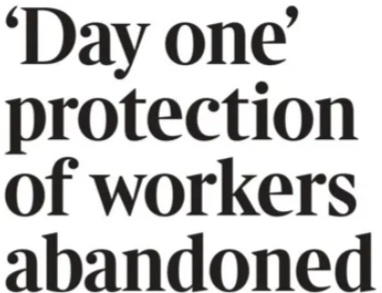
The bill on improving workers’ rights – still currently going through parliament although it was promised to be enacted in the first “hundred days” – is in the sights of business leader, who want it diluted down to virtually nothing. The latest news is that protection from unfair dismissal “from day one” – promised to the trade union leaders – has been dropped. It will not be the last element of workers’ rights abandoned.
Starmer and Reeves bending to capitalist interests
The Starmer/Reeves government has always based its economic outlook on the needs and mechanisms of capitalism. They will not tax the super-rich or shut down their tax-havens, because they are politically and philosophically in lockstep with these people. Not that it will help them…we can expect an ongoing press campaign against the government, over “unaffordable” welfare and “red tape” (workers’ rights and minimum wage) as the economy continues to slide.
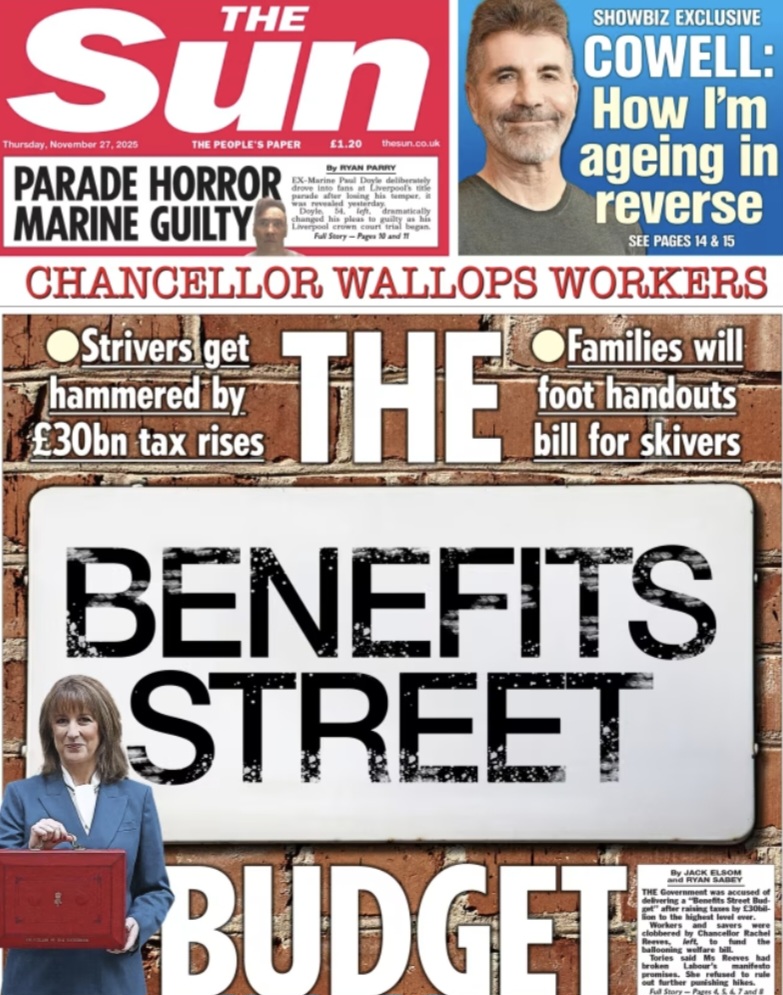
The very best the OBR expects from the economy in the coming year is a miniscule increase of 1.5%, and this is without additional, unfavourable external factors. The press, business and the financial markets will pile more pressure on the government over the coming months, to try to force through more cuts and economies for the needs of Rent, Interest and Profit. (See the comments on the budget and economic prospects by Marxist economist, Michael Roberts, here)
It would be an entirely different matter if there were a genuine ‘Labour’ leadership that based its outlook and its aims on socialist policies. It could appeal to workers for their support to take over and use the basic resources of the economy, to wield them in the interests of the majority of the population, instead of a numerically insignificant 1% at the top.
It could mobilise support for the public ownership of the main levers of the economy, industry and finance, to organise a democratic plan of production. On that basis, it really could offer affordable homes for all, decent education and health services and other benefits. Such ideas, however, are a million miles from the thoughts of this ‘Labour’ cabinet and so the crisis of British capitalism will stagger on and there will be continued demands for belt-tightening by workers.
Starmer and Reeves are between a rock and a hard place. Their own personal preferences lean them towards what is in the best interests of business and finance. But the modest reforms implemented in this budget – such as the removal of the the two-child cap – were only put in the budget to appease the growing storm of anger in the labour movement. In that sense, the different elements in the budget reflected the opposing class pressures on the government.
Government will be forced into making ‘tougher’ choices
If the government is forced to follow through with ‘tougher’ choices in the future – and we believe it will be – that will not go unanswered within the labour movement. Starmer was under threat before the budget, and MPs were taking bets on the timing of a leadership challenge. It remains to be seen how much time Starmer has bought himself with this budget, but we do not think it will be very much.
When the dust settles and the New Year turns, Starmer will still be looking at the coming May elections like a man looking into an abyss. We will see if this budget makes any positive impact on opinion polls, but we doubt it, and more than half of Labour MPs will still be looking at alternative careers in few years’ time.
The key to what happens in the coming months still lies with the trade union movement. The insecurities and uncertainties of workers’ lives will inevitably transmit themselves into their trade unions and, despite the weakness and cravenness of most of the leaders (with a few notable exceptions), they will be forced to defend their members’ interests.
In hindsight, this budget will not be seen as one that saved the Labour government from its catastrophic slide in popularity. And it will not be a budget that saved Keir Starmer or its author, Rachel Reeves.