
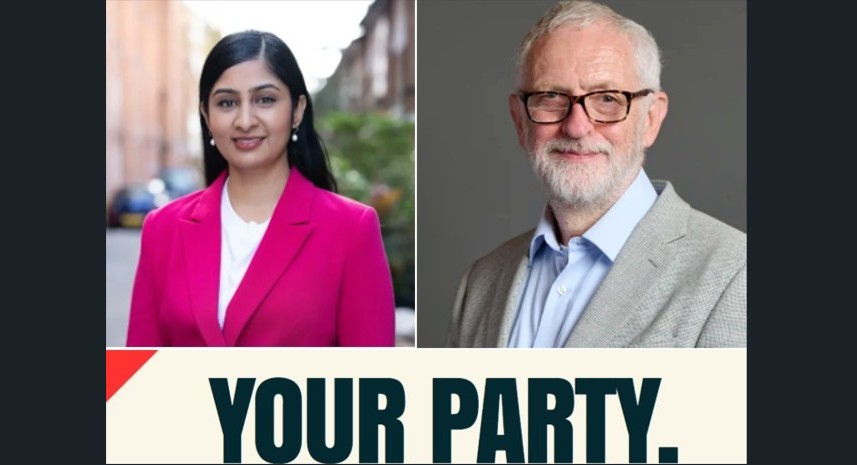
By Ray Goodspeed – Your Party member in Leyton and Wanstead
The difficult process of setting up Your Party has reached the stage of electing the Central Executive Committee (CEC). This is all the more vital as the conference last November vested leadership of the party in this collective body, rather than a single leader, widely seen as a rebuke to Jeremy Corbyn and the group of central organisers around him.
So these elections will determine the character of the party over the next couple of years, and two main factions are seeking to win a majority. These two groups, while based around Corbyn and Zarah Sultana, also represent different political positions and approaches to running the party.
Conference in November opted to have CEC members elected from within each of the nine regions of England. Eighteen members are to be elected this way, two from each region, at least one of whom would be a woman. Your Party organisations in Scotland and Wales are semi-autonomous – one member will be elected from each nation to the all-Britain CEC.
Four designated “elected-office-holder” positions, such as MPs, councillors etc, are to be elected by all members. So each member can now vote for two CEC members in their region (one in Scotland and Wales) and four office-holders elected to the CEC on a national basis.
Anyone who joins the party before February 5 can vote in the online ballot, which stretches from February 9 to 23. The results will be announced on February 26.
Given the factional warfare in the party since last summer, it is no surprise at all that two rival slates have appeared. Corbyn’s slate is “The Many” while Sultana’s is the “Grassroots Left”, and the names sum up the main differences quite well.
Important differences
Some say that slates are divisive and favour those connected to well-known national figures, but slates do not cause splits; they exist because there already is a clear division about the direction the party should take. It need hardly be said that these differences, while important, are nothing like the absolute gulf between Your Party members and the Starmer right wing of the Labour Party.
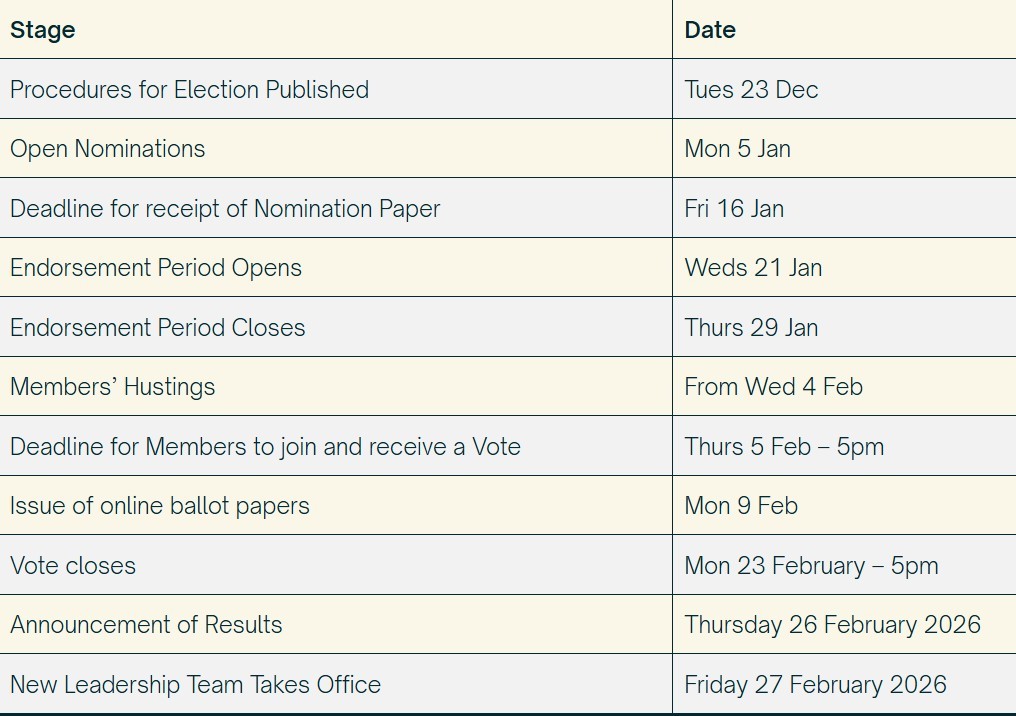
(from the Your Party website)
“The Many” have issued publicity and social media posts that stress “getting the party back on track” and looking back to the support the party seemed to enjoy six months ago. It focuses on broad policies that most on the left would not oppose. They mention the need to campaign on the issues that that matter most to people “from the cost of living to opposition to racism and war”. That is all well and good, of course, though it could and should go a lot further.
But there is a troubling undertone to their approach. They explicitly target “Reuniting our multiracial coalition – by focusing on what unites us, not what drives us apart.” This is an implied criticism of Zarah Sultana and her supporters; but what issues could they have in mind? It can only be the differences that opened up over issues of trans rights and abortion, between Sultana and Adnan Hussein, one of the “Gaza independent” MPs, and a member of Corbyn’s independent Alliance.
But this contains within it some dangerous assumptions. Firstly, it implies that some communities – specifically, Muslims – will have particular problems with these issues, and secondly, that the issues therefore need to be marginalised or quietly dropped for the sake of unity with Muslim voters.
But let us be crystal clear. It is simply not true that the Muslim community do not support parties that have a clear position on LGBT issues or abortion. For decades, Muslims joined the Labour Party and voted for it in vast numbers (around 85%) while it introduced laws to improve LGBT rights, including the 2004 Gender Recognition Act and the Equality Act of 2010, and supported the Cameron government’s law on equal marriage. Many Muslim voters have now transferred their support to the consistently socially liberal Green party. One leading Muslim political campaigning organisation, “The Muslim vote” are calling for a vote for the Greens in the coming Gorton and Denton Parliamentary by election.
Divisive tactic
It was a divisive tactic of the Labour Right – Starmer and his allies – to blame the loss of support for Labour on “Muslim social conservatism” when they lost, or almost lost, vital by elections. But the reason many Muslims voters have abandoned Labour in large numbers, apart from their failure in general to offer solutions to the fall in workers’ living standards, was, of course, the disgraceful support given to Israel during the ongoing genocide in Palestine and the widespread perception that Labour is increasingly Islamophobic, operating a hierarchy of racism which focuses on antisemitism to the exclusion of all else.
Of course, there are some more religious and conservative elements within the Muslim community who oppose LGBT rights, but the current wave of attacks on those rights are overwhelmingly coming from the conservative Christian right, using the vast financial resources supplied from the USA, or from the author J K Rowling, to bankroll vindictive legal challenges. The most vicious sections of the right wing press and TV channels lead the whipping-up of anti-trans prejudice and panic – the same media outlets that attack migrants, Muslims, and supporters of Palestine.
And supposing, for the sake of argument, that Muslims, or anybody else, will not support socially progressive policies, should socialists therefore abandon them and pander to such ideas? Of course not! Sultana did not suddenly prioritise such policies out of the blue, but responded specifically to anti-trans tweets on “X” from an Independent Alliance MP, one who Corbyn and his supporters were putting in a central role to run the process of founding the new party. And let’s not forget that Zarah Sultana herself is also from the Muslim community.
Any large socialist party, will attract members with a range of ideas on social questions that do not align with its policies or approach to these matters. This has always been the case and the response should be to respond patiently and try to educate the membership, though repeated oppressive or discriminatory behaviour in the party cannot be tolerated. However, it is a different thing entirely when an MP in an important central leadership role tweets these ideas for the world to see, and then resents being taken to task.
Many socialists and opponents of the Gaza genocide more generally would have been hugely impressed and encouraged by the unprecedented success of four so-called “Gaza independent” MPs in the general election of 2024, and the large number of extremely close contests and near misses. Even many Labour party members may have been secretly pleased at their success, which was mainly, though by no means entirely, based on the votes of the Muslim community in particular seats.
Independent Alliance
Corbyn rightly linked up with these MPs in Parliament on issues relevant to Palestine. He even caucused with them on a number of other issues related to austerity and the cost of living, eventually forming a parliamentary group – the Independent Alliance. Building unity around specific political issues is often essential. The street demonstrations in support of Gaza attract a myriad of different people who support the people of Gaza in their own way and for their own reasons.
But these kinds of alliances are very different from the task of building a new, consistently socialist political party from scratch. Having prevaricated and dithered for years about forming a new party, Corbyn was finally prodded into starting a new party, but then elevated these independent MPs into a key central position in the process of founding it. Yet, they were not consistent socialists. To be fair to them, they do not even claim to be. Ayoub Khan MP was a Liberal Democrat politician in Birmingham for 20 years right up to 2024, serving as a councillor and Parliamentary candidate.
This was not a principled position but an opportunist alliance and it is typical of the lack of clarity and rigour that Corbyn sometimes exhibits in his political choices. Some of those on the Corbyn slate seem to have been picked for similar reasons. There is a danger of repeating the unprincipled errors of Galloway’s Respect party, which sprang from the anti-Iraq War protests, and his subsequent other parties.
Corbyn preferred working with these informal arrangements in Parliament but Zarah Sultana had a different vision of a fully organised new party which she bounced Corbyn into founding in July 2025. Rather than work with her, a young, firebrand, left-wing socialist, woman MP from a Muslim background, Corbyn and his allies worked with the independent MPs to exclude her, to freeze her out.
It is striking that the “Grassroots Left” slate around Sultana endorsed Jeremy Corbyn for one of the four office holder positions, but his slate, “The Many” nominated two of these independent MPs, Ayoub Khan and Shockat Adam, and a previous left Labour MP, Laura Smith to stand alongside him. This is clearly an attempt to prevent Sultana from being elected to the CEC at all. So much for their calls for unity.
“The Many” talk of not “turning inward” or not “fighting among ourselves”, or “attacking our allies”. This is a not-very-subtle, dog-whistle attack on Sultana and those members of the party who have stood against top-down bureaucratic manoeuvres. Sadly, it echoes the insincere language used by many leaders and officials in the Labour and trade union movement when they want to dominate the narrative and shut down opposition by cynically appealing for “unity”.
Chaos and public division
Zarah Sultana, to be sure, must take a large chunk of blame for the chaos and public division around her premature launch of the membership portal on 18 September last year, and the subsequent confusion around the money people paid to join. This had a devastating effect, crushing the enthusiasm and morale of members for the new project. It damaged the trust that hundreds of thousands of people had tentatively placed in the new party, and led to seething anger among local activists and mass defections to the Green Party. Sultana has apologised, but will have to live with the consequences of that error.
However, it was not just her actions, but the very public response to them from Corbyn on social media, the threats of legal action, the secrecy, anonymous smears and backbiting, that compounded the problems, which arose in the first place because of shadowy manoeuvres and power grabs from his allies.
Another troubling aspect of the platform of Corbyn and “The Many” slate, is their opposition to allowing socialist groups to join and organise inside Your Party. For Corbyn, this is a truly remarkable transformation. He has spent decades being the public face, or honorary president, of any number of campaigns set up and run by Marxist groups, such as the Socialist Workers Party.
He served in Parliament in the 80s with MPs who were Militant supporters, including the Coventry MP Dave Nellist, and was forthright in opposing attempts to expel them from the Labour Party. He even ran a campaign from his own house against the witch-hunt.
In spite of the November conference voting by 70% to allow dual membership of socialist groups that the CEC approves, the anonymous organisers have decided that, before the CEC even exists, some Your Party members should be banned from standing to be elected onto it – including the very same Dave Nellist and a few other people accused of the crime of being in a socialist group.
This obsession with sniffing out and purging members, on political grounds, is an echo of the tactics of the Labour right and their loyal party bureaucrats. It is a self-defeating and divisive waste of time that will rob the party of countless experienced and hard working socialists. Incredibly, this is being proposed in a party made up of large numbers of activists who joined Your Party because they have bitter experience of such purges carried out by Starmer and co.
“A party for the whole left”
The programme and platform of the “Grassroots Left” has a very clear position on the internal democracy of the party and the encouragement of local branches with real power and access to the membership data and 50% of the members subs. It stand for a “party of the whole left” and the “freedom to organise into factions, tendencies and platforms”. It opposes proscriptions and bans on dual membership or other socialist groups.
Its political programme goes a beyond the list of reforms of “The Many”. It boldly proclaims its goal is to: –
“bring an end to capitalism, a socially and ecologically destructive system driven by the profit motive and private ownership of the means of production, and to replace it with a socialist society organised to meet people’s need, not generate profit.”
This becomes less bold or clear when it calls for: –
“An equal, fair, just and ecologically sustainable society organised around the needs of the majority, not for the profit of the few; key sections of the economy owned and democratically controlled by the people who work in them and depend upon them…”
It does not specify what these “key sections of the economy” are, using the same ambiguous phrase as in the Political Statement agreed at the conference. It is certainly a far cry from Sultana’s widely-mocked and clumsy response to an interview question where she suggested nationalising “everything”, but it does not clarify whether the bulk of the major companies and banks would be taken over so as to break the grip of the ruling class on the economy and society.
Unless this is done, any left government would be entirely at the mercy of a capitalist class that would still control the levers of economic and state power and either force the government to bend to its demands or overthrow it completely. However, the “Grassroots Left” platform is plainly leaning more towards such a position and it deserves to be supported on that basis.
It will be said that the Corbyn group’s more limited reform agenda, based on the 2017 Labour manifesto, is more likely be the basis of unity and get a wider level of support. That is a position often argued by reformists of all descriptions, right and left.
Experience of left governments
Of course, Corbyn and his supporters are genuine and well-intentioned in their desire to improve the lives of working people. Whatever disagreements we may have, we don’t doubt their sincerity. We don’t criticise programmes such as these to prove how left wing and revolutionary we are, but to analyse, in the light of previous experience of left-wing governments, whether such a programme of partial reforms can actually be implemented or rather lead to demoralisation and defeat. It is important to tell the truth, even when it is easier to fudge questions for the sake of short-term popularity or unity.
If Your Party restricts itself to Corbyn’s programme, it will be difficult to distinguish themselves from the Greens, whose programme is very similar. Corbyn likes to draw a distinction between his views and the Green Party, which he criticises as “not a socialist party” – but to most voters, the policies will seem identical. And The Green Party has 190,000 members, hundreds of councillors and the resources of an established party, not to mention a new and charismatic leader with a talent for communicating the message.

independent candidate in SE region
[photo from her social media]
There are some good socialists who are standing for the CEC as independents. Naomi Wimborne-Idrissi is standing in the South East Region. A leading figure in Jewish Voice for Labour and a tireless campaigner for Palestine, she was elected to Labour’s NEC but expelled before its first meeting! She is not formally part of the Grassroots Left slate but she is endorsed by it and also by Andrew Feinstein.
The election is by Single Transferable Vote (STV) so it is possible to vote for good independents but allocate your second and subsequent preferences to avoid splitting the vote. The fact that the CEC is elected in nine separate English contests prevents the committee from representing minority viewpoints in the party as fully as if it had been elected on an all-England STV basis.
Further, giving two CEC reps to each region, regardless of wildly different populations and membership figures, is not a fair basis of representation. This will have to be looked at again in future elections.
Endorsement period – ends 29 January
Many people have put themselves forward for election, but to get on the ballot paper each person standing to be a regional representative needs 75 individual members in that region to “endorse” them via an online system. Members can only endorse two such candidates each. The endorsement period runs from 21 until 29 January, so potential candidates are currently feverishly seeking support from other members on social media and via personal connections so as to get over the threshold by next Thursday.
In more populous regions, several independents have already got over the threshold, in addition to those on the two main slates. In London, for example, some candidates have received hundreds of endorsements, while in smaller regions, even the four “slate” candidates are struggling, at the time of writing, to get the necessary 75. This will also have the effect of limiting the choice of candidates as many will not make it on to the ballot at all. These anomalies will also need to be ironed out in future.
“Office-holder” potential candidates need just 150 endorsements from the whole country, and most of them have reached that total easily, with Corbyn and Sultana in the lead.
In this election it is vital to ensure that the party is established on democratic principles and to reaffirm the consistently anti-capitalist, socialist nature of the party. Left Horizons supporters who are in Your Party should therefore offer their support, in the main, to those candidates standing on the “Grassroots Left” slate.
[Featured title image – from the websites of Your Party, The Many, and The Grassroots Left]











“Zarah Sultana, to be sure, must take a large chunk of blame for the chaos and public division around her premature launch of the membership portal on 18 September last year, and the subsequent confusion around the money people paid to join. The[y] had a devastating effect, crushing the enthusiasm and morale of members for the new project. It damaged the trust that hundreds of thousands of people had tentatively placed in the new Party, and led to seething anger among local activists and mass defections to the Green Party. Sultana has apologised, but will have to live with the consequences of that error.” Crushing the enthusiasm and morale of members for the new project? Your Party or rather “Their Party” is already a spent force in my opinion. The initial enthusiasm has been squandered and with the infighting it won’t be long before there’s a split in “Their Party”.