Left Horizons introduction: This is the second part of Ted Grant’s reply to the policy statement (manifesto) of Chesterfield CLP, a left Labour Party influence by Tony Benn, who was one of the most important post-war figures on the left of the party.
This part deals largely with foreign policy, peace and the United Nations. Although Grant’s perspective for the Stalinist states of Eastern Europe and China were not borne out by events, his description of these states at the time has important historical value. As we published the first part exactly as it was in the original Militant newspaper, this second part is also exactly as it appeared, with one tiny insertion (see note at the end).
The Chesterfield CLP statement was published in Left Horizons here, and the first part of Grant’s reply here.
Notes for the text:
The Treaty of Rome. This was the founding agreement between European states to establish the ‘Common Market’, which later became the European Union. Adherence to the Treaty, therefore, implied membership of the Common Market.
Grant refers to the “200 monopolies” in relation to the British economy (and the “60 families” in France). This was a shorthand used by Marxists for the small number of large companies that dominated and controlled the capitalist economy. Today, a much smaller number of giant firms control British capitalism.
Forty years ago, it was common to describe the post-colonial states, especially those in Africa, the Middle East and Asia (with the exception of China) as the “Third World” – the “first” and “second” being the capitalist west and the bloc of Stalinist states. Nowadays, “Third World” states would be referred to as the “developing world”, whatever their actual level of poverty or economic development.
Shah and Murdoch. Eddie Shah was a relatively small-time newspaper proprietor who established a non-union printing company. Rupert Murdoch, was a much bigger player in the media industry and he, too established a plant without allowing any workers to joint the established print unions.
…………………………………………………………………………………………………………………..
[photo – Militant 31/1/1986]
Only workers can guarantee peace
Last week, Ted Grant, Militant’s political editor, began an analysis of the statement of aims and objectives of the Chesterfield Labour Party, the publication of which he described as a service to the Labour movement. He continues with a look at the statement’s aims on the Stalinist countries, international affairs and the media.
Totalitarian bureaucracy
The Tories in Britain, and America especially, but throughout the industrially advanced capitalist states use the example of Russia and of Eastern Europe as a scarecrow to frighten workers as to what socialism would mean. It would mean the end of your liberty and a totalitarian state is what they say.
The truth is that all that is left of the great achievements of the Russian revolution are the nationalisation of the means of production, distribution and exchange, and a plan, however bureaucratically distorted now, of production. The capitalists and the Tories take advantage of the totalitarian regimes in Russia and Eastern Europe to discredit socialism, just as they take advantage of the abuses of nationalised industry , in order to discredit nationalisation.
As the Chesterfield document correctly remarks no country can build socialism alone. It is an aberration due to backwardness and isolation that led to the lack of democracy in the Stalinist countries. Russia is further away from socialism 70 years after the revolution than in the early years of the revolution under the leadership of Lenin and Trotsky. The bureaucracy has taken power out of the hands of the workers and now runs the economies of Russia, Eastern Europe and of China in the interests of the nationalist bureaucracies rather than in the interests of the working class.
There is less equality, freedom, discussion, democracy and debate than even in the period of the civil war which followed the revolution. The economic basis for a move towards socialism is there due to the successes of industrialisation, because of the abolition of capitalism and landlordism. There is no political basis for a movement in this direction.
All that remains is state ownership of the means of production, but run in the interests of the parasitic bureaucracy and not of the workers and peasants. How far they are from socialism is indicated by the fact that the economic integration of the Comecon countries is less than that of the capitalist EEC! Each national bureaucracy tries to build the economy for itself instead of integrating the economy for the benefit of the peoples of all these countries. It is impossible in a bureaucratic regime to do this. The only way international co-operation could be established would be through the overthrow of the bureaucracy and the coming to power of the workers and peasants of these countries, who would establish a real workers’ democracy with freedom for all parties.
Four conditions
Not a single one of the four conditions laid down by Lenin for the beginning of the revolution, preparing the way to move towards a greater and greater equality until all inequalities are abolished, exists in Russia now.
These conditions were: 1. The election and recall of officials in Soviets. 2. No official to have a higher wage than a skilled worker. 3. No standing army, but an armed people. 4. All jobs to be done in rotation – if everyone is a bureaucrat, no-one is a bureaucrat. None of these apply today. In reality Russia is further from socialism now than it was at the dawn of the revolution.
World socialist federation the goal.
The Chesterfield document says: “The adoption by Britain of a non-aligned foreign policy, committed to the United Nations but free of all military alliances, so that this country, with others could help ease international tensions, reduce arms expenditure and assist the development of the Third World.
The development of closer economic, industrial, social and political links between working people here and in other countries free from the control of the Treaty of Rome and NATO.”
In reality this is an entirely utopian policy. Britain being one of the large countries cannot opt out of the international arena. War is a continuation of policy by other means to quote the famous German general Clausewitz. Wars are not moral questions. They are caused by the struggle for markets, raw materials, spheres of influence and nowadays neo-colonial domination.
Foreign policy, like home policy, is dictated by which class is in power. Capitalists would not allow even a left Labour government to pursue a different foreign policy unless they had been rendered impotent by the taking over of the 200 monopolies. There is only one way to develop closer, economic, industrial and social links between working people and that is through the labour and trade union movement. And through the actions of working people themselves.
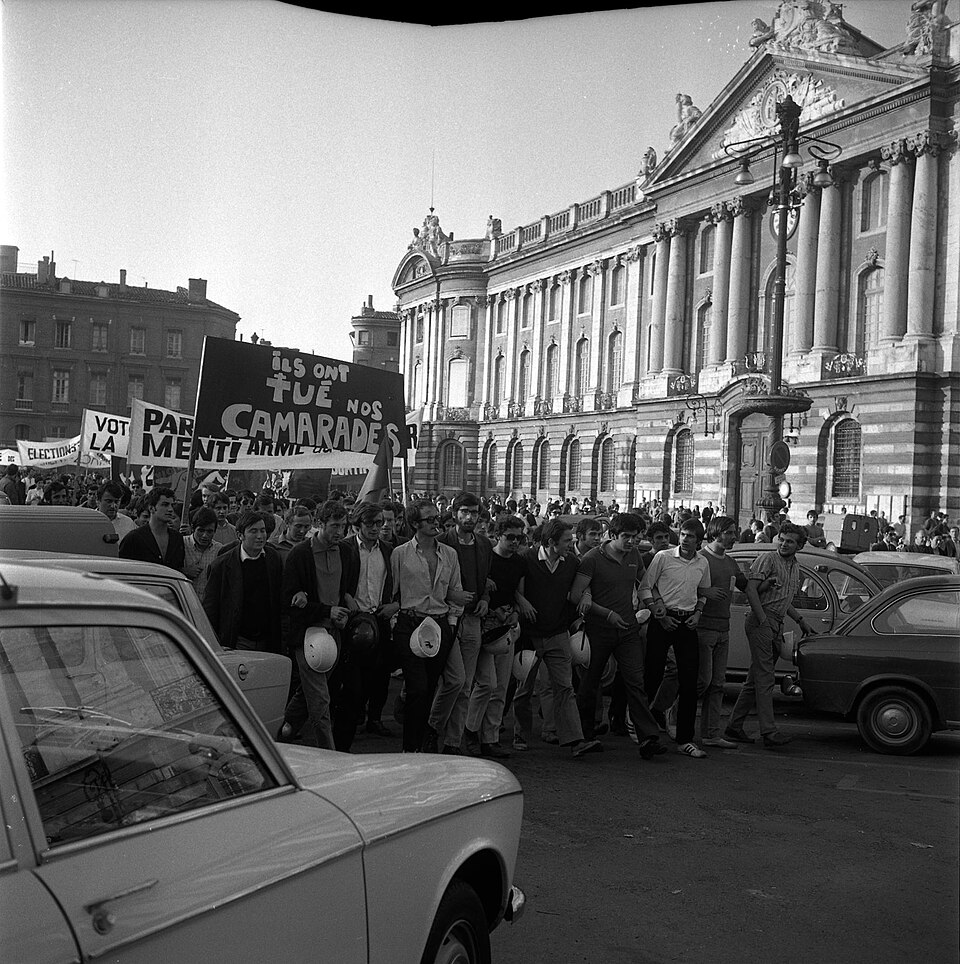
[photo André Cros – wiki commons]
This was shown in action at the time of the stay-in strikes in France in 1968 when ten million workers in effect tried to carry through the socialist revolution by seizing control of industry for an entire month. Their action had an enormous effect on the workers of other countries. Dockers, railwaymen, airport workers, lorry drivers of Germany, Italy, Holland, Belgium and other countries bordering France immediately introduced a blockade so they would not scab on the French workers. This was done without a lead from either the labour or trade union organisations in those countries.
A socialist transformation of society in any important country of Europe would have an enormous effect on the working class of Europe and of the world. Had the Socialist/Communist government in France, with 55 per cent of the votes transformed that society by taking over the industry of the 60 families that control France the situation there would have been different. Even the nationalisation of all the banks was not sufficient to give a genuine control of the economy.
The only way to break free from the Treaty of Rome and NATO would be to establish a genuine socialist regime in Britain which would then appeal to the workers of Europe and the world for succour and support. They would get an enthusiastic and massive response. While of course standing for the rights of all the peoples, Marx explained that under conditions of super imperialism, under conditions of enormous economic development of the world market, it is not possible for genuine independence to be established by small nations or the colonial peoples themselves.
Terms of trade
Collective exploitation by the EEC, Japan and the United States of the peoples of the Third World is even greater now than when the empires controlled most of the colonial world. To give a recent example, in the last 18 months, the terms of trade between the ex-colonial world and the industrialised states has changed. This has meant the transfer of $79 thousand million as a parasitic extraction from the poor, the hungry and the starving for the benefit of big business. The price of the goods that the underdeveloped world sells – raw materials and food – has dropped, while the price of the manufactured goods and capital goods they buy are still continuing to rise.
There is no way that this could be altered except by socialist governments taking over the economy of the capitalist states and then integrating the economy with that of the underdeveloped world. They could then provide them with cheap credits, technicians and expoerts of all sorts to help with the development of production by integrating the economises of these countries with Britain and Europe. This would raise enormously the standard of living and prepare for the time when their standards of living will be as high as those of the developed countries.
Britain exports 30 per cent of the goods she produces and imports also about a third of the goods that are sold in Britain. Even more than all other capitalist countries, she is completely dependent on the world market. That is why it will be impossible to build socialism in Britain alone. That mean that a socialist Britain would have to strive through propaganda and appealing to workers of other countries to establish like governments in Europe, leading to a socialist united states of Europe which in its turn would lead to a socialist united states of Asia, Africa and of Latin America, linking the world in a world socialist federation.
The economies of the world are linked together indissolubly through the world market. Internationalism is not a sentimental question but a question of material interests of the workers of Britain and of the world. The interests of workers of all countries are the same because they struggle against the same enemy in capitalist countries and against the bureaucratic Stalinist regimes in Eastern Europe, Russia and China. It will not be sufficient merely to overthrown capitalism within the boundaries of one state but will be necessary to spread the socialist revolution to other countries as well. The material interests of the workers of the world are the same everywhere.
The right of self-determination for colonial peoples must be supported, but economically it is meaningless without democratic socialist governments linking the economies of these countries with the economies of the workers of the West.
A genuinely socialist Britain would lead to the collapse of capitalism in Europe, the United States and the Third World. It would lead to the collapse of the Stalinist dictatorships which would turn to workers’ democracy.
UN will not prevent wars
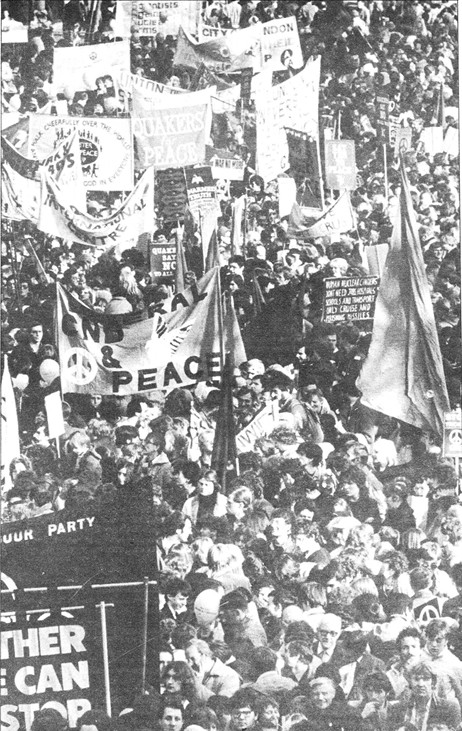
The United Nations can solve not a single one of the important problems. In fact it has even been impotent to stop, prevent or solve any of the wars which have taken place since 1945 which together must have seen almost as many people killed as during the massive world war of 1939-45.
The United Nations remains a forum to settle secondary differences by the big powers. All the resolutions demanding action by Russia and America and the EEC countries and even by the smaller countries have failed utterly to have any effect. Nor could it be otherwise.
Big powers decide
At the United Nations only secondary questions are discussed for serious solution. The fundamental problems, as for instance on the question of disarmament are discussed outside by the big powers – now only by the big two of the super-powers of Russia and of America. When their important interests are at stake the big powers ignore entirely the pleas of the United Nations. In any event the United States, Russia, Britain, France and China have a veto through the Security Council of all decisions of the United Nations. Thus it is the big powers that decide and no others.
The tensions of the world are caused by the fundamental contradictions caused by the fact that the national state is too small for the purpose of developing national production. While all give pious prayers for disarmament, in reality the piling up of arms has reached a horrifying level. The world spends £1 million million on armaments in less than two years now. This insane and senseless arms race is caused by the contradictions between the different countries.
It is also welcome to the capitalists as a partial means of getting rid of the enormous surplus by building scrap metal. This also means diverting the attention of the masses from the real contradictions in society by the Russian bureaucracy on the one hand and above all by American imperialism and its satellites on the other. Thus the United Nation has not prevented the greatest arms race and arms expenditure in the whole of human history.
The United Nations is completely incapable of having any effect on wars, such as that between Iran and Iraq. In the same way as the workers would not trust the bosses to conduct their negotiations for higher wages and better conditions, so they can trust even less the representatives of these bosses in international affairs. The predatory and dictatorial attitude of Shah and Murdoch as individual capitalists is an indication of how the capitalists behave. Where the capitalists are organised as the state, how much less can we expect that the bosses on an international plane would behave any differently than the individual forces?
Agreements between nations are like agreements between the workers and the capitalists. They are scraps of paper as far as the capitalists are concerned, to be broken when employers can gain an advantage. The print industry at this moment demonstrates that clearly.
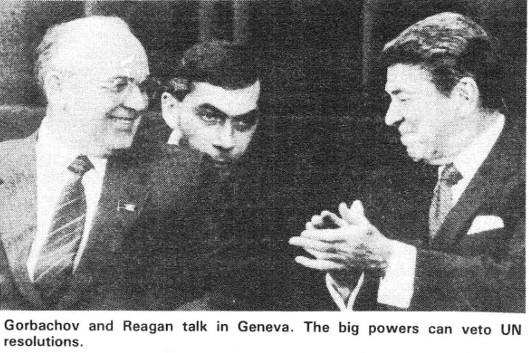
Even more when nations are involved they are the same. Nationally and internationally workers can rely only on their class organisations, solidarity, class strength and consciousness. Workers must trust in these rather than in foolishly imagining that the class enemy will construct international or national organisations to help them in their struggle. Only workers’ power and socialism can lead to permanent peace and genuine fraternity between peoples.
How can the press be fair?
It is not the Marxists, but the right-wing Labour leaders and even more so the Left Labour leaders who have utopian ideas. One of the rights put forward in the Chesterfield statement is: “The right to mass media which provide accurate news, free from bias or distortion, and a diversity of views”.
In Britain we now have the most vile and disgusting press of any capitalist country. Workers in struggle have found every time that their struggle has been distorted by the lies of the Sun, the Express, the Mirror and the Mail. Therefore there should be a forthright demand for the nationalisation of the press under the control of the labor and trade union movement. It is not put forward in the Chesterfield document because of the fear of the howls about totalitarian control, by the millionaires who make a mockery of freedom of the press and who exercise semi-totalitarian control of the media themselves. [To counter the lies*] they will put forward, let us explain that once the press is under control of the labour and trade union movement then right of access to the media would be allocated according to votes at elections. What could be more fair and democratic than that?
Robert Williams, one of the Labour leaders in 1920, declared; “Give me dictatorship over Fleet Street for a single month and I will destroy the hypnosis!”. There is a tradition in the labour movement for control of the press and we are asking not for dictatorship but access to the press for all in accordance with the support they have within the ranks of the population.
Of course it is our mission not only to take over the Fleet Street mafia but also the new media which are even more powerful – TV and radio – which are systematically under the control of big business, even the BBC which is supposed to be impartial but in reality has almost become a department of the Tory party. Only this way could a genuine democratic and fair access to the media be guaranteed for all tendencies in society.
[* In the original at this point, there was a clear omission at the beginning of the sentence, almost certainly as a result of an error in laying out the newspaper. Four words have been inserted by Left Horizons so the sentence makes sense]
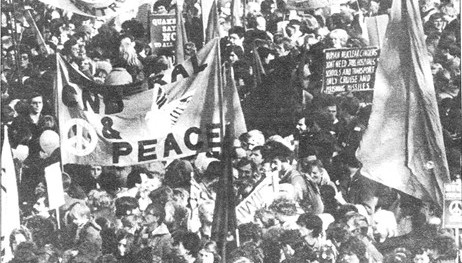
[Featured image – peace demonstration in London – 1980s – clipped from a photo in Militant – 31 January 1986]