By Andreas Bülow
Under military pressure, sanctions and direct threats from the United States, the Venezuelan government is rolling back key parts of the Bolivarian revolution. A reform of the Hydrocarbon Act opens the way for massive privatisation of the oil sector and marks a historic loss of national sovereignty.
The battle for Venezuela can be roughly reduced to one piece of legislation. It is the law on hydrocarbons (Ley de hidrocarburos) – the law that regulates Venezuela’s entire oil sector.
The law was introduced under President Hugo Chávez in 2001. It was precisely this law that was one of the main reasons for the failed, US-backed coup d’état of April 13, 2002. And it is exactly the rollback of the very same law that Marco Rubio boasted loudly about on Thursday in his speech to the US Senate. The rollback is a direct consequence of the US attack on Venezuela on January 3 and the threat of new attacks.
Chávez’s original law was an attempt to increase national sovereignty over Venezuela’s oil wealth. In my 2010 book The Venezuelan Revolution, I described how Venezuela’s oil wealth during the Fourth Republic (i.e., before 1998) was mainly extracted for the benefit of multinationals and a local oligarchy. Chavism can historically be understood as an attempt at a national-democratic revolution, which in the process went in the direction of socialism (but not all the way there).
The law on hydrocarbons specifically meant that restrictions were placed on private capital: 51 percent of all the joint venture companies that extracted and sold the oil were to be in the hands of the state. The obligation to pay royalties to the state was significantly raised. It increased from the previous 16.67 percent to a flat rate of 30 percent for both light and heavy crude oil.
A section of the law stipulated that any legal disputes between the multinationals and the Venezuelan state should be settled in local courts. And last but not least, the law meant that oil revenues were earmarked for social programs, the missions: to fight poverty and improve education and health.
The reform relinquishes sovereignty
At the end of January 2026, Venezuela’s parliament passed a reform of the law, which appears to pave the way for massive privatisation.
The law had already been greatly relaxed by the Maduro government with a special law in 2020 (the so-called anti-blockade law). But the new reform seems to go much further, and is likely to make major concessions to the multinationals.
Royalties can vary and are no longer set at 30 percent. Legal disputes must now be settled in international bodies, outside Venezuela. Venezuela’s parliament used to have to approve contracts, now it just has to be “notified”. The extraction tax will be lowered from 30 to 15 percent. Foreign companies will have the opportunity for full operational and sales control.
In other words, the reform represents a surrender of sovereignty in all respects. That’s why Marco Rubio was so pleased – even though he admitted that it might take more to attract investors, but he promised that it’s just a first step.
US sanctions exacerbate the crisis
The bourgeois financial world portrays it as if Chávez destroyed Venezuela’s oil sector. But that is not correct. Even in the years 2002-2003, when the local elite tried to overthrow the government with an employer lockout in the oil sector, Venezuela exported over two million barrels of oil per day throughout the period.
It was not until much later, when Maduro was in power and in the wake of the economic crisis in 2014, that oil production collapsed and reached a low point of about 0.5 million barrels of oil sold per day.
The situation had then deteriorated significantly with sanctions from the United States. They started with President Barack Obama’s decree in 2015 that Venezuela was an “extraordinary and exceptional threat” – and were later tightened by Trump, with a financial blockade (2017) and then a complete oil embargo (2019).
It is true that Venezuelan governments – including the Chávez government – made mistakes by not preparing for crises and adversity. For example, they did not invest in massive renovation and maintenance of PDVSA (the national oil company). But the idea that it is national sovereignty – the hydrocarbon law – that in itself created the collapse is completely wrong.
Workers’ rights are also under fire
The hydrocarbon law is not the only law under fire. At the same time, the Venezuelan Parliament approved the launch of a reform of labour legislation.
A law – also from the Chávez era – that originally provided a large number of improvements for workers, unions and framework conditions with a moderate, but nevertheless important, set of rights. But a bit like the hydrocarbon law, the law was to some extent overridden in August 2018 when the Maduro government introduced a package of economic measures – including Memorandum 2792, which de facto suspended all collective agreements in the country.
Special economic free zones with limited labour rights were also introduced. These measures are a large part of the explanation why we are today faced with a huge weakening of popular resistance in the wake of the North Americans’ air strikes on Saturday 3 January.
A government with a gun to its head
It is clear that Delcy Rodriguez’s government has a gun to its head. Both Trump and Marco Rubio are openly talking about her having to cooperate “if she is not going to suffer a worse fate than Maduro“. At the end of January, Delcy said in a speech to Venezuela’s National Assembly that “orders from Washington may be enough.”
But in practice, she is rolling back a large number of the cornerstones of the original Bolivarian revolution. It is precisely these cornerstones that the White House wants removed in order to gain access to the oil.
Some see this as a tactical retreat. They argue that the enemy is too omnipotent and that time must be gained. But the problem is that this kind of tactical retreat must always be explained to one’s political backers, if you do not want to risk demoralising everything and everyone.
As it stands, there is not a single explanation from the Venezuelan government leadership, neither for the military failure on January 3 – when the country’s air defenses were almost completely out of order – nor for the many economic concessions to the United States.
Last week’s meeting between CIA Director, John Rattcliffe, and Delcy Rodriguez has also not been commented upon, although it has been widely reported in both US and Venezuelan media. Nor has the new oil deal with the United States – where the money is deposited in an account in Qatar, where the United States decides what Venezuela can use it for – been explained and presented openly. All these ‘corridor agreements’ are the opposite of building a broad anti-imperialist resistance.
Venezuela’s future is not decided
There are many examples in the history of the world where colonial masters and imperialists have been defeated by militarily inferior armies. One could mention Haiti, Vietnam or Algeria, but Venezuela’s own history and war of independence are probably the best examples.
Simón Bolívar did receive some support from Britain, but he did not drive out the Spaniards because he had more horses or better artillery. On the contrary, he made a broad appeal to the masses – to the natives, to the African-American enslaved people, to the peasants and agricultural workers on plantations. This is how Venezuela became free back then – this is how it will be liberated again.
The battle for Venezuela’s future is far from settled. There is a clear direction in the direction the government is going now. But there may be resistance and new developments that tip the balance in one direction or another.
Towards the end of his life, Simón Bolívar predicted that “the United States of America seems destined to spread misery in America in the name of freedom”. So far-sighted was the man who died before the United States had developed into the industrial, imperialist power it is today.
[Translated from the Danish socialist website, Solidaritet, original here.
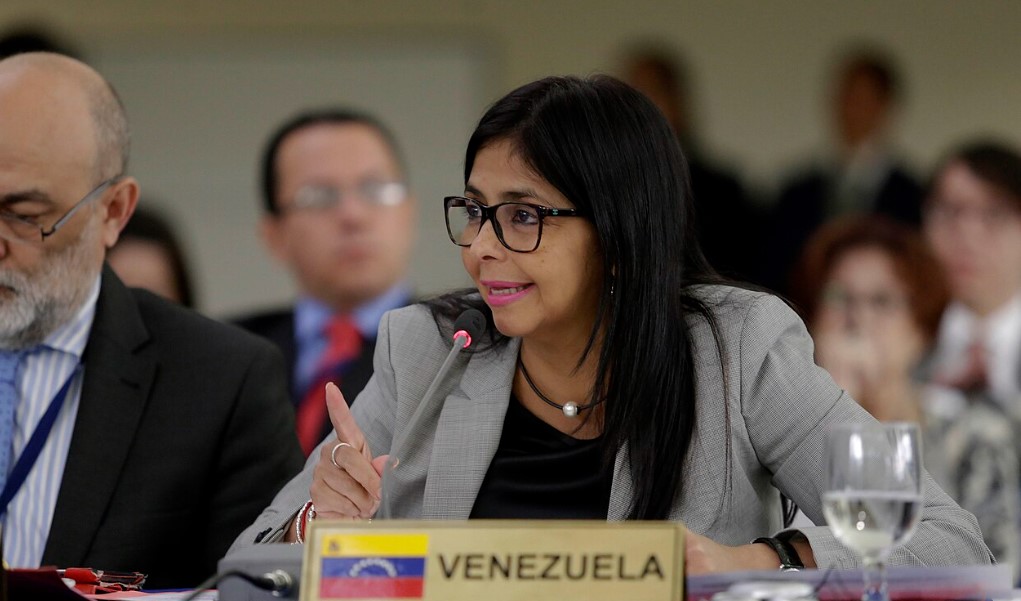
Feature photograph of Delcy Rodriguez from Wikimedia Commons, here]
Andreas Bülow is the author of the book The Venezuelan Revolution – Eyewitness Account and Analysis (2010, unfortunately only available in Danish). Andreas is active in Hands Off Venezuela, the Red-Green Alliance and writes for Socialisten. Read more