
JOE LANGABEER reviews this TV series based on the dystopian video game.
[WARNING – this review contains partial spoilers of some plot twists]
The second season of Fallout, currently on Amazon Prime Video, has just wrapped up and has proven to be another commercial and critical success for the series. It has been ranked as the number one show on the platform in both the UK and the US. The series is based on the popular Fallout video game franchise, which I happen to be a massive fan of.
In my youth, I was drawn to its dystopian, parody-like depiction of an America decimated by nuclear fallout, alongside the amount of choice the player could have over the narrative of the story. As I have grown older, however, I have come to better appreciate the political themes that both the games and the television adaptation bring to the table.
The premise of Fallout is that after the Second World War, following the atomic bombings of Hiroshima and Nagasaki, the western world developed nuclear power for efficient everyday use. Cars, transport, robots, and machinery could all be powered by nuclear fusion, allowing society to progress rapidly on the basis of technological advancement.
But by 2077, the year in which the nuclear annihilation begins, the world, and America in particular, remained culturally stagnant due to its continued clinging to the American Dream. Popular music is still Billie Holiday and The Ink Spots, a nostalgic holdover from a bygone era. As a resource war breaks out between America and China in the years leading up to the nuclear fallout, the United States still reflects an obsession with maintaining its perceived importance on the world stage, even as the promise of the American Dream fades.
Nuclear annihilation
Like the majority of the games, the events of the show begin 200 years after the bombs dropped, with flashbacks used to fill in the broader historical context. Central to the narrative is the question of who actually initiated the nuclear annihilation. The audience is introduced to Lucy, who has grown up in a vault built by the Vault-Tec Corporation, a private company that constructed these shelters before the war to house the rich and powerful.
Unbeknownst to their inhabitants, the vaults were secretly designed as experimental laboratories by the ultra-wealthy in collaboration with the US government. Their primary purpose was to study humanity, with the assumption that if nuclear fallout were to occur, only the strongest individuals from certain vaults would be allowed to survive. It is, at its core, a eugenics programme engineered by the capitalist class in cooperation with the state.
Lucy’s vault, Vault 31, is linked to two other vaults: Vault 32 and Vault 33. Without giving the full plot away, as the relationship between these vaults becomes central to the story, the initial perception of their design is rooted in a social experiment. The question posed is whether groups isolated from the rest of the world would learn to cooperate with one another, or whether they would instead attempt to exploit or even kill each other in competition for dwindling resources.
A raider group from the surface infiltrates Lucy’s vault, resulting in the deaths of several inhabitants and the kidnapping of her father, Hank, who also serves as the leader of the vault (referred to as “overseers” in both the games and the show). From there, Lucy leaves the vault in search of her father and enters the wasteland.
She is repeatedly confronted with moral conundrums and, due to her naivety and belief in the inherent good in people, is often met with aggression and violence from its survivors. She is tortured, abused, manipulated, and almost killed on multiple occasions, as her sense of morality is slowly eroded. The wasteland is utterly devoid of any serious attempt to rebuild decency or social cohesion, operating instead on the logic that survival can only be sustained through barbarism.
Barbarism
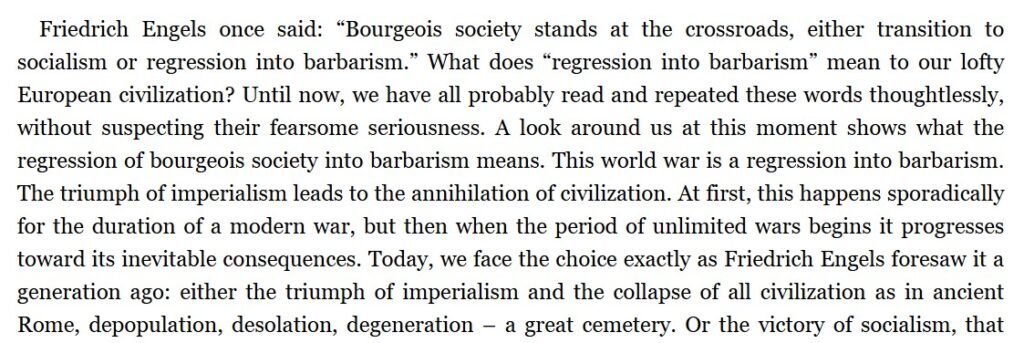
Both the show and the games are reminiscent of Engels’s comments, as quoted by Rosa Luxemburg, that if a bourgeois society does not transition to socialism, it will eventually regress into barbarism. For socialists in the early twentieth century, the phrase “socialism or barbarism” referred to the looming threat of the World Wars, as Luxemburg outlines in The Junius Pamphlet when discussing the crisis of German social democracy.
[from Marxist.org]
For socialists from the 1960s onward, this regression was framed through the threat of nuclear war between the West and the Soviet Union, which the games and the television show have been greatly influenced by. Today, it is often understood through the lens of climate change, where the consequences of environmental catastrophe could be so severe that, without a socialist transformation of society, we would lack the infrastructure necessary to respond, forcing humanity into a new era of barbarism.
Fallout interestingly manages to weave these different strands of bourgeois regression together, forming a near-perfect depiction of humanity’s descent into barbarism. A resource war, driven by a capitalist class hell-bent on extracting profit, leaves the public without power or energy to work, resulting in mass unemployment. The West, fuelled by renewed patriotism and cultural stagnation, revives a McCarthyist propaganda machine against China, with posters in the games comically vilifying communism in a satirical manner.

[photo – wiki commons]
Most of the survivors, and even the technology responsible for broadcasting this propaganda, are incapable of explaining what communism actually is, knowing only that it is something to be feared and this is intended to be a parody of the “red scare witch hunt” of McCarthyism. Alongside this sits the imperialist front, where America and China both lay claim to Alaska and engage in conflict over its ownership, a struggle that, until the television series, was suggested by the games to be the catalyst for the atomic bombs being dropped.
The show ultimately informs us that it was the capitalist class who paved the way for the atomic bombs to fall. In order to create opportunities for Vault-Tec, which is controlled by the elite, the first season finale explicitly states that members of this ruling class were prepared to drop the bombs themselves in order to generate profit and expand their social experiments.
Staggering revelation
It is a staggering revelation, one that sends one of our central characters, former soldier and actor Howard Cooper – later known as The Ghoul in the present timeline – into a spiral. Married to a Vault-Tec executive, he gradually uncovers the truth and is pushed towards working with an insurgent group determined to prevent nuclear annihilation.
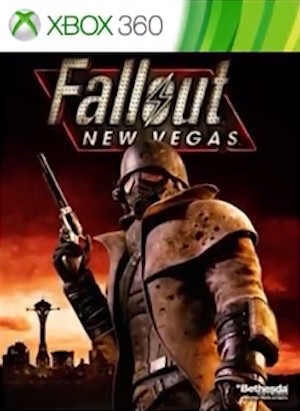
Season two introduces several factions within the current post-apocalyptic timeline, based on the fourth entry of the video game series, Fallout: New Vegas. There is the New California Republic, battered by rival groups in its pursuit of revitalising American imperialism through military colonisation of their former territories. The Brotherhood of Steel emerges as a purist, cult-like organisation obsessed with recovering pre-war technology. They are violently discriminatory towards anyone deemed not purely “human”, particularly those transformed by radiation into ghoulish figures, described in the game and show as literal ‘ghouls’.
[image – wikicommons]
Many ghouls and other casualties of the wasteland are not harmful, yet the Brotherhood refuses to accept them and uses military force to eliminate them.
Caesar’s Legion represents a barbaric, fascistic faction that models itself on the imperial conquests of the Roman Empire, constructing rigid hierarchies in which women, children, and so-called “weak” men are enslaved. Torture, rape and public execution are central to its rule over the wasteland.
Then there is Mr House, a self-described capitalist and key architect behind the Vault-Tec project, who seeks to commodify human experimentation on a mass scale. In Fallout: New Vegas, he survives the nuclear catastrophe by placing himself into cryogenic hibernation, appearing to the player via vast television screens as he directs events, and the player, in pursuit of profit.
The television series expands his role, portraying him as instrumental in supplying Vault-Tec with the nuclear capability required to initiate the catastrophe. His logic is that if the bombs fall, he can use missile defence systems to preserve himself and Las Vegas, allowing him to continue his profit-making ventures in the post-apocalyptic wasteland. For a time, as the game shows, he succeeds.
Critical energy resource
The game significantly informs the structure of the television programme. Towards the end of New Vegas, the player must choose which faction will control New Vegas and its critical energy resource, the Hoover Dam. The current show has drawn criticism for refusing to select a canonical ending from the game, released sixteen years ago. Instead, it adopts the position that in a world consumed by barbarism, nobody truly wins, even if each faction believes it has.
That has always been the central message of both the series and the games. Barbarism can never produce liberation for the masses. Humanity must choose an alternative to a system driven by profit. The choice remains the same – socialism or barbarism. Though it should be said that neither the show, nor the games ever explicitly state this.
However, it is worth noting that the project director and lead designer of Fallout: New Vegas, was Josh Sawyer. He is a self-described progressive and democratic socialist. He has spoken at length about the intersections between video games and socialist politics, offering thoughtful reflections on video game design, the politics of the video game industry and political ideologies of his video games through his YouTube channel. For those interested in exploring these connections further, his work there is well worth seeking out.
By the end of the second season, further suggestions emerge that a shadowy organisation, devised by big business in collaboration with the US government, orchestrated the dropping of the atomic bombs as a means of experimenting on humanity and “purifying” it for a new civilisation. This group is known as the Enclave, who are referenced in the first season but not explored. While the television series has yet to explore them fully, they have served as primary antagonists across several of the games.
The Enclave operates as a fascistic paramilitary force practising eugenics and conducting grotesque experiments in an attempt to engineer super-soldiers capable of rebuilding a militarised post-apocalyptic state. Many of these experiments failed, making the wasteland even more hostile than it already was. They are likely to serve as the central antagonistic force moving forward, though, as with most factions in Fallout, their agenda is fundamentally self-serving, rooted in militaristic domination rather than rebuilding a better civilisation.
Irony
It is highly ironic that Amazon serves as the producer of a show so openly critical of capitalism’s decline and its descent into barbarism. That irony, however, should not mislead anyone into thinking that the creators have strayed from the source material. The politics and world-building of the television adaptation are as compelling and as politically pointed as they were in the games. While Fallout can at times present a bleak, even nihilistic, view of humanity, those conclusions are framed within the logic of a system driven towards war by a capitalist class that sees no alternative for its own preservation.
As the tagline of the series declares, “War. War never changes.” The statement resonates because it reflects the cyclical violence embedded within that capitalism class to protect their interests, often through imperialist means.
Capitalism cannot reform itself into something fundamentally different; it will always reproduce those same contradictions. If the series poses a choice, it is the same one echoed throughout its political undercurrent: socialism, or barbarism.
[Featured title image – logo of the Fallout TV series – from wiki commons]