By Cain O’Mahony
If the Far Right in the UK thought they were on a roll with their recent riots and rallies, many communities – particularly the youth – are beginning to fight back. There have been some impressive mobilisations, most at very short notice.
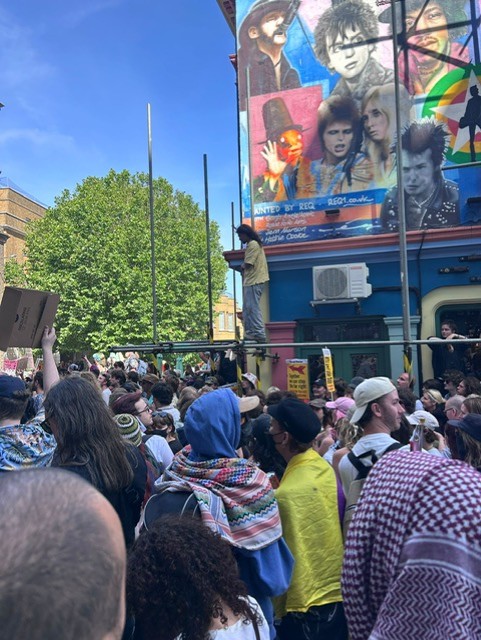
In Brighton on 13 June 4,000 turned out to confront a Far Right march called by the so-called ‘East Sussex Patriots’. Police kettled the anti-fascist protesters, while they tried to march the 200 or so fascists to the station. But in the end, it was the fascists who got kettled by the anti-fascists, firstly being stuck in a tunnel and then later in a pub as police could not cope with the size of the anti-fascist protest.
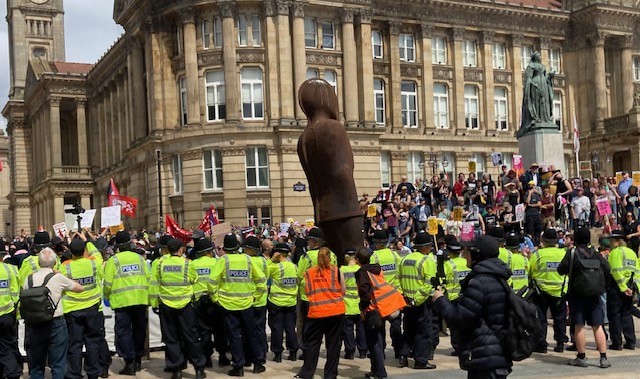
Meanwhile over a thousand anti-fascists mobilised in Birmingham on 20 June after the fascist Britain First group held a march in the city. It was a national mobilisation for this nazi outfit, but they could only muster a couple of hundred, with not a Brummie accent to be heard amongst the lot of them.
A huge police operation saved them from a very noisy counter-demonstration. After the briefest of ‘marches’ – very much a ‘Grand Old Duke of York’ event, with the BF marching up Hill Street and then back down again – the police then bundled them into New Street station and sent them from whence they came.
But while the anti-fascist mobilisations are to be applauded, it is vital that the labour movement needs to be more involved. There is a growing feeling amongst trade unionists that the union leaderships – including of left unions such as Unite and UNISON – have ‘franchised out’ their responsibility for combatting the Far Right by simply affiliating to the Stand Up To Racism (SUTR) campaign.
In turn, while we certainly applaud movements such as SUTR, they seem politically directionless and can have a casual attitude to organisation. As one fellow trade unionist said to me at the Birmingham protest: “They seem to think that a campaign just consists of sticking a poster on Instagram and hope people turn up!”
At the Brighton protest, there were some trade union banners present, but these were very much organised at local level. At the Birmingham event, there was only one trade union banner present (which had been organised by Birmingham Left Horizons supporters).
Danger
There is a danger that if an organisational vacuum is left during such anti-fascist mobilisations, there will be a rise of what we used to call ‘Squadism’. This was certainly the case in Birmingham, where three different, small ultra-left groups turned up with their members masked up, waving their party flags and marching in little blocs (mostly in different directions).
The danger of Squadism is that it becomes a substitute for action by the class. The priority for the small groups becomes to ‘get at the fascists’, rather than the hard graft of campaigning in the labour and trade union movement and communities to get a mass response to the Far Right threat, and then crush it by weight of numbers.
Equally, even if Squadism was successful and the fascists got a good drubbing, it can lead to the class acquiescing and sitting back, and leaving it all to the ‘squads’ to sort out. It is an admission of failing to mobilise the class – for the impatient ultra-left, it is yet another short-sighted short cut around the labour movement.
In confrontations with the Far Right, there is no room for weak organisation, confusing or directionless instructions or half-measures. That can have dangerous consequences for those who turn out.
The labour movement must take the lead – not just on paper or passing resolutions, but committing its resources to a thorough anti-fascist campaign throughout its ranks, and ensuring mass mobilisations wherever the Far Right raise their heads.
[Featured image – Heavy policing of the anti-fascist protesters in Birmingham. All images from the author – and daughter!]