By Greg Oxley
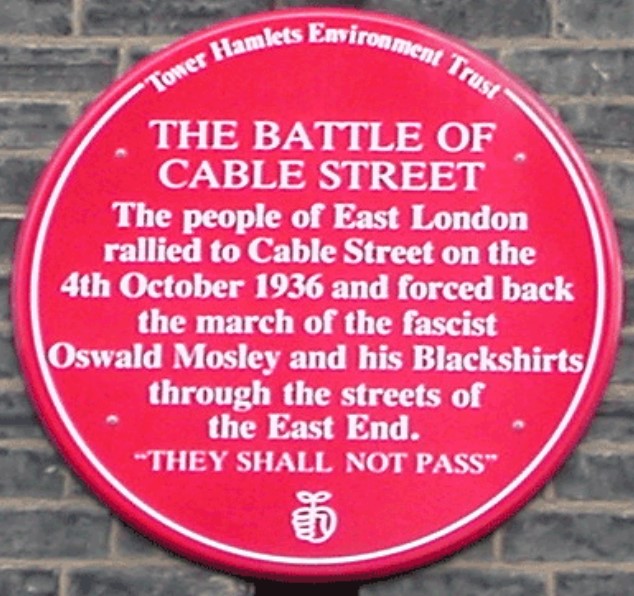
Ninety years ago this week saw what became known later as the ‘Battle of Cable’ street in East London. It was an event held in high esteem in the traditions of the labour movement as a landmark in the interwar years’ struggle against fascism and their British representatives, the blackshirts of Oswald Mosely.
……………………………………………
In 1936, Hitler had been in power for three years and Mussolini for fourteen. In Spain, the Spanish workers’ movement was at war with the fascist forces led by General Franco. In Britain, prominent representatives of the ruling class – including Winston Churchill – made no secret of their approval of fascism as a formidable weapon against the working class.
In a speech in Rome in 1927, for example, Churchill said: “I could not help falling in love, like so many others, with Mussolini’s kind and simple manner… If I were an Italian, I am sure that I would have been with you with all my heart, from beginning to end, in your triumphant struggle against the avarice and bestial passions of Leninism…Italy has provided the indispensable antidote to the Russian poison. Henceforth no great nation will find itself without a final means of protecting itself from the cancerous growth of Bolshevism.”
The British Union of Fascists (BUF), under the leadership of Sir Oswald Mosley, enjoyed financial support and political encouragement from the capitalists. In the context of the deep economic and social crisis of the 1930s, the British “blackshirts”, like the German Nazis, developed their organisation on the basis of antisemitic propaganda, pointing to Jews as the cause of unemployment and misery.
Britain’s Jewish population was concentrated in the working-class neighbourhoods of East London. The announcement of a fascist demonstration that was to pass through these neighbourhoods on October 4, 1936, provoked anger among the working population of the capital.
The mobilization was general. Inspired by the example of the Spanish revolutionaries, the communists, socialists and trade unionists of the British workers’ movement decided to resist around the same slogan: “They shall not pass!”
A petition for the banning of the fascist demonstration had been launched. Labour MPs intervened in the same direction, but in vain. The only way to rout the fascist vermin was to physically confront them in the streets. This confrontation has gone down in the annals of the British labour movement as the Battle of Cable Street.
Eggs, pots, chairs…
It is always difficult to make an estimate of the size of demonstrations; but according to virtually all sources, the anti-fascist demonstration of October 4, 1936 mobilised at least 250,000 workers, and by some accounts twice that. The police supervised the fascists to protect them and open a path for them through the Jewish neighbourhoods.
This could only be done by fighting the anti-fascist demonstrators, whose mood was becoming almost insurrectional. From the upper floors of the buildings were raining down rubbish, rubbish bins, bottles, pots and pans and various kitchen utensils, but also eggs, potatoes and even chairs. Down in the street, more missiles were flying from everywhere.
The police tried to force their way through. But a barricade had been built to block their way. Hundreds of marbles were thrown under the horses of the police. More than seventy police officers were injured.
Finally, faced with the ferocity and power of the opposition, the police understood that they had no choice but to give up their mission. The 5,000 blackshirts fled. Pursued into the small alleys and stairs of the buildings, many of them were beaten. They had to be made to understand that it was in their interest to never do it again!
Local Communist Party organisations played a crucial role in this victorious mobilization. On the other hand, the party’s national leadership only supported the initiative at the last minute, for fear of being held responsible for “disorder”.
Arriving in Britain in 1934 (he had begun his life as a militant in the South African Communist Party), the revolutionary Marxist, Ted Grant, was among the demonstrators. For him, the Battle of Cable Street marked “the height of the BUF’s arrogance,” but also, thanks to its defeat that day, the beginning of its decline.
The story of a communist militant
Reg Weston, who was the young secretary of the Southgate branch of the Communist Party, left us detailed memories of the day as he experienced it.
Regarding the organisation of the anti-fascist demonstration, he wrote: “The Mosleyists announced their demonstration just four days before. We had no precise information. At the time, very few people had phones.
“There was no television and few radios. To get information and inform, it was necessary to go door-to-door, leave leaflets in letterboxes and organise meetings in the workplace or in the street. The main source of information was the press. There was the [Communist Party newspaper] Daily Worker, with a circulation of some 40,000 copies, and also the newspaper of the trade union confederation, The Daily Herald.
“When the day came, we had gathered about forty members and sympathizers of the party. We went to oppose the demonstration of a few thousand blackshirts in East London. When we arrived at the Aldgate subway, we still had no idea of the events in the neighbourhoods over the previous days. The streets were full of people. We couldn’t move.
“In the middle of the street (Aldgate High Street) there was a line of trams, all of which were stationary. We were told that it was done on purpose to embarrass the fascists. There were 10,000 police officers, from what I read in the press. They wanted to open the way for the Mosleyites.
“I often say that I was at the Battle of Cable Street, but in fact, that’s not entirely accurate. My comrades and I couldn’t even get close to Cable Street, because of the compact mass of demonstrators. It is said that there were perhaps 500,000 people in the streets that day. We couldn’t count them, anyway. We were stuck there, like sardines.
“It was understood that the fascists had gathered next to the Royal Mint and that the mounted police had attacked the demonstrators in order to be able to escort them. It didn’t work. We overturned a truck and built a barricade. Finally, the police told Sir Oswald that his demonstration could not take place. The fascists had been beaten and humiliated; The police were unable to protect them.”
He summed up the political impact of the battle as follows: “In Britain, the workers’ movement had not yet recovered from the defeat of the 1926 general strike and the consequences of the 1929 crisis that carried on into the 1930s. The Labour Party split with the betrayal of MacDonald [who had led a coalition government with the right in 1931-1935].
“The Conservative government was pursuing a vicious policy against the unemployed. We felt that this had to change, and we thought we could hasten the advent of this change. So, the win on Cable Street boosted our morale. It was proof that we could wake up the masses, despite the suffocating softness of the Labour leadership, and despite the Liberals. It showed what could be done with a little organisation and a lot of determination.”
The events in Cable Street remind us that fascism – that mortal danger to the working class – cannot be defeated by appeals to wisdom and morality, nor by petitions or pompous speeches, but only by the organised and vigorous action of the working class.
Today, thanks to the change in the balance of class forces since the time of Hitler and Mussolini, fascism does not present itself as a mass movement and an imminent danger. But fascist organisations are growing all over Europe. And who knows what the future holds?
Ultimately, the only way to eradicate the possibility of new fascist dictatorships is to eradicate the social system that engenders them, namely the capitalist system.
[Greg Oxley is editor of the French Marxist website, La Riposte, where this article was originally published, here]
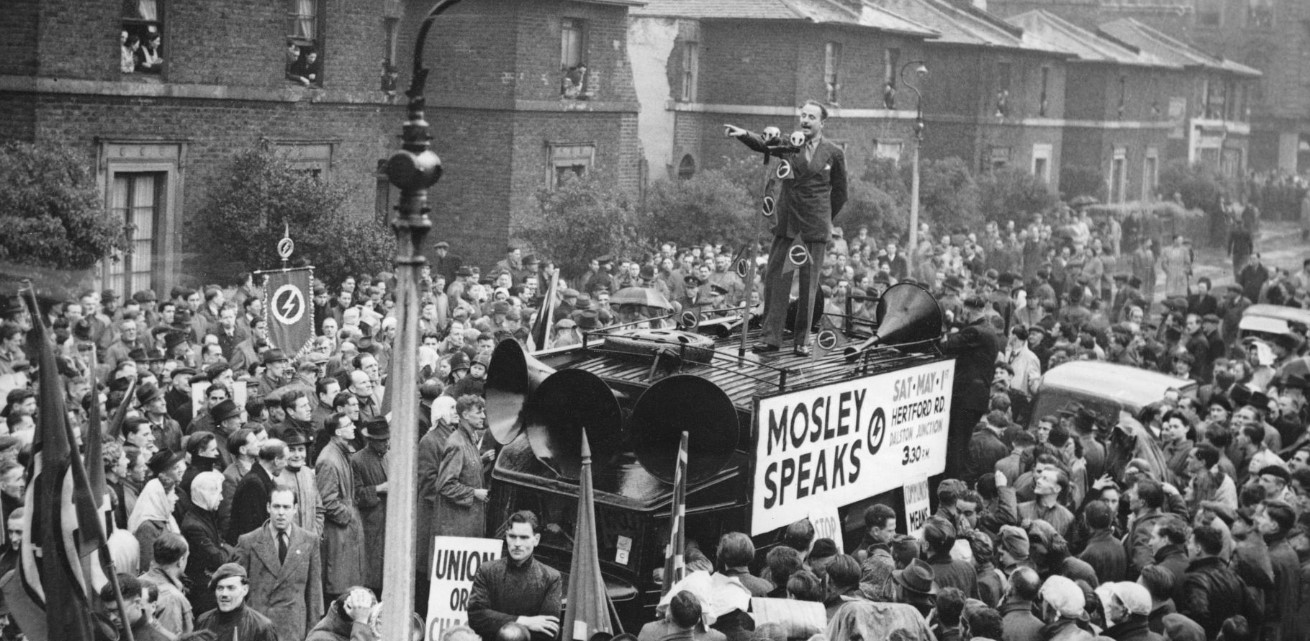
Feature photograph shows Mosely speaking at a street rally – something he signally failed to do in Cable Street. From Wikimedia Commons, here.