
 We need to talk about trans rights
By Sjaan Heemskerk, UNISON delegate on TUC Young Workers’ Committee
We need to talk about trans rights. Not as an optional extra, not as something separate to our movement, but as a basic matter of fairness, safety, and dignity. Because right now, in Britain, trans people are under sustained attack. And those attacks are being used – deliberately – to distract from the real crises we all face.
The Supreme Court Ruling
In April, the UK Supreme Court ruled that, when mentioned in the Equality Act, “man” and “woman” mean only “biological sex”. Even if a trans person has a Gender Recognition Certificate, the law now says they are legally the sex they were assigned at birth. Biological sex was not even defined but held to be “self-explanatory”, which it certainly isn’t.
The court stressed that trans people still have protections under “gender reassignment,” but that’s not the same. The ruling has already been used to justify excluding trans women from women-only services and spaces, under the false name of “protecting women and their spaces”.
And here’s the strange irony: that interpretation of the ruling means that trans men (so-called biological women) will now have to use female toilets.
This could actually result in more male-presenting people in women’s facilities. Because let’s face it, what women is going to ask a male presenting person in the toilets to pull their trousers down to prove they should be in there? Who’s gonna police it?
This blows apart the argument that this is about “protecting women.” Plus If a man wanted to enter a women-only space, he could already just walk in—no one’s putting up force fields at the door.
Even worse – the judgement even allows trans men, in some circumstances, to be excluded from women’s spaces – so they are not welcome anywhere!
So what is this really about? It’s about creating fear, confusion, and division.
The EHRC Guidance
After the ruling, the Equality and Human Rights Commission rushed out a consultation on guidance for “single-sex spaces.” Over 50,000 people responded, but reports say the EHRC will ignore large numbers of submissions, up to 25,000 of them, even using AI to filter them.
The draft guidance is expected to tell service providers they can exclude trans women from women’s spaces. It’s not a legal requirement, but it sends a clear message: exclusion is acceptable. And once that message is out, it emboldens prejudice.
Why Trans People Are Being Targeted
Let’s be honest—this isn’t about safety or fairness. This is about scapegoating.
When politicians and parts of the press whip up fear about trans people, they’re doing it to distract from the real issues we all face: underfunded services, long NHS waits, unsafe streets, insecure work, failing schools.
If you can get the public arguing about who uses which toilet, you can avoid talking about why the toilets are falling apart in the first place.
TERFs and JK Rowling
We also need to talk about the role of so-called “gender critical” campaigners, sometimes called TERFs – trans-exclusionary radical feminists – and their most famous supporter, J.K. Rowling.
They present themselves as defending women, but their arguments depend on defining womanhood in the narrowest, most exclusionary way. This isn’t feminism—it’s the same old biological essentialism that has been used for centuries to control women’s lives.
When high-profile figures like Rowling endorse this thinking, it legitimises bigotry. It makes life harder and more dangerous for trans people.
What Feminism Really Means
Feminism means fighting for all women—trans women included. It means fighting for bodily autonomy, safety, and the right to live without fear. It means rejecting the idea that someone’s body or birth assignment defines their worth.
That’s why I don’t actually like to refer to them as TERFs as I don’t believe they represent the word ‘feminist’ in any sense of it at all.
Healthcare and Puberty Blockers
Right now, young trans people are being denied puberty blockers—safe, reversible treatments that have been used for decades.
The science hasn’t changed. The medication hasn’t changed. What’s changed is the politics. When cisgender children need blockers for other medical reasons, they get them. But when trans kids need them, suddenly there’s a moral panic.
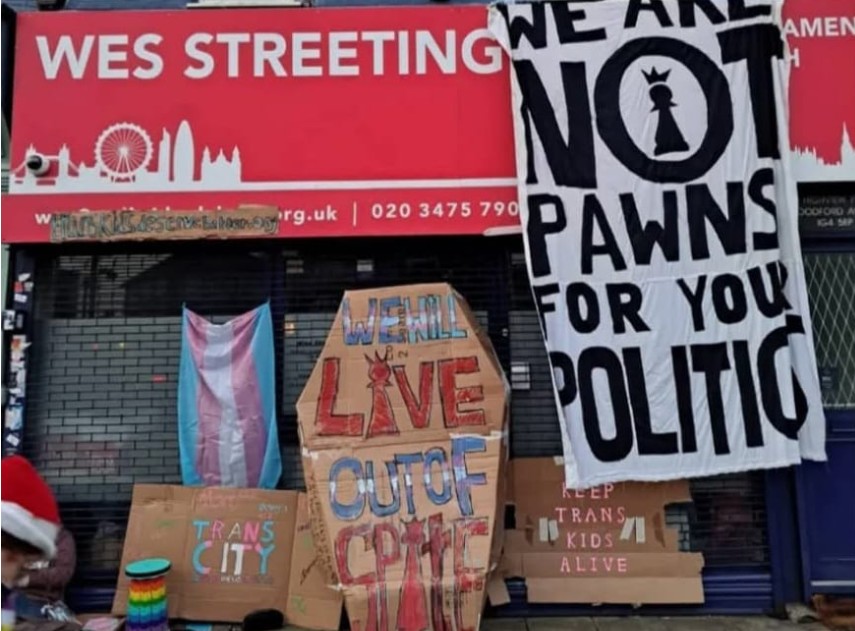
[photo from Lesbians and Gays Support the Migrants]
And we know the consequences: delays and denial of care can cause years of unnecessary distress and harm.
This is a class war issue as if you are rich, you can still get the medicine privately or even fly abroad for treatment. Although Wes Streeting has made this a criminal offence, the rich are more likely to find a way around this.
This punishes working class trans kids and worsens their mental health simply for not having the money or resources to do the same.
Labour’s Failures
The Labour leadership has failed to stand up clearly for trans rights.
Keir Starmer talks about “single-sex spaces” without addressing the reality of service closures and lack of funding. Wes Streeting has made statements denying trans women’s womanhood – words that give a green light to bullies and bigots.
But there’s another group whose existence Labour barely even acknowledges – non-binary people.
‘Non-binary’ simply means someone who doesn’t identify strictly as male or female. That could mean identifying as both, neither, or somewhere in between. For some it’s fluid, for others it’s fixed. It’s been part of human diversity for as long as we’ve existed, in cultures across the world.
Yet our laws, our healthcare systems, and our politicians treat non-binary people like they’re invisible. When politicians debate “single-sex spaces” as if everyone fits neatly into male or female, they erase us completely. They send the message: you don’t count, you don’t exist, your needs don’t matter.
When the leader of the party meant for the working class can’t even say the word “non-binary” in public, and when policies don’t even attempt to include us, it’s not just neglect – it’s erasure and discrimination.
Personal Story
For me, gender has never been simple. Sometimes I feel more masculine, sometimes more feminine, sometimes neither. I remember asking to be called “Fred” as a kid. Maybe I’m non-binary, maybe gender-fluid. I’m still figuring it out.
But I know what it’s like to be told you’re not valid. To feel unsafe. To be treated like a problem just for existing.
And I know I’m not alone in that.
The Rise in Hate Crime
The statistics prove it. Hate crimes against trans people have been rising year after year. In 2023–24, police in England and Wales recorded almost 5,000 hate crimes targeting trans people. That’s nearly triple the number from just a few years earlier.
And that’s only what’s recorded. Many people never report what happens to them – because they’re afraid they won’t be believed, because they don’t trust the system, or because reporting might put them in more danger.
It’s not just the physical attacks. It’s abuse in the street. It’s being spat at. It’s being laughed at on the bus. It’s being called a pervert or a freak when you’re just trying to buy groceries.
And the problem isn’t only strangers – it’s discrimination in workplaces, in schools, in healthcare settings. When leaders in politics and media question our existence, it sends a signal that this behaviour is acceptable.
That’s why words matter. And why the language from the top – whether it’s in Parliament or from celebrity authors – has real, measurable consequences for our safety.
History Repeating
We’ve been here before. In the UK, Section 28, in the 1980s, tried to silence LGBTQ+ people, banning schools from “promoting homosexuality” and creating a climate of isolation for queer youth. Using the AIDS epidemic to spread fear and homophobia.
In the United States, the late 1940s and 1950s saw what’s now called the Lavender Scare – a purge of LGBTQ+ people from government jobs, often tied to the wider Red Scare that targeted left-wing activists, trade unionists, and anyone suspected of communist sympathies. The two were linked deliberately: queer people and leftists were painted as “subversive threats” to national security.
It wasn’t about safety or morality then, just as it isn’t now; it was about creating an “enemy within” to distract from economic problems, inequality, and political failures. We’ve seen the same approach when immigrants were blamed for unemployment during economic downturns, when striking workers were portrayed as dangerous radicals, and when people of colour were accused of “taking resources” during times of austerity.
Every time, the pattern is the same: those in power choose a group, stir up fear and mistrust, and use that division to weaken solidarity.
Today, trans and non-binary people are the latest target in that long, shameful tradition. And if we let it stand, we’ll see the same tactics used against the next marginalised group, because it has never been about the group itself. It’s about keeping us divided and distracted.
Where We Go From Here
- Speak out: say clearly, trans women are women. Trans men are men. Non-binary people exist. No government, no law and no right-wing media outlet can change that.
- Organise: get unions, workplaces, and community groups to adopt inclusive policies. Get motions passed wherever you can that call for support of the LGBTQ+ community.
- Push for access to healthcare without political interference.
- Call out transphobia—especially in our own spaces.
Because when trans rights are under attack, everyone’s rights are at risk. And when we stand together, we’re harder to divide.
Trans rights are human rights. Feminism is for everyone and solidarity is our strength.
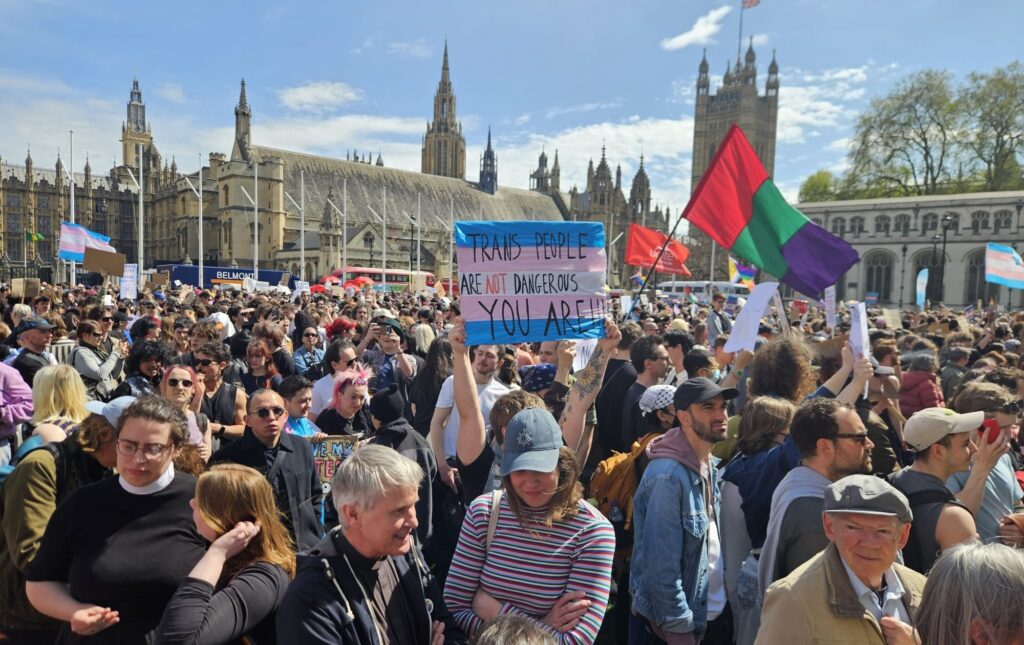
[Featured photo – April 2025 demonstration against the Supreme Court judgement – Photo by Left Horizons]
 We need to talk about trans rights - By Sjaan Heemskerk, UNISON delegate on TUC Young Workers’ Committee We need to talk about trans rights. Not as an optional extra, not as something
- TV drama review: ‘What it feels like for a girl’. - Ray Goodspeed reviews the groundbreaking new drama currently showing on BBC 3 [which can be watched here] It is a very welcome coincidence that this
 The anti-trans onslaught: Trans people fight back - By Ray Goodspeed Trans people right now are suffering from shock after shock as attempts are made to turn back the clock and take away
 Editorial: the labour movement must stand with trans people - The recent judgement of the Supreme Court in favour of an appeal from the anti-trans activist group For Women Scotland has sent shock waves through
 Letter: Streeting’s betrayal of trans youngsters - From Ray Goodspeed Looking at Wes Streeting’s performance in the House of Commons while announcing the ban on puberty blockers and taking questions, it is