By John Pickard
Every now and again there is a story in the media that reminds us of the bottomless hypocrisy of the mainstream media. The latest is the hysteria over what performers may or may not have said at the Glastonbury Festival, and which was streamed live on BBC. The Daily Telegraph and Daily Express headline writers were foaming at the mouth this week to demand the sacking of the BBC boss who allowed live coverage of anti-Israeli chants to be broadcast from the stage at Glastonbury.
We would not support the kind of inane comments that are often made by celebrities, but we cannot help noticing that these same newspapers raise no outcry, and in fact are completely silent, on the daily murders – there is no other word for it – being perpetrated by the Israeli army in Gaza and in the West Bank, and on a scale that would be astonishing if it happened in any ‘civilised’ western country.
While the press have gone into overdrive over the chants at Glasto and all the friends of Netanyahu in the British establishment have added their penniworth, no attention whatsover has been paid to the daily killing of those Palestinians in Gaza who have been in the wrong place at the wrong time, which means in the gunsights of Israeli soldiers.
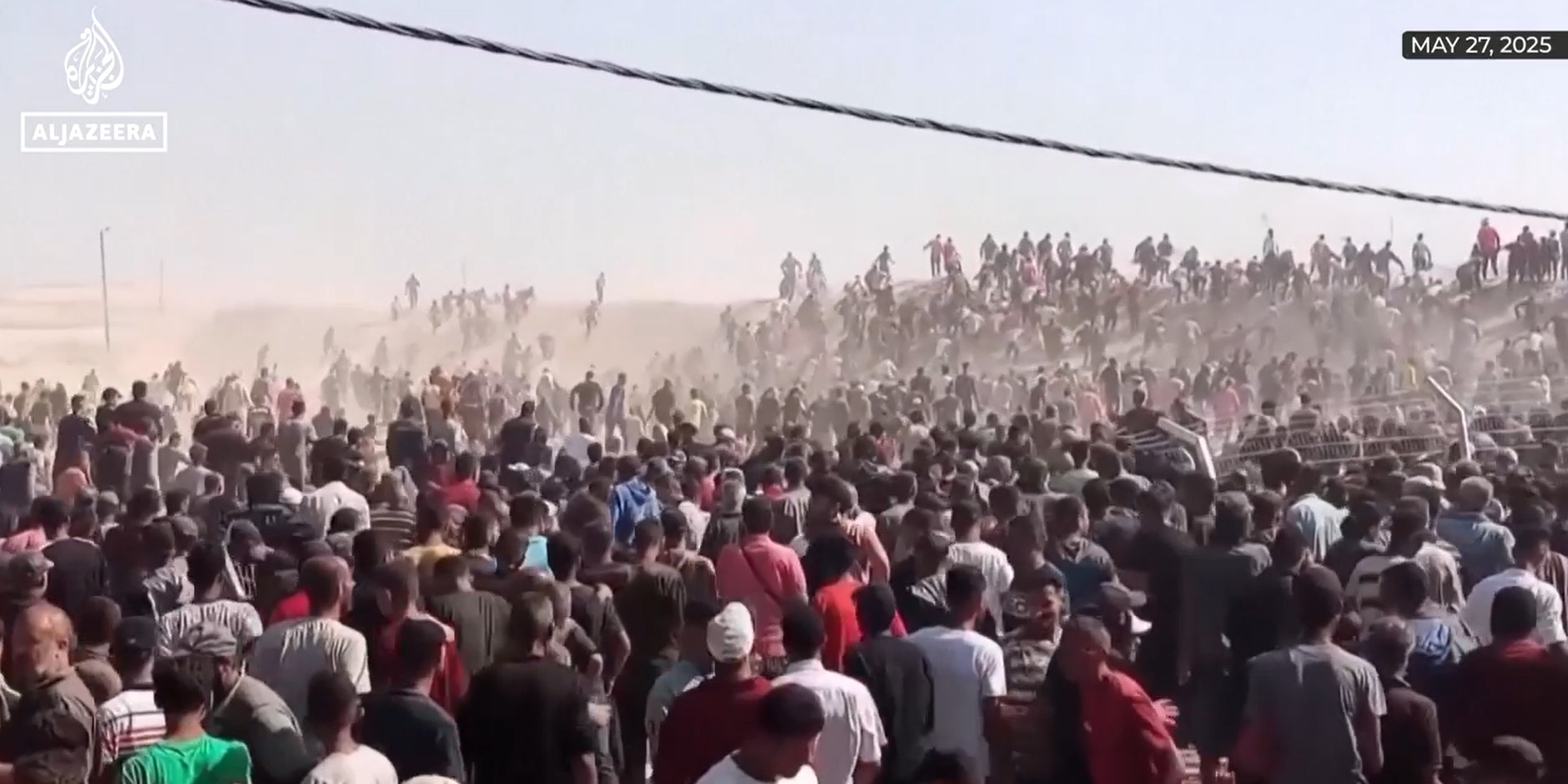
The organisation of so-called ‘humanitarian aid’ in Gaza is based on four distribution points that are typically open for one hour a day. With two million Palestinians in Gaza, all desperate for food, it is obvious to anyone with an ounce of humanity that people will not wait patiently in lines for their meagre rations. Inevitably, some are too early, too late, or in the wrong place – and it is these, according to revelations in the Israeli newspaper, Haaretz, upon whom soldiers are ordered to fire. The newspaper reports that approaching 500 Palestinians were killed between May 11 and June 24 “in food distribution lines”.
Restricting humanitarian aid as a weapon of war
Using humanitarian ‘aid’ as weapon of war – rationing it so tightly that it is effectively denied to most – is only the denoument of a terrible slaughter visited upon the people of Gaza. From the beginning it was a collective punishment for the Hamas incursion into Israel on October 7, 2023. The official death toll in the destruction of Gaza stands at around 56,000, which out of a population of two and a quarter million, is a catastrophically high figure.
Last week, the Health Ministry in Gaza, or what is left of it, published an updated list of casualties so far. The IDF, Israeli ministers and mainstream politicians in the west try to cast doubt on their figures, and never fail to mention that the Ministry is ‘Hamas-controlled’, all an attempt to ‘minimise’ a genocide. But independent assessments of Health Ministry figures in the past have shown that they were always correct.
The new Health Ministry list, in Arabic, and on a 1,227-page chart, includes the full names of the deceased, the names of their fathers and grandfathers, their dates of birth and their ID numbers. In total, the list includes 55,202 dead – correct up to the time the list was finalised – including 17,121 children under the age of 18 and 9,126 women.
International experts in war casualties, however, while accepting that the data of the Health Ministry are correct, suggest that the list is an underestimation of the number of deaths. Michael Spagat, a professor of economics at the University of London, is a world-renowned expert on the mortality figures in violent conflicts around the world. This week, he has published the results of a study into deaths in Gaza, after his team of researchers surveyed 2,000 households, comprising 10,000 people.
Real number of deaths more likely to be near 100,000
They came to the conclusion, as of January – six months ago – that around 75,000 people had suffered violent deaths from Israeli munitions. Yet at that time, the Gaza Health Ministry had a death total of 45,660. In other words, the ‘official’ death count underestimated the likely real count by around 40%. This is a similar figure to a study published in The Lancet in February.
It means that while the official figure today is 56,000 deaths, the real figure by now is likely to be closer to 100,000, with most of those unaccounted for buried under tens of thousands of tonnes of rubble and collapsed buildings. Some deaths would also be unidentified simply because they were so close to the centre of bomb and shell explosions that nothing remains of their bodies.
The data reveals that around 56% of those killed were women and children up to the age of 18, which is an exceptionally high figure compared to the Second World War or any other war since. “the proportion of women and children killed via a violent death in Gaza is more than double the proportion in almost every other recent conflict, including, for example, the civil wars in Kosovo (20 percent), northern Ethiopia (9 percent), Syria (20 percent), Colombia (21 percent), Iraq (17 percent) and Sudan (23 percent)”. (Haaretz article)
All told, the report of Spagat found, “the war in Gaza as one of the bloodiest conflicts of the 21st century. Gaza is in first place in terms of the ratio of combatants to noncombatants killed, as well as in terms of rate of death relative to population size”.
Deaths from cold, hunger and disease
Last month there was also another study published, commissioned by Action on Armed Violence, which examined the names of 1,000 children out of 3,000 that the Health Ministry had erased from its lists in error. The study concluded that, although names were erased supposedly to correct mistakes, there was “solid evidence” that most of the children originally listed had been killed. This was because the Health Ministry only counted deaths where a body was identified, this study concluded, families often buried their own dead quickly and failed to report the death.
Another horrifying aspect of the Spagat inquiry is that there are large numbers of deaths, so-called “excess mortality”, attributable to the indirect affects of war: hunger, disease (the risks of which are increased by malnutrition), cold, and the failure of a health system deprived of resources, staff and equipment. Spagat found that up to January, excess deaths were around 8,540 of those recorded.
These deaths occurred specifically because the IDF used humanitarian aid – ie blockading it – as a weapon of war. Because doctors were targeted for arrest by the IDF. Because hospitals, clinics and health facilities were targeted by bombs. Because the established UNRWA facilities and experienced staff were banned by Israel.
It is important to note also that what Spagat called ‘community support’ was available to the sick and injured, through family and community support, in the first few months, but which has been completely undermined by Israel’s deliberate physical destruction of Gaza.
Crowded into tent cities
A population of desperate refugees is mostly crowded into tent cities – can we now call them ‘concentration camps?’ – where an increasing number are vulnerable to disease, ill health and death as a result of the blockade of humanitarian aid. Because of the conditions in which Gazans are now forced to live, Spagat says, “I would speculate that the ratio of nonviolent to violent deaths has gone up since [the January study]”
This is the hard reality of what has happened in Gaza in the past nineteen months and as it is still happening today. Has it featured much in Daily Express or Daily Telegraph headlines? Not that we have noticed. But some anti-Israeli chants are heard in Glastonbury, and suddenly the ‘antisemitism’ alarms are ringing.
The UK’s “chief rabbi”, Sir Ephraim Mirvis, has condemned the ‘antisemitism’ at Glastonbury, as usual doing Benjamin Netanyahu’s work for him by conflating anti-Israeli sentiment with ‘antisemitism’. I am not religious, but if I were, I’d imagine there’d be a special place in Hell for those whose common humanity and sympathy for Palestinian suffering seems to be inversely proportional to their hypocrisy. The smaller the one is, the larger the other one becomes. History will be the judge and it will not look kindly on these people.
[Feature picture shows hundreds of desperate Palestinians trying to find food. It is from an Al Jazeera short video on killings in Gaza, which can be found here]