
By Jamie Green
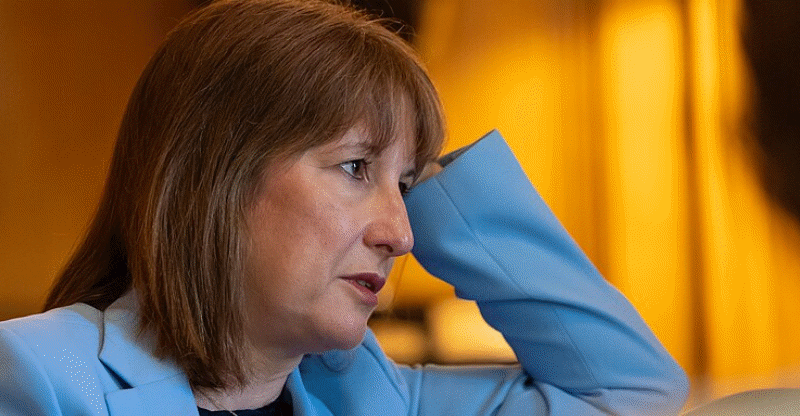
Irish singer and songwriter, Ciara Mary-Alice Thompson (pictured), known as CMAT, from County Meath, Ireland, has released a new single, “Euro Country” that examines her experience as a young working class girl during the Celtic Tiger era, calling out the capitalist exploitation and its significant impact on Irish working class communities.
The bridge lyrics of her single are pretty clear
“All the big boys, all the Berties
All the envelopes, yeah, they hurt me
I was twelve when the das [dads- ed] started killing themselves all around me
And it was normal, building houses
That stay empty even now, yeah
And no one says it out loud but I know it can be better if we hound it
“All the Berties” references Bertie Ahern, former Irish Fianna Fáil politician who was leader of Fianna Fáil from 1994 to 2008 and was the Taoiseach(Prime Minister) in charge of three governments (1997-2008), including at the time of the banking crash that devastated working class communities.

Ahern, who stated at the time that the, “boom was getting more boomer” was one among many who benefited from the economic rise of capitalism and the boom under neoliberal policy in Ireland at this time (Curran, 2023). At the centre of this boom were major house-building projects, financed by toxic property loans from the Irish banks. Foreign investment flooded into the Irish economy – bringing with it hopes of prosperity and the future.
Bankruptcy
However, the property-led boom and bust nearly brought Ireland to the point of bankruptcy. A 2011 book, “Placing neoliberalism: the rise and fall of Ireland’s Celtic Tiger” (Kitchin et al, 2011) examines the role of neoliberal politicians and policies, and the reliance on and door opening for foreign investment, that caused devastation and cross-generational trauma that is still being paid for by the working class.
The so-called “Irish Model” had enticed corporations with ultra-low corporate tax rates, just 12.5%, which allowed manipulation of tax rates and export into the European market. This facilitated a large shift from public to private ownership in public services, and a significant concentration of wealth. Business was certainly “booming” for some.
The working class families purchasing these homes were hit hardest by the, entirely avoidable, crash and subsequent recession. Many were pushed into financial difficulties, trapped in debt, or lost their homes. Some were even rendered homeless. Emigration tripled, and Ireland saw a significant increase in those driven to suicide. At one point, in 2009, the suicide rate had increased by upwards of 25 percent (Hayes, 2010). Data shows there were also significant increases in domestic violence – during and following the rise and crash.
Of course, the rich tried to diminish their responsibility and the harm they caused. Some are still revising history even now, taking the line that was spouted during the crash that we were “all in the same boat”. Unsurprisingly, the bloated, affluent minority sang this tune from the comfort of mansions and yachts – suffering the least effects of the crash, while majority of us were in dinghies, battling waves.
Although living in the United States, I was 17 at the time of the 2008 global crash – a first of many, subsequent, financial crisis’ of my lifetime. We are generation that still bears the brunt of the economic scars of the time. Many of these homes and estates were built on speculation, including many (as CMAT says) “that stay empty even now” – referred to as “ghost estates, unoccupied and unfinished.
Political corruption investigated
During the Mahon Tribunal (1997), an investigation into political corruption, it was found that Ahern had accepted envelopes of cash filled with undisclosed amounts of money from developers, some estimating thousands or more. Ahern’s explanation of one envelope stuffed with £8,000 cash, claiming he was present at a “whip-around” during a dinner of 20 wealthy Irish businesspeople – was not (unlike Ahern, himself!) ‘bought’ by the tribunal and was branded “untrue”.
It was also alleged by one property developer, Tom Gilmartin that a rival developer, Owen O’Callaghan, had “bragged he gave Bertie Ahern two payments totalling £80,000, (€100,000) in 1989 and 1993” (Gartland, 2007). Ahern went on to state, in 2008, that he had won money in 1996 from well placed “successful horse-racing bets”. Ahern later stated in an interview, “What I got personally in my life, to be frank with you is none of your business. If I got something from somebody as a present or something like that, I can use it.”
This was a marked change of tune from Ahern when he was in opposition, when he stated that, “the public are entitled to have an absolute guarantee of the financial probity and integrity of their elected representatives, their officials and above all of Ministers. They need to know that they are under financial obligations to nobody” (Dáil Éireann parliamentary transcript, 1996)
Ahern went on to publicly apologise for the crash in 2015, saying he “wished the housing bubble did not happen and would, in hindsight, have done things differently to avoid the property crash”, words that offer little in terms of material reparations or atonement to those of the working class who lost their lives – and for the ongoing experiences of the survivors still dealing with the devastation dealt to them by neoliberal exploitation.
Not all violence is transparent
Many of the homes built during the boom were found to have been defective, with homeowners left “footing the bill” (Bielenberg, 2017) with problems ranging from dampness, sewerage problems, flooding basements and “serious defects” with fire safety. This is just another way in which the so-called ‘free market’ determines who lives and dies. Not all violence is transparent – some forms take shape through policy. Lack of affordable housing is a key issue for the working class – one now used and exploited by the right-wing to try and target immigrant, refugee and asylum seeking communities (see Plessis, 2024).

CMAT’s song rightfully takes a swipe at the benefactors and enablers of this period of history, and further, at the economic model that facilitates such exploitation. She told the NME magazine in July that, “Capitalism is one of the worst things to ever happen to us”.
While Marx, in his theory of historical materialism, suggested that capitalism is a necessary stage in the development of human society, which, with all its inherent contradictions and crises, paves the way towards socialism, he would have sympathised with CMAT’s loathing of such a vicious economic model. In Capital, Marx famously wrote,
“If money, according to Augier, comes into the world with a congenital blood-stain on one cheek, capital comes dripping from head to foot, from every pore, with blood and dirt.”
The BBC’s coverage of CMAT’s title track was called into question when the 40 second Irish-language intro of the song was cut from the radio debut. CMAT voiced frustration on her Instagram, saying, “It was not my decision to have the Irish language edited out of the first-ever play of Euro-Country on radio…I don’t know if it was a mistake or what happened. However, they have just gotten into contract and said they are gonna play the Irish-language intro, full version of Euro-Country tomorrow to make up for it” (Mcloughlin, 2025).
This comes shortly after the BBC’s controversial decision, refusing to air West-Belfast hip-hop trio, Kneecap’s performance at Glastonbury Festival earlier in June in connection with the trio’s outspoken support of Palestine (Read LH article on Kneecap, here). Dubbed the “Kneecap effect”, the trio’s Irish language revolution is said to have revitalised the Irish language, boosting interest and popularity of the language within sixth-year students by 68% (Osborne, 2025).
Alongside CMAT and Kneecap, there is a global surge in popularity amongst Irish artists, such as Fontaines D.C. and Inhaler, who show they are more political, unapologetic and undeterred by the threat of witch hunts and retribution, from calling out politicians, the rise of the far right, anti-immigrant ideology and showing solidarity with the Palestinian people, subjected to the ongoing genocide and occupation. Such sociopolitical shifts – and such bravery, I would argue, are things to watch out for – and to welcome.
[Featured photo – CMAT – BBC]
*****
Sources:
Bielenberg (2017) https://www.independent.ie/business/personal-finance/cracking-up-the-legacy-of-celtic-tiger-ireland/35706369.html
Gartland (2007) https://www.irishtimes.com/news/developer-alleges-rival-gave-80-000-to-bertie-ahern-1.1209581
Hayes (2010) https://www.irishcentral.com/news/celtic-tiger-collapse-causes-increase-in-number-of-suicides-98699899-237705491
Kitchin et al. (2011) https://kitchin.org/wp-content/uploads/2019/04/EPA-Placing-Neoliberalism-2012.pdf
Mcloughlin (2025) https://www.standard.co.uk/showbiz/bbc-clarifies-radio-edit-cmat-single-b1239674.html
Osborne (2025) https://www.breakingnews.ie/ireland/kneecap-effect-boosts-irish-language-popularity-but-teaching-methods-are-outdated-1728554.html
Plessis (2024) https://www.ips-journal.eu/topics/democracy-and-society/its-housing-stupid-7950/