
Andy Ford completes his occasional series of articles on 80-year anniversaries of Soviet involvement in WW2
*******
On 9th August 1945 the Red Army began its invasion of the Japanese puppet state of ‘Manchukuo’, as promised at the Yalta and Potsdam conferences of the allied powers. Imperial Japan’s defeat in Manchuria, with almost a million soldiers killed or captured, was, in fact, its biggest defeat of the war.
The Japanese had invaded Manchuria, in north-east China, in 1931 in pursuit of its rich supplies of coal and mineral wealth, renaming it Manchukuo, and setting up a puppet government under the last Chinese Emperor, Pu Yi. The invasion was largely tolerated by the imperialist powers, Britain, France and the USA, with protests limited to diplomatic protestations. Even trade sanctions were ruled out as ‘harmful to commerce’. In truth, they were happy to unleash a further threat to the Soviet Union on its eastern borders.
During the bulk of WW2, Japan and the Soviet Union observed an uneasy neutrality, but at Yalta, Stalin had committed to go to war with Japan within three months of the surrender of Nazi Germany. The invasion had originally been set for August 14th, but the use of the atom bomb at Hiroshima on August 6th caused Stalin to advance his plans, and the invasion actually commenced on August 9th, the same day that the second atom bomb was dropped, on Nagasaki.
The invasion was a huge logistical achievement, with 20-30 trains a day travelling the Trans-Siberian railway through June and July, transporting 89 divisions from Europe, both to Mongolia and the Soviet Far East around Vladivostok. By early August the Russians had assembled a force of 1,5 million men, 28,000 artillery-piece launchers, 5,000 tanks, and 3,700 aircraft.
Against this formidable force the Japanese puppet army, the Kwantung Army, had maybe 900,000 men, but many of them were Manchurian auxiliaries, pressed into service by their need for food or to escape the brutality of the Japanese occupation. They had no reason to fight for the Japanese Empire. But also, the Soviets had a huge qualitative advantage: their tanks were the most battle-effective in the world at that time, up against Japanese tanks from the 1930s; while in the air thousands of Russian Ilyushin-2/ Sturmovnik, planes tested in combat against the Luftwaffe, faced just a few hundred singe seat Nakajima fighters.
The Japanese had constructed fortifications to guard against a Soviet attack all along the frontier with Russia itself, but these fortifications were concentrated on the main transport link at Hutou. In the west, on the border with Mongolia,, they relied on the terrain – the Mongolian steppe, and the Khingan mountains, which rise to a height of 6,600 feet.
Japanese army brushed aside
The Soviet attack aimed to go round the Japanese strongpoints, isolate them, and deal with them later. On the 9th August the Soviet Trans-Baikal front crossed the Mongolian frontier and began an advance across the steppe of Inner Mongolia and then over the passes of the Khingan Mountains. Japanese intelligence had believed it impossible to mount a meaningful military operation 500 miles from the nearest rail link and in such inhospitable terrain, so the defenders found themselves in stuck in unfortified positions. They were simply brushed aside by the overwhelming force of the Red Army.
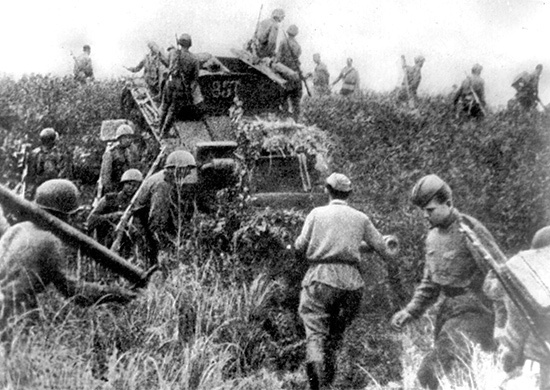
Soviet infantry crosses the border of Manchuria. August 9, 1945
It is still hard to understand how an army of 600,000 soldiers and 2,000 tanks could have been assembled on the Mongolian border for the Khingan offensive. But it was done, and as a result, the Russians advanced 300 miles in just 6 days, reaching the main road and railway junction of Manchuria, Changchun, by August 19th. This cut off the region’s capital, Harbin.
Meanwhile, further east, in heavy rain, the Soviet Far Eastern Front attacked the Japanese across the Amur River. Overcoming the initial fortifications they then advanced west through thick taiga (pine forests and swamp), avoiding the huge Japanese fortification at Hutou, and pushing 200 miles into Manchuria towards Changchun. A secondary force, supported by the Soviet Far Eastern Fleet, advanced down the coast from Vladivostok, securing the Korean ports of Hamhung, Seishin and Racine, and so cutting Manchuria’s supply lines to and from Japan.
At this point the Japanese were effectively finished in Manchuria and the commander, General Yamada, asked for talks leading to surrender. While these were ongoing, Russian forces liberated the north of Korea as far as the 38th parallel, as agreed with the Americans, and also the strategic Chinese port of Dalian (named Port Arthur by the imperialist powers). The Russians installed a then-unknown Red Army captain of Korean origins, Kim Il-Sung, as their agent in the Korean territory they had taken.
The Japanese fortress at Hutou, comprising 70 square kilometres of concrete bunkers and barbed wire, held out, finally surrendering on August 26th, and the Soviets dropped paratroopers to occupy the remaining cities of Manchuria such as Jilin and Harbin.
Horrible war crimes of Unit 731
What they discovered in Harbin was chilling. A huge camp, termed ‘Unit 731’, had been developed for the purposes of biological warfare, with toxic agents and infectious bacteria like plague, cholera, syphilis and typhus tested on live human subjects. It is estimated that 14,000 people, mainly Chinese prisoners of war, had been killed in the course of the horrific ‘experiments’ at Unit 731. There are no known survivors. Its output had been used to create plague and cholera epidemics in Chinese cities in 1940 and 1941, or infecting water supplies with typhus, and deaths are estimated at 200,000.
The different responses of the Soviets and Americans are revealing: the Russians put those they captured on trial in the Khabarovsk Trials; but the Americans put the scientists they captured, including Shiro Ishii – who was the leader and organiser of the whole monstrous enterprise – on the military payroll at Fort Detrick, Maryland, and shielded them from prosecution.
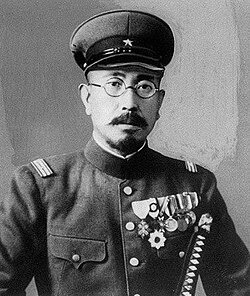
There are credible reports that Isii’s macabre expertise was behind biological attacks on North Korea in the Korean War (1950-53) and it is a definite fact that US Defense Secretary, George Marshall, signed off an order for the deployment of germ warfare agents “at the earliest practicable time” in North Korea.
What ended the war? Atom bombs or the Red Army victory in Manchuria?
In the west it is a commonplace that the atomic bombings of Japanese cities forced the Japanese surrender on August 14, and so saved the lives of hundreds of thousands of American servicemen. But the historical evidence is not so clear. The Japanese historian Tsuyoshi Hasegawa in his book Racing the Enemy: Stalin, Truman, and the Surrender of Japan, found that the American atomic bombings of Hiroshima and Nagasaki had little effect on the Japanese will to fight on, but that the Soviet invasion of Manchuria, and its rapid success, was the event that forced the Japanese government to surrender quickly.
The Soviet advance had been so rapid that their next target was clearly an amphibious assault on the northernmost Japanese island of Hokkaido, which lay barely defended. While the Trans-Baikal Front and the Far Eastern Front had been liberating Manchuria and Korea, another army, the Soviet 16th Army of 100,000 men, had occupied the south of the island of Sakhalin and now stood just 30 miles by sea from Hokkaido.
The main faction of the Japanese war cabinet wanted to make the cost of invading Japan so high that the Americans would grant peace terms. They also refused to believe that the US had more than a few atom bombs, and in this they were actually correct. After the bombing of Hiroshima, the war cabinet was deadlocked 3-3 on whether to surrender; after Nagasaki the majority were for surrender, but a coup on August 14 by fanatical army officers threatened the decision.
However, the Red Army destruction of the Kwantung Army in just a few days, and the parallel seizure of Sakhalin, raised the spectre of a Soviet invasion of Japan Such an invasion would not just mean defeat in war, but also the erasure of capitalism in Japan.
The coup leaders were left isolated, allowing Emperor Hirohito and his aristocratic advisors to gain a majority. They then made haste to surrender to the Americans, preferring to preserve capitalism in Japan – even as American vassals – to being overrun by the Soviet Union and see the abolition of capitalism itself in Japan. Even for the fanatical Japanese nationalists, war was ultimately a class issue.
In Manchuria
Stalin honoured the letter of his agreement with the anti-communist Chinese government of the Kuomintang (KMT) not to hand over the cities of Manchuria to the Communist peasant armies of Mao-Tse Tung, but the countryside was left to the Communists. The cities soon fell to the guerillas. Much military equipment found its way to Mao’s forces, and large numbers of the Manchurian conscripts to the Kwantung Army switched sides to the Communists. The Soviet victory in Manchuria dealt Mao a much stronger hand for the imminent civil war in China.
The end of the USSR’s war
Ironically, World War Two for the USSR, which had begun at Khalkin Gol in Mongolia [see LH article here] in 1939, ended in the same region, in Manchuria in August 1945. After a titanic struggle, costing the lives of 27 million Soviet citizens, and in which the Red Army had been virtually destroyed in 1941 and rebuilt more or less from scratch, the Soviet planned economy had defeated Nazi Germany, backed by almost the entirety of European industry.
Now capitalism had been abolished in a region stretching from the River Elbe, in the centre of Europe, to Korea and Manchuria in the far east of Asia. Just four years later, in 1949, Mao would win his twenty-year war with the KMT, and a further 500 million people, a fifth of humanity, were freed from imperialist domination. This is what allowed China to develop into the superpower it is today.
[For an excellent analysis of the general processes at work see – Ted Grant: Stalinism in the Postwar World – which can be found here.]