
Strenous efforts are going into the creation of a new left party – presently without a name, except for the adopted one, ‘Your Party’, which we have used here – but the efforts seem to be overwhelmingly based on local initiatives and meetings. This is in sharp contrast to an apparent lack of clear plans from the top. It is such a marked contradiction, nearly three months after the first announcement of the party’s formation, that yet threatens to derail the whole project.
There is no doubting that the policies of the clique around Keir Starmer have created a huge groundswell of support for a new party. That 800,000 have registered an interest in Your Party stems from the strangulation of the Labour Party under its present leadership and its charge to the right.
Hundreds of thousands of members have left Labour and many of these were expelled. Local meetings are strangled by regional bureaucrats and there is no longer any local democracy in the selection of local government or parliamentary candidates. If a new left party comes into existence, it will be entirely down to the Keir Starmer legacy.
The Starmer/Reeves government strategy is based entirely on the preservation of the interests of businesses and financial institutions, so that the needs of working class people – affordable housing, decent services, good health care, a living wage and proper pensions – are pushed to the back of the queue. This Labour government has done nothing to change the pervading sense of insecurity and uncertainty affecting tens of millions of working class people.
We have seen direct attacks on the living standards of pensioners and the disabled in the cuts in winter fuel allowance and welfare. The Tory-imposed two-child limit on benefits is still in place, even though it is the single most important cause of child poverty. The continued freeze on thresholds means that more workers are being drawn into paying higher income tax than ever before. All this, while Starmer and Labour ministers mouth empty slogans about helping “working people.”
Anger over UK government support for Israel
Among many voters who in the past would have been the natural constituency of support for Labour, there is seething anger at the inaction of the government over the genocidal, one-sided war waged on the people of Gaza. While over 64,000 Gazans have been killed, and while ethnic cleansing of Palestinians accelerates in the West Bank, the UK government has continued to trade with and supply arms to Israel.
While Israeli diplomats and Labour ministers shake hands and slap each other on the back, Israel has created an artificial famine in Gaza, in an attempt to drive its two million people out. It is no wonder that so many former Labour voters have turned away from Starmer’s party, seeing it as utterly degenerate and beyond redemption.
Labour’s right wing have said, in effect, that there is no room for a left in the Party – and so many on the left are taking them at their word and looking to form their own party. We are aware that some readers of Left Horizons are included in this, having been thoroughly dismayed by Starmer’s politics, and we completely understand this.
The thirst for ‘something new’ on the left of British politics is undeniable. In as much as this surge of activity around Your Party has brought many local activists into direct contact with each other, it is a hugely positive development and something to be welcomed. These meetings and local discussions will need very little prompting to look at the alternatives to ‘Starmerism’, not least the need for bold socialist ideas.

Of those three quarters of a million who have expressed an interest in Your Party, many thousands have turned out to local meetings to get involved. Many such meetings have been packed, with hundreds in attendance, with echoes of the same enthusiasm, elan and excitement as the huge events that characterised Jeremy Corbyn’s two leadership campaigns.
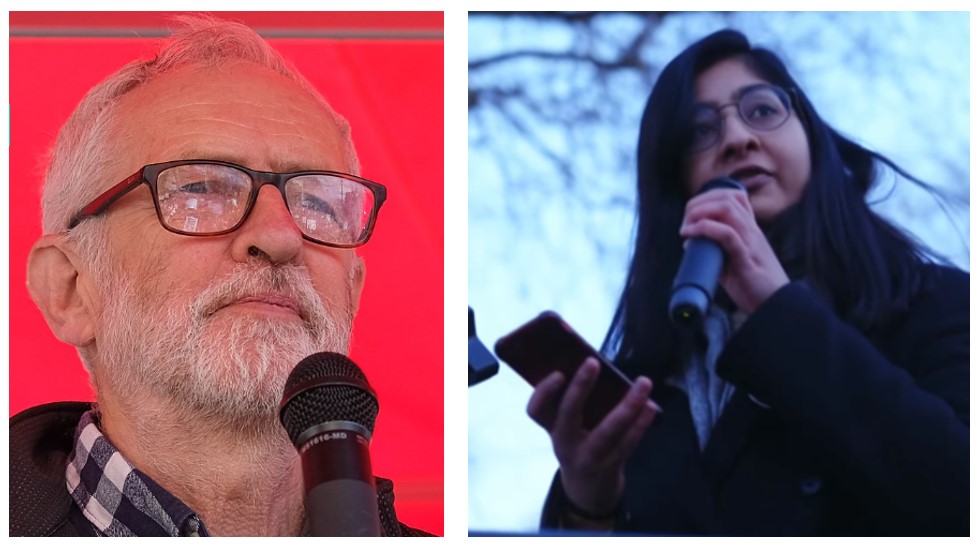
In contrast to the energy and enthusiasm displayed at the grass-roots level, however, there are very worrying signs about how the process is being handled at the top. Both Zara Sultana and Jeremy Corbyn, acknowledged as the two ‘co-leaders’ of the initiative, have spoken at meetings, sometimes on Zoom and sometimes in physical meetings, and they have been met with enthusiastic acclaim. But a new party will need more than mass rallies.
Plans for a founding conference?
It is really astonishing that after so many signed up to express an interest, three months later, few, if any, have received any kind of reply or indication about how to organise. There are reports of a plan for a founding conference, but no date, format or structure has emerged. It has been reported that a small group of individuals are involved in organising the new party, but to the dismay of some potential members, the composition of this group and its intentions are nowhere set out.
It is not a good start for Your Party – bearing in mind that its potential membership are repelled by the careerism and personal enrichment of so-called ‘Labour’ MPs and that openness and transparency are in such short supply inside the Labour Party. The last thing Your Party needs is opaque and inexplicable manoeuvring behind closed doors.
If there is to be a conference of Your Party later this year, it can only be one of two things: either a rally, addressed by the great and good, but with little membership participation, or a conference, in which case delegates will decide on national policy principles and priorities. If it is the latter, then what will be the process of electing delegates from local branches?
These ‘organisational’ issues and not unimportant or incidental. How they are dealt with will determine whether or not Your Party really does become a party, or something that offers no more than an umbrella for local radical groups of various kinds.
As was suggested in an article in July, the ‘messy’ start to the party was partly due to different ideas about what kind of party the leading participants wanted – a ‘regular’ national party, with national membership and national conferences, or a ‘federal’ organisation that embraced different local or regional organisations. In the latter case, the national party would only be a ‘badge’, an identifier to link allied, but different, regional and local groupings under one umbrella.
Will the new party be federal or not?
There are worrying signs that the organisers of some local meetings have already decided that the new party will have a federal structure. A lot of commentary has been made – including by some of those on the national ‘steering’ committee supposedly organising things – about ‘community-based’ activities, and some of these, it has to be said, are incomprehensible.
Just to take one example, a report of a 200-strong meeting in Glasgow spoke about a “grievance gathering programme across the city”. This apparently would involve “knocking doors, running stalls, hosting neighbourhood, community and workplace meetings”.
There is no disputing that a new party will need to organise locally, with canvassing, meetings and stalls, and it will need to sink roots in the community. But “grievance gathering” is a meaningless expression. The 200 who attended that meeting in Glasgow already know what the grievances are – affordable housing, low wages, poor services, unreliable transport, complicity in genocide Gaza, etc, etc – there is no need for a mass canvass to unearth them. Very few of that 200-strong audience will have gone to the meeting to find out how to “gather grievances” – they will have gone to find out answers to them.
There was a similar level of nebulousness in an interview in New Left Review, with James Schneider, who is, apparently, a member of the shadowy steering committee at the top. “Our party”, he says, “needs to be a vehicle for establishing unity, a catalyst for popular organising and a lever for popular mobilisation towards a social alternative.” There is too much coming from the top, in other words, of ‘community-babble’ which is meaningless to voters.
What there needs to be are clear statements, coming either from a conference of delegates or from the founding leadership, of what a Your Party government would do. What national economic and political policies should the party have, in other words? How would it address the grievances of working class people?
The suffocation of democracy in Starmer’s Labour Party
When the issue of policies is so studiously avoided, it unfortunately gives the impression that those at the top might want a mass membership scurrying around on ‘community’ initiatives, while the leaders decide national policies. That would not be acceptable to most of those who are trying to escape the suffocation of democracy in Starmer’s Labour Party.
For most of the likely members of this new left party, there will be two important elements that will be vital to their support and participation. The first is that the party is democratic and organised in such a way as to promote the interests of workers and not a handful of careerists. That means, among other things, selection of all candidates by local members and open selection at every stage of the democratic cycle. No MP or councillor should have a job for life. It also means that MPs, especially, should have no outside financial interests and should follow the principle of “a workers’ MP on a worker’s wage”.
The second element, of course, is that a new party has to have a radical and transformative programme. All the polling evidence shows that in both 2017 and 2019 (when both times Corbyn got more votes than Keir Starmer did last year), the social content of the Labour manifestos were very popular.
Those manifestos should be the minimum that the new party should adopt and, in fact, if it is to seriously challenge the power of vested capitalist interests, it should campaign for a democratic plan of production, in the interests of working people, based on the public ownership of the main levers of the economy, including manufacturing, utilities, services, transportation and finance.
We believe that such socialist ideas would prove very popular in a free and open discussion among members of this new party, but it is not a view supported by some of its organisers. It is disappointing, for example, that the Majority Party in the North East – which is likely to be the main component of Your Party in that region – is not explicitly a ‘socialist’ party. Indeed, one cannot find the ‘S’ word anywhere on its website.
There is much talk about the need for ‘change’, but even from the two most prominent Your Party MPs, there is little in the way of specific policy being put forward, and this, we believe, is a great weakness. One would have thought that the two Corbyn manifestos would have been a good starting point.
Despite the huge upsurge of interest, therefore, it is still not certain that a party will come into being. If and when there is a founding conference, it is possible that the structure of the conference and the party that comes out from it, will collide with the hopes of many of those hundreds of thousands who signed up originally.
Other important factors will affect the dynamics
It is impossible to say in advance what will happen with Your Party. We can only outline here some of the developments, so far. One of the difficulties in anticipating events is that there are other important factors that may change political dynamics on the left.
One of them is the election of Zack Polanski as leader of the Green Party, and by a large majority. Many of those expelled from Labour, or who have walked away in disgust, are already members of the Greens. The election of Polanski shows that his party is not only focused on climate change and environmental issues – although these are important – but on other issues that affect the left. Polanski was one of the few national politicians (with some left Labour MPs) who called for the arrest of the Israeli president when he flew into London, for his complicity in war crimes.
At the very least, we would expect electoral agreements between a new left party and the Greens. But the Greens have the advantage of a ready-functioning party structure and machine. We have no doubt that, running up to next May, they would have a relatively smooth and straightforward candidate selection mechanism. In the event, therefore, that a new left party is perceived to be developing chaotically, without a clear plan or purpose, or even undemocratically, the Green Party could provide a ready-made alternative pole of attraction for lefts not currently in the Labour Party.
But another factor that might change the dynamic of politics on the left is the growing discontent in the Labour Party itself. The domination of the right wing would not have been possible but for the right wing trade union leaders who have swallowed everything Starmer has said and done. But the worm is turning.
Labour deputy leadership contest: a lightning rod for opposition to Starmer
While big business is pushing the Starmer into further diluting the proposed bill on workers’ rights, leaders of all of the major trade union have expressed their anger at this possibility. Even as it stands, the new law effectively allows fire-and-rehire and zero-hours jobs. Any further emasculation of the law will make it meaningless.
A number of different strands could come together in the coming months, therefore: growing opposition inside the trade unions to Starmer’s leadership, a deputy leadership campaign that will be a lightning rod for opposition to Starmer, and a realisation among scores of Labour MPs (and hundreds of councillors) that Starmer has put them on a trajectory to losing their seats – many to Reform – at the next election.
There is a strong possibility, therefore, that these factors can revive and re-energise a left inside the Labour Party. Those who argue that the Labour Party is now ‘dead’ are being somewhat premature. Should major trade unions disaffiliate and other left Labour MPs defect, then that would be a different story: but from where we stand now, that is not looking likely.
The next few months will be a period of turmoil and possibly confusion for the left of the labour movement, and looking at that coming upheaval, it is not possible to say with any certainty what the outcomes will be. What is important for socialists, is to find a road to the most active workers and youth wherever they are – which may vary from area to area – to promote socialist ideas with honesty and clarity.
If that means some socialists are in the new party and others are fighting for socialist ideas with other lefts still in the Labour Party, then so be it. There is no contradiction, given the confused state of the left at the present time, in fighting on both fronts, or even a third, if we include a radicalised Green Party. The political ideas, after all, are the same.
We will no doubt find out in due course what the possibilities are for all three parties: a viable alternative left part, an energised and more radical Green Party or the left in the Labour Party. Marxists will fight in any or all of these for the programme of socialism.
Feature picture composite from Wikimedia Commons pictures, here.