
From Greg Oxley in Paris
September 10 2025 must surely go down as a major event in the history of class conflict in France. This day of protest was initially called for practically anonymously on TikTok and then on other social media, as explained in our previous article, under the slogan “bloquons tout”, or “shut down everything”.
The call clearly struck a chord deep within society, as a result of an accumulation of social injustices, institutionalised racism, declining living standards, growing social inequality and a profound mistrust in state and government.
While 10 million people live in dire poverty, the now-defunct Bayrou government, ingloriously swept away two days ago, presented a budget which would have imposed cuts of more than €40bn, affecting social security benefits, sick pay, paid holidays, health and education, while at the same time handing €211bn in subsidies – with no conditions attached – to big business, and massively increasing military expenditure. In a word, more money for capitalist greed and the means to kill people, and less money to feed, care for, and educate them.
This ignited the fuse for yesterday’s tumultuous events. If the scale of the movement could not be predicted, it was clear ahead of time that it would be a major success, based on the online response and widespread preparations on the ground. Even now, after the event, it is difficult to say exactly how many people came out onto the streets or participated in some way or other.
Huge crowds in all the main squares and boulevards
The first official estimates are around 250,000 demonstrators, but the photographic evidence in Paris alone – leaving aside many hundreds of major demonstrations and protest actions in the rest of the country – suggest that this figure is far below the real turnout.
Huge crowds occupied all the main squares and boulevards, wall to wall, in the east, the north and the south of the capital. Barricades were set up in many places. Whatever the numbers are for actively participating demonstrators, one thing is sure: in homes, workplaces and schools, they were understood and supported by many millions of working people.
And whatever the spokesmen of capitalism might say in public, this is a reality which is not lost on any of the serious representatives of the existing order. The ground is shifting beneath their feet.
In the morning and the early afternoon, state authorities sent heavily-armed police to charge and beat up peaceful demonstrators. Some pitched battles took place, and the police didn’t always win. But as the day went on, it was clear that the sheer numbers of people in the streets had simply swamped the police.
Throughout the country more than 80 000 armed police were deployed. The government issued strict instructions to the police that the demonstrations have to be contained and dismantled at all costs. But overall, despite the many serious injuries they inflicted, the police operation was a failure.
It has only served to fuel further hatred and resentment against Macron and the state. The people want solutions. Macron can only offer tear gas, batons, armoured vehicles, and rubber bullets.
Annual Fete de l’Humanité in Paris
Macron did not win the day. It was a major success for the people. But the struggle is not over yet. Throughout the country, general assemblies are taking place to decide on further mass action. This weekend, hundreds of thousands of people will gather at the annual Fête de l’Humanité, organised by the PCF (French Communist Party), near Brétigny, south of Paris. And then, on the 18th, the workers’ unions are taking the lead in a day of strike action, demonstrations and protests.
Bayrou has gone. He and his government were constitutionally obliged to resign after the parliament rejected its budget in a vote of no confidence. Macron immediately replaced him by another servant of capitalism, Sébastien Lecornu, the former Minister for the Armed Forces.
The names of the ministers will change, but the new government will be no stronger than its predecessor. It will not have a parliamentary majority. As soon as it presents a budget, if it resembles in any way, as it must, that of Bayrou, it will fall in turn. Weak, suspended in mid-air, with no basis in parliament and even less support in the population, the governmental apparatus will continue to be paralysed.
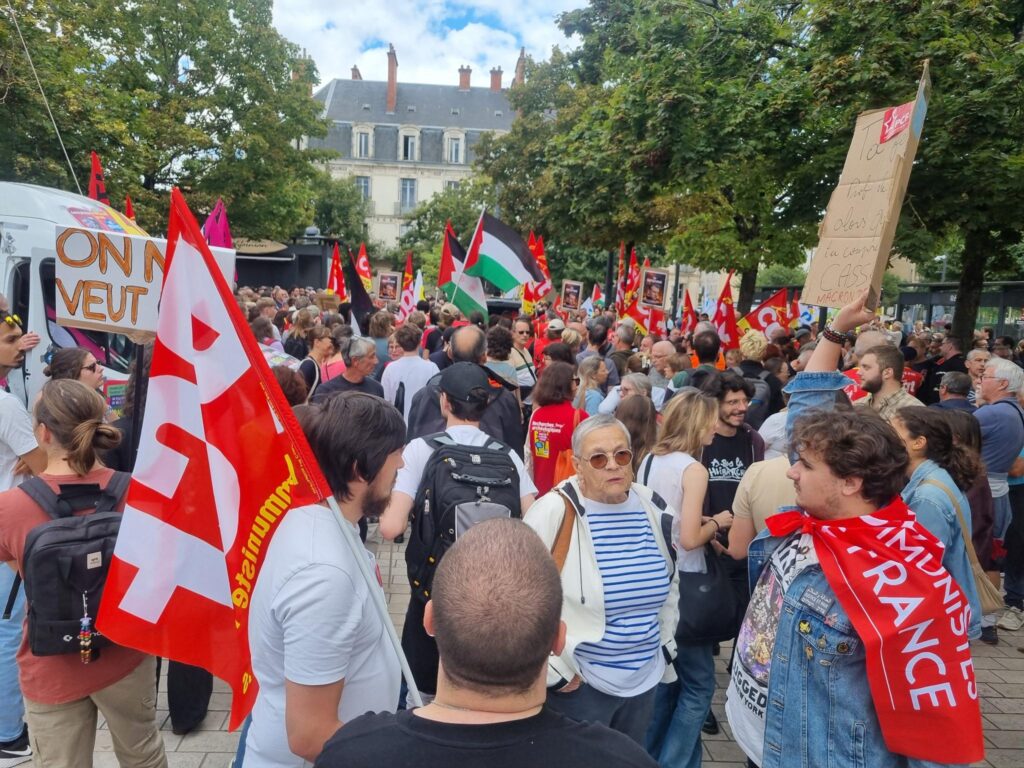
It is not surprising that the present situation has exerted leftward pressure on the political and trade union organisations of the workers. For a long time, indeed ever since the 1990s, the CGT ceased even trying to present any alternative form of society to capitalism.
CGT call for a “democratic plan”…which begs the question
Previously, its oid Stalinist leadership had held onto the USSR and the Eastern Bloc as examples of “socialism”. When all of those regimes collapsed, these “models” were replaced with… nothing. The role of the unions was now to be limited to combatting the social consequences of capitalism, but without challenging the existence of the system itself.
This problem has not been resolved at the federal level but some unions within the CGT confederation, such as CGT Thalès, have nonetheless taken a significant step in the right direction, in calling for “democratic plan” of production and wealth distribution. This must now be taken a step further, to explain whether or not such a plan can be implanted under the rule of private ownership of the banks and industry, under the rule of profit, the Stock Exchange, and capitalist competition.
The PCF, for its part, has proposed an “investment plan”, which begs the same question, but which in itself points towards a discussion about how to change the social order. Similar pressures are affecting Mélenchon’s Party, France Insoumise, and an internal crisis is underway in the Socialist Party, whose leadership offered to form a government in collaboration with Macron, and under his authority. The ranks of the party were utterly opposed to such a shameful capitulation.
The need for a clear democratic and socialist policy has never been more acute. Interestingly, in what amounted to his farewell speech before the National Assembly (the French parliament), Bayrou said that it was one thing to do away with a government, but the economic realities will still be there. By that time, no one was really listening to him anyway.
France is headed for very stormy times.
And yet, the point he was trying to make is of the utmost importance. Governments may come and go, but as long as the system remains intact, profit will come before people, the rich will get richer and the poor will get poorer, and society will be ever divided between exploiters and exploited.
Governments, including “left” governments, will be only the temporary masks of the same iniquitous system, unless they seek to overturn it. Only the emergence of a mass movement around a policy of socialist expropriation, of public ownership of the economy under democratic control, can break the deadlock.
France is headed for very stormy times. There is massive opposition to Macron. And yet, it is by no means impossible that because of the historic performance and inadequacies of the left organisations, the present crisis may result in a victory for the nationalist right, in the shape of Le Pen’s Rassemblement National, in the next presidential elections.
Many people have been taken in by the rants of nationalist and xenophobic demagogues. Nonetheless, under the cover of a reactionary shift in the ballot box, accentuated by massive abstention from voting, an active and radical revolt in the opposite direction is building up, against austerity and against racism.
The polarisation in society has become so flagrant, so acute, that it cannot be resolved by what some might call “normal democratic process”. Might is right. The capitalist class has the power, and therefore the right, to drive society backwards, to impose sacrifices on the working people, the latter are increasingly claiming the right to resist. And where rights are equal, force will decide.
Greg Oxley is editor of the French Marxist website La Riposte, here. Photographs taken by supporters of La Riposte in Dijon and Rouen.