By Greg Oxley
110 years ago, in September 1915, just over a year into the horrific carnage of the First World War, twenty or so representatives of socialist anti-war organisations and groupings gathered in Zimmerwald, near Berne, in neutral Switzerland. It would be easy to dismiss this event as insignificant, as did the European socialist leaders who had betrayed their pre-war “internationalism” in 1914.
However, in the years that followed, the Zimmerwald Conference was to play a very an important role in the development of the international workers’ movement. This was not only as a common point of reference for the scattered groups of genuine internationalist militants within the remnants of the Socialist International, but also in clarifying the lines of demarcation between the different political strands among opponents of the war at that time.
The outbreak of the war in August 1914 had led to an ignominious collapse of the Second (Socialist) International. The leadership of practically all of the parties within this international alliance of workers’ parties, with the notable exception of the “Bolshevik” component of Russian Social Democracy – which had established itself as a separate party in 1912 – and the Serbian Social Democrats, capitulated to the pressure of national patriotism.
These leaders supported “their own” national states in the war, putting themselves in the service of kings, emperors, and capitalist republics, assisting them in the vast mobilisation of men and resources which would cause the death of some 11 million soldiers, with another 23 million wounded – often with horrific injuries. The final civilian death toll was estimated at somewhere between 6 and 12 million.
Workers swept up in patriotic wave
Socialist members of parliament, prominent trade union leaders, and many notable exponents of “revolutionary” ideas, were swept up in the patriotic wave. The leaders of the formerly powerful German Social Democracy supported the establishment of a military dictatorship in Germany, to hound and persecute opponents of the war.
With the agreement of SPD leaders, Karl Liebknecht, a member of parliament, was stripped of his parliamentary immunity and thrown into jail. After the war, during the German Revolution, these same leaders applauded his execution, along with that of Rosa Luxemburg (see our series, The German Revolution of 1917-1919, starting here).
In France, socialist leaders, including Jules Guesde, the renowned exponent of “orthodox Marxism”, joined the government and organised the persecution of socialists opposed to the war. The Russian anarchist, Peter Kropotkin, supported the Tsarist war effort, and even Lenin’s early mentor, Georges Plekhanov, who made a truly outstanding contribution to revolutionary thought in the pre-war period, collapsed into the most repugnant imperialist patriotism.
Just after the beginning of the war, Plekhanov told the Italian socialist and friend of Rosa Luxemburg, Angelica Balabanova, “So as far as I am concerned, if I were not old and sick, I would join the army. To bayonet your German comrades would give me the greatest pleasure!”.
Bureacrats comfortable in positions
However surprising this development might appear on the surface, anyone making a serious appraisal of the pacifist propaganda of the national sections of the Socialist International can see that the seeds of this betrayal were already evident. Most members of parliament and locally elected officials, full-time staffers in parties and unions, had become rather comfortable in their positions.
Socialism was a theme for public rallies and internal conferences, but seemed to be anything but an immediate practical aim. Politically, this let led to a gradual opportunist adaptation to the existing capitalist order, and an emphasis of limited reforms. There was a reluctance to organise costly struggles of uncertain outcome.
In practice, international solidarity between the national sections was transformed into a tacit agreement to close their eyes to the others’ opportunism. There are many examples of the way opposition to the rise in militarism and the growing threat of war was flawed in this way.
For instance, before the war, the leadership SFIO (French section of the International), having stated its firm its opposition to war with Germany, appealed to their German counterparts to guarantee that Germany would never partake in such a war. August Bebel, for the German Social Democrats, replied, quite rightly, that his party could give no such guarantee, because the decisions were made elsewhere.
The implication in the French request could be summed up as follows: “Please do not put us in a situation where France will be forced to conduct a war against Germany”. This kind of pacifism might sound radical in a time of peace. But it is useless once war is declared. It is one thing to be against war in a time of peace. But when the war begins, what is to be done? The answer to this question, on both sides, was “defence of the Fatherland”.
For millions of workers who had believed in the “internationalist” rhetoric of the leaders of the Socialist International, seeing them now encouraging the slaughter in the name of the Fatherland – meaning the total collapse of the International – came as a terrible shock. In addition, a great many working-class people were themselves caught up in the patriotic fervour, believing the propaganda that the war would be over in “a few months”, if not weeks.
Repressive policies of governments at war
Even those who stood firm in their anti-war convictions, like Alfred Rosmer and Pierre Monatte in France, were often soon to be called up. The repressive policies of governments, combined with the departure of millions to the front, meant the impotence and almost complete disintegration of the workers’ movement.
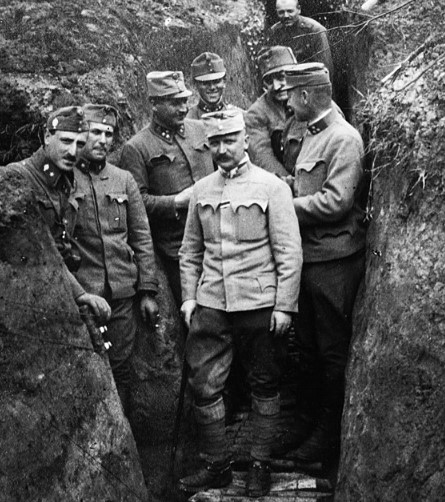
However, not everyone gave in to war fever. Throughout Europe, scattered oppositional groups, although weak and isolated, were hoping to retie the thread of genuine internationalism and socialism. This usually involved working extremely cautiously. All of them, in an epoch when communications were much more difficult than today, and especially in wartime, were looking for information and possible contacts with like-minded groups and individuals abroad.
Towards the end of January 1915, a leader of the Swiss Socialist Party, Robert Grimm, came to Paris to explore the possibility of restoring contact between socialists within the belligerent countries. He met the SFIO leader Pierre Renaudel, who basically told him this was impossible.
Grimm found his way to the anarcho-syndicalist group around Rosmer and Monatte which published La Vie Ouvrière (Workers’ Life), and a group of Russian and Polish militants which published – incredibly, given the scarcity of their resources – a daily newspaper entitled Nashe Slovo (Our Word). This group included Léon Trotsky, in France at that time as the war correspondent of the Ukrainian newspaper Kievskaja Mysl, as well as Julius Martov, and VA Antonov-Ovseenko.
A few months later, a second foreign visitor came to Paris, the Italian Socialist MP Odino Morgari, who was doing a tour of several countries with the same aim as Grimm. He also met with the groups around Nashe Slovo and La Vie Ouvrière. Like Grimm, he met with a hostile reaction from most of the leading figures in the socialist movement.
Conference organised in Switzerland, 1915
At the end of this tour, Morgari, in agreement with Grimm, decided to organise an international conference in Switzerland. In July, it was decided that this would take place in the village of Zimmerwald, about 7 miles from the city of Berne, from September 5 to 9.
Four motor cars were enough to take the twenty or so delegates to the location. Lenin was there, representing the Bolsheviks, and immediately set about organising a left grouping to combat the pacifist and conciliatory elements among the delegates.
Merrheim, for instance, general secretary of the CGT Metalworkers, representing La Vie Ouvrière (Rosmer and Monatte had been drafted into the army), made it clear from the outset that he would only accept resolutions limited to propaganda for peace, on whatever basis, and was opposed to the resolution for opposition to social-patriotism, and for class struggle and revolutionary action, drawn up by Karl Radek and presented as the credo of the left.
Another French delegate, Salomon Grumbach, a journalist for the Socialist daily L’Humanité, was also known for “social-chauvinism”. Thus it was clear from the outset that there were major political differences between the delegates. Lenin’s “left group” only had eight delegates, and there were even differences among them.
After national reports, Lenin moved a resolution and presented a text to serve as a “manifesto” for the conference. It was immediately clear that he had no chance of getting a majority for either document. The majority wanted to concentrate on the “practical” question of peace, and leave the struggle for socialism, as was the habit of the pre-war socialist movement, to sometime in the long-distant future.
Trotsky was the last to speak in the discussion. He put forward an intermediary position which, he thought, would the best possible outcome in the circumstances, if it could get a majority behind it. He tried to appeal to those delegates who, like himself, while not belonging, to Lenin’s group, did not go along with the social-patriotic delegates on the right.
Trotsky’s resolution was the one agreed
Trotsky argued that the Bolshevik’s resolution neglected the need for immediate practical action for peace. At the same time, he said, those who oppose him leaned too much into pacifism and neglected the question of the class struggle for socialism. He proposed an intermediary position, placing the struggle for peace to the forefront, but explaining the imperialist causes of the war, and denouncing capitalist “reaction” in all countries concerned.
His text also denounced the failure of the leadership of the Socialist International, calling upon workers to support the call of Zimmerwald to re-establish international cooperation, and to lead the working class in a struggle for peace, “without occupations and annexations”, without punitive economic measures, and respecting the right of nations to self-determination.
Finally, it calls upon workers to act on the basis of the class struggle for the “sacred cause of socialism” and it ended with the slogan known to millions of workers at that time: “Workers of all countries, unite!” His motion was carried.
Neither Lenin nor Trosky were entirely happy with the content of the Zimmerwald Manifesto. It did not clearly call for the creation of a new International, for instance. However, despite its shortcomings, they both supported it, as representing a significant step forward.
The Zimmerwald Manifesto captured the attention of the most militant and class-conscious layers of the working class across national boundaries. It served as a focal point for opposition to the war, which was clearly turning into a blood-soaked stalemate across a large part of the European continent.
Attempts to justify carnage
The Zimmerwald Manifesto also served as a call for opposition to social-chauvinism, that is to say, the attempt to justify a continuation of the carnage and the sacrifices of the war as supposedly a “first step” to social justice. In this sense, it helped to clarify the difference between the pious pacifism of the right-wing, pro-capitalist, elements within the labour movement, and those who saw the struggle against the war as inseparable from the struggle against the system responsible for it.
It is often said that that Zimmerwald was a precursor to the Third (Communist) International, which emerged in 1919-1920, largely on the basis of clearly differentiating between the old social-patriotic and the genuinely socialist parties, as at Zimmerwald, only this time on a massive scale.
Zimmerwald certainly played a role. It was a beacon of hope, in the darkest days of the imperialist slaughter of 1914-18. However, by far the main event in the preparation of the new International was the overthrow of Tsarism and the establishment of workers’ power in 1917.
It is true that the new regime of workers’ democracy in the former Tsarist empire proved incapable of maintaining itself, and that it was worn down by the isolation of the revolution in a country that was very backward, both socially and economically, finally to sink into the horrors of Stalinism.
That revolution of 1917 deserve careful study and discussion among present-day socialists, as do the years of theoretical and practical preparation which laid the basis for it. Zimmerwald occupies an important place in that preparation. It gave voice to ideas and aspirations that stand in stark contrast to the horror of war and imperialism.
Greg Oxley is editor of the French Marxist website La Riposte which can be found here.
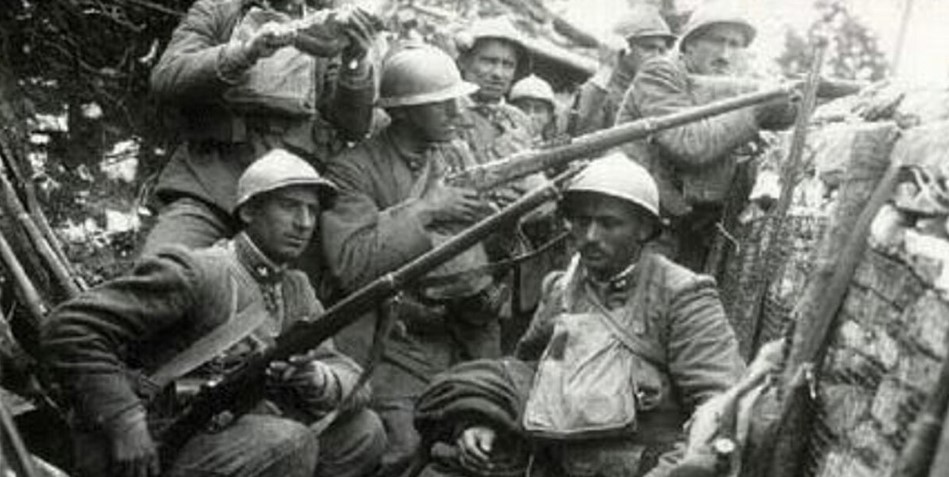
[Feature picture shows Italian troops in World War I, from Wikimedia Commons, here]