By Gray Allan, retired member, Falkirk Council UNISON
Compared to previous conferences, this one has probably set some alarm bells ringing at UNISON Centre. From being a sleepy backwater, the retired members section, 169,000 strong, could become a significant force inside UNISON.
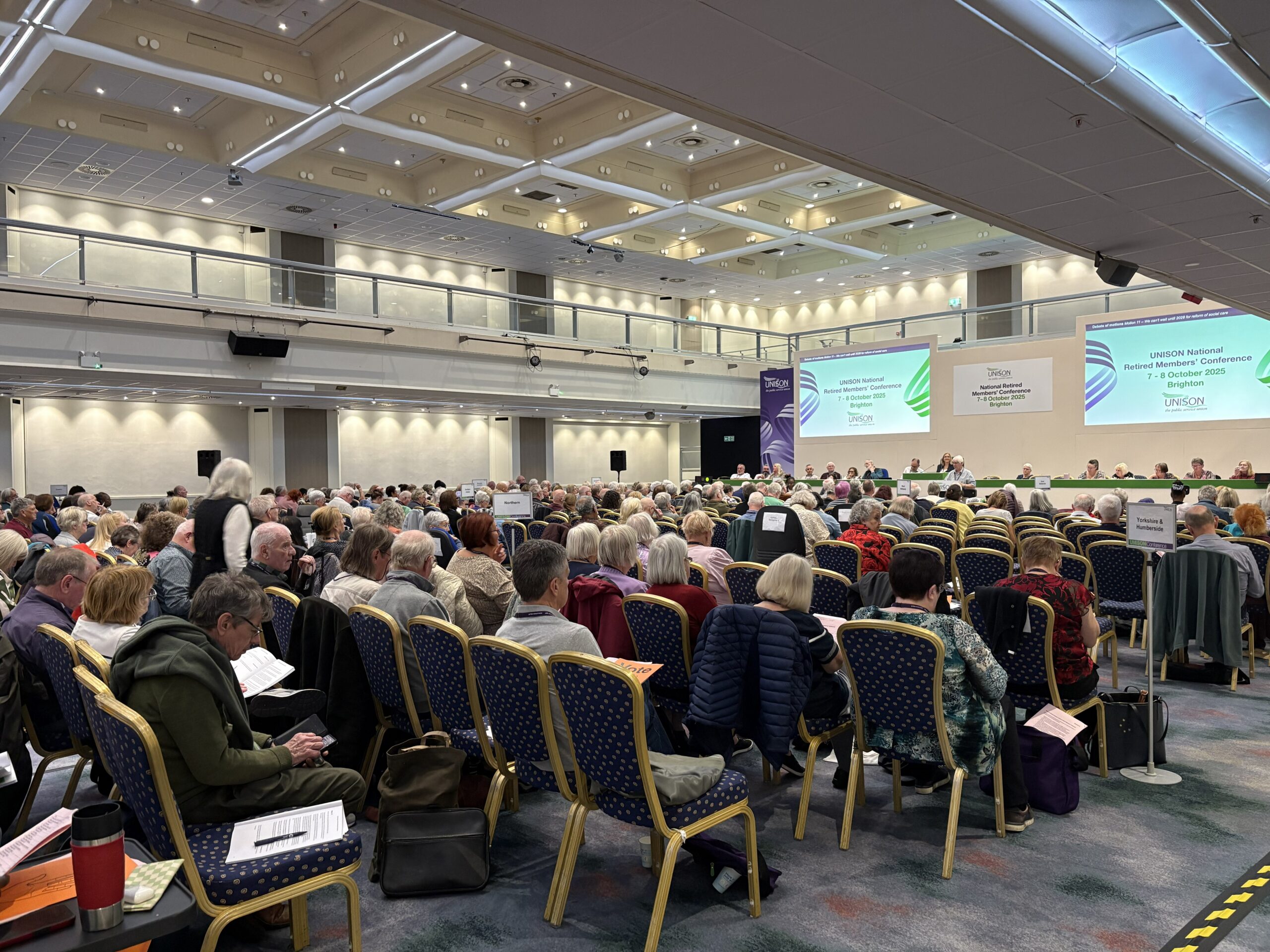
The annual conference (NRMC) of the UNISON retired members section was held in Brighton with one of the days being taken up by meetings of regions and self-organised groups such as women, black members disabled members and LGBT+. The motions-based conference takes place only on the second day.
In past years the conference may have been regarded as something of a freebie for some retired members: a chance to get away to the seaside on an all-expenses paid trip courtesy of the Union, with food and drink holding a higher priority than policy and trade union business. It was little more than a collective moaning meeting over the cost of residential care, funeral plans, free TV licences and the low level of public pensions in comparison with other European countries.
There was little organisation of retired members in branches. Where branch sections existed, they were primarily social societies, organising coffee mornings, day trips and Christmas dinners. Political and industrial organisation was very far down the agenda, if indeed on it at all.
Exclusion from decisions on pay and conditions
Retired members were not considered to be “full” members of the Union and the rulebook still reflects this. Exclusion from decision-making affecting pay and conditions of employment of working members is set out in Rule and is absolutely correct. But UNISON’s actions go far beyond that, effectively locking retired members into a silo, safely isolated from the mainstream of trade union activity.
This was a state of affairs entirely acceptable to the UNISON Centre, with little worry that troubling demands or policy initiatives would come from retired members. The profile of retired members used to be like that of career public employees having worked for decades in local government, the health service, higher education of the utilities and retiring on the state pension age.
But all that has changed, with retired members wanting to discuss UNISON national policy and political issues. So, one of the key battlegrounds on the agenda of the NRMC, is specifically what motions are allowed on to the order of business.
In the past this was a matter of supreme indifference to most UNISON retired members. However, things have changed. The impact of austerity under the Coalition government – which has continued unabated – caused big changes in the public sector. Reorganisations, restructurings and ‘efficiency savings’ all led to job losses in one shape or another. “Voluntary early retirement on the grounds of redundancy” often targeted UNISON stewards and activists.
Cuts and austerity transform retired member sections
So, in the last fifteen years, an increasing number of former activists re-surfaced in the retired members sections, keen to continue playing a role in the work of the union and definitely not keen to be corralled into coffee mornings or bowling tournaments. These fresh, “younger” retirees have joined up with some well-known figures from earlier days, now active as retired members.
While UNISON’s rulebook says that retired members in branches can attend branch meetings and speak and vote on ANY matter other than matters affecting the pay and conditions of working members, when it comes to the NRMC, all that goes out of the window.
For a motion to be accepted it is supposed to deal specifically with issues affecting older people. Motions on general citizenship issues of interest to older people, such as climate change, would be ruled out of order, unless the writers can find a clever way to make a general motion look as if it is focussing exclusively on older people’s interests. Difficult, but not always impossible.
NRMC 2025 saw 36 motions making it onto the final agenda. However, 23 were ruled out of order by the Standing Orders Committee, defined as “beyond the remit of Conference” or “not specific to the National Retired Members Conference”. These included motions on Reform UK and migrant care workers, and for a free national energy allowance, Palestine and welfare cuts.
Rule changes needed to permit wider debate
One of the main objectives of the left in the retired section is winning rule changes to make it easier for members to debate and decide on citizenship issues that do not exclusively affect older people but are nevertheless of interest and concern to older people.
Despite all the obstacles, some good motions did get on to the agenda…and once a motion is on the agenda there is no limit to what can be said in speeches during the debate!
Motion 14 dealt with Opposing Reform UK. It had been admitted because it addressed polling showing that Reform was gaining ground among older people. The debate on the motion was wide-ranging, with speakers pointing out the racist nature of Reform UK and its support for demonstrations outside asylum hostels in many parts of the UK.
It was noted that numbers of UNISON members will probably vote Reform in the upcoming elections, but there was disagreement on how such members and Reform voters should characterised. As out and out racists and ignored? Or as being misguided and engaged with?
A motion on Israel and BDS got on to the agenda because, presumably, it centred comment on pension funds in general and specifically on the Local Government Pension Fund. It was not reached because of time, but another motion, on “Welfare not Warfare” gave speakers the opportunity to talk about Gaza.
There were a number of good motions on pensioner poverty, fuel poverty and housing, which allowed speakers to make general points on the cuts and the need for public investment. Roger Bannister from Liverpool spoke on affordable housing for retired people, calling for state provision of suitable housing.
Motions on the WASPI pension scandal and on the Winter Fuel Allowance had delegates loudly applauding speakers’ condemnation of the Labour Government. In debates on these subjects, two speakers said they had joined Your Party and got some muted applause, perhaps unsurprising, given the demographic of the delegates.
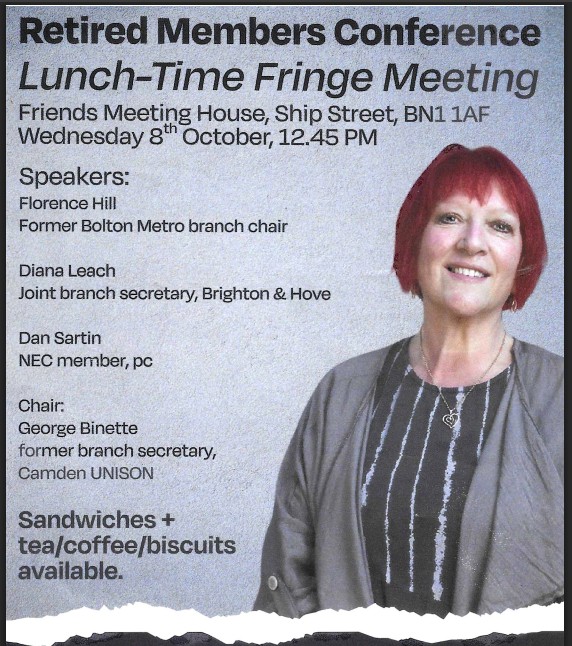
“Andrea Egan for General Secretary” fringe meeting well supported
A fringe meeting in support of Andrea Egan’s General Secretary election campaign was held over one lunch time and forty attended – another indication of the way in which the retired members section is changing.
When it comes to union elections there are very few in which retired members are allowed to take part, but the election of General Secretary is one of them. Both former and present general secretaries, Dave Prentis and Christina McAnea, in the past made statements on the importance of retired members and their potential to strengthen the organisation of the union. But both failed to deliver. The National Retired Members Committee did vote to endorse Christina McAnea, although when reported this had a muted response from delegates.
It’s time for real change, so many retired members are campaigning to elect Andrea Egan as the next general secretary