
By Adel Mostowfi, Iranian socialist
“In short, the communists everywhere support every revolutionary movement against the existing social and political order of things. In all these movements, they bring to the front, as the leading question in each, the property question, no matter what its degree of development at the time.”
~ The Manifesto of the Communist Party, Marx and Engles,1848
The current uprising had been anticipated three months earlier, when the Islamic government arrested two leftist economists, Mohammad Maljoo and Parviz Sedaghat. At that point, it became clear that the government – under its current minister of economy, Ali Madanizadeh, a graduate of the Milton Friedman Institute in Chicago – intended to continue its neoliberal economic policies and had even anticipated the possibility of social unrest.
The government seeks to “trickle down” its way out of economic stagnation caused by US sanctions, the 12-day war with Israel, and this summer’s devastating climate-induced drought, all of which have substantially increased public debt. To this end, the government cut subsidies by raising the dollar price for essential imported commodities (like pharmaceuticals), while the central bank set a so-called “market price” for the dollar by increasing the rial-to-dollar exchange rate.
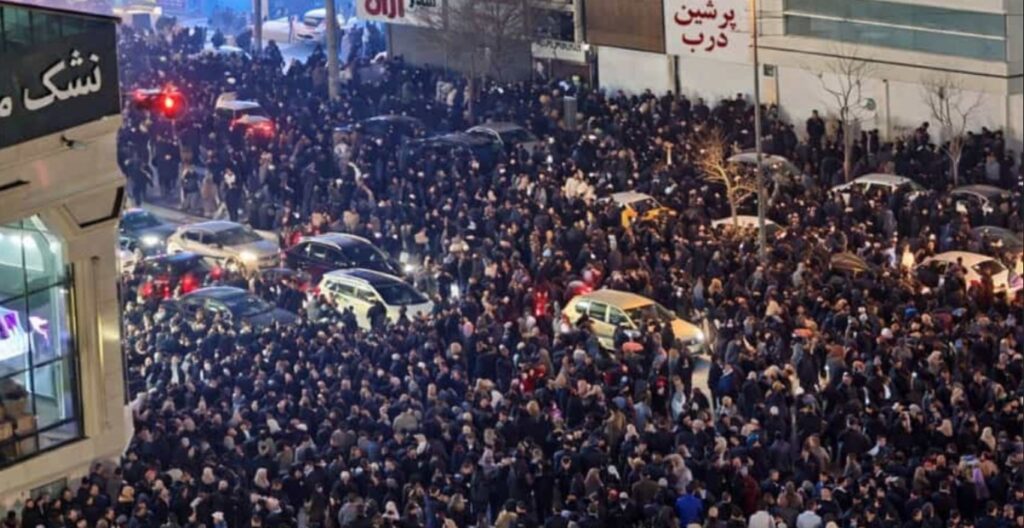
These measures fuelled inflation and price instability, unsettling the petty skilled and professional workers and the ‘Bazaar’, small capitalists and traders, who have historically been closely tied to the religious clergy and which funded the latter’s rise to power after the revolution of 1979, but who increasingly appears to be no longer so.
Many middle class fallen below poverty line
At the same time, the neoliberal economic policies placed even greater pressure on the more skilled and middle class workers in the major cities, which, once reformist, has lost much of their wealth under these policies, and many of whom have fallen below the poverty line. This has transformed into a largely educated revolutionary force – the same one that chanted “Woman, Life, Freedom” in the mass demonstrations in 2022. Added to this, are the unemployed residents and farmers of smaller cities and rural areas, who have suffered most from the climate drought.
The distinctive feature of the current unrest is precisely this convergence: populations from both large and small cities are protesting together – whereas previously it was typically one or the other – uniting farmers and the unemployed from smaller localities with the deprived middle class of the major urban centers.
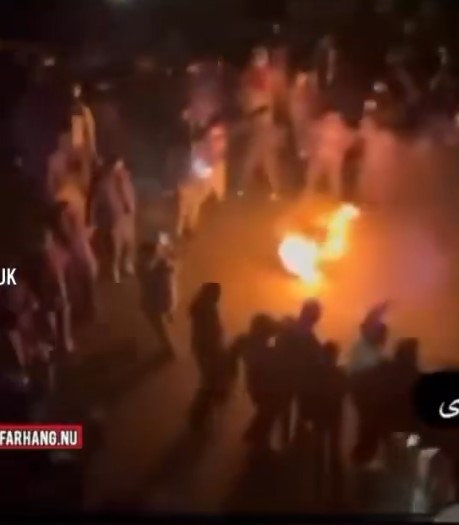
What is new in the practical street struggle is, on the one hand, the mass use of Molotov cocktails by protesters and, on the other, the regime’s deployment of drones. At the level of a struggle for power, the slogans heard on the streets indicate a significant shift. One part of the ‘left’ – who supported the regime’s foreign policy alignments with Assad, Hezbollah, and Hamas regardless of their intense exploitation and harsh neoliberal economic policies – has become politically irrelevant.
Meanwhile, the revolutionary wing of the left, which opposes both the exploitation of the Islamic regime and the Zionists’ genocide, has failed to mobilise the working class and remains extremely weak.
Son of the former Shah of Iran
The neo-fascist opposition clustered around the Shah’s heir, the son of the former monarch, currently holds the upper hand, particularly in the central regions of the country, such as Tehran. They market a narcissistic and abstract vision of “Great Persia” and the “Aryan race” to a desperate population, using this rhetoric to obscure the root cause of their underlying material condition, ie their lack of property rights.
They are openly patriarchal and explicitly opposed to the slogan “Woman, Life, Freedom.” Moreover, they have launched cyber-attacks against protesters, using artificial intelligence to generate fake images and fabricated, dubbed slogans in an attempt to steal the movement in their favour.
This ‘opposition’ has all the support of western far right and full coverage of the Farsi outlet of BBC, Euronews, DW, France24, VOA, etc. For instance, consider this news report from Deutsche Welle titled “Iranian call on Trump to intervene”. The invited guest, Taleblu, is supposedly presented as the voice of the protesters, though he works for a Washington-funded think-tank NGO.
When it comes to oppressing the masses the Islamic regime and US imperialism are in complete agreement While the regime tries to silences protests through internet shutdowns, US imperialist NGOs step in to put words in protesters’ mouths.
Outside the centre, and Tehran in particular, the situation is different. In the periphery – especially in Kurdistan, though not exclusively – where the Communist Party of Iran (with a Maoist background, not to be confused with the Tudeh Party) has significant popular support – many people oppose both the neo-fascists and the Islamic regime. In Kurdistan, the general strike has been successful. The periphery has hesitated sometimes to enter into the streets precisely because of the Persian chauvinism.
More impactful than previous uprisings
(Historically, after the 1979 revolution, leftist revolutionaries fled executions by the regime and sought refuge in Kurdistan. However, it is important to note that political formations in Kurdistan are not homogeneous. There are multiple groups with differing tendencies, including organizations such as PAK, which are openly pro-U.S. and pro-Israel.)
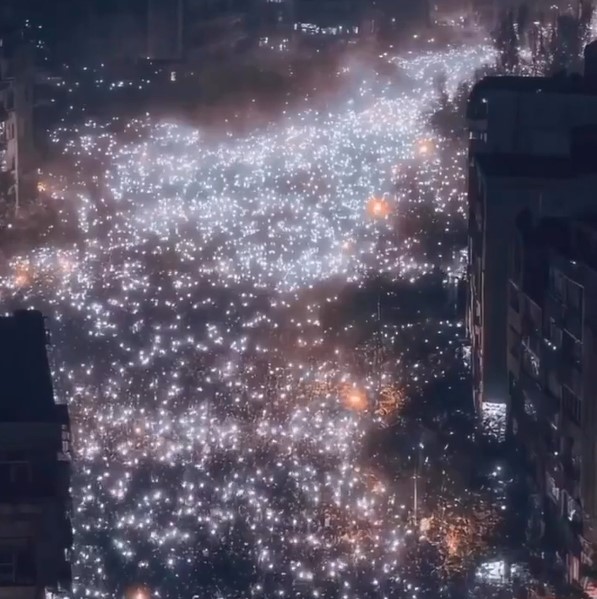
Although the current uprising is far more impactful than previous ones, and the number of casualties and deaths has already surpassed past instances (more than a thousand now dead), the central problem facing the establishment is how to sustain everyday life. It is becoming increasingly difficult to imagine “business as usual” with Ali Khamenei remaining at the top.
While elements of the establishment appear to be seeking a Gorbachev-like figure to reframe the system without the Ayatollah, disrupting the return to everyday normalcy represents the working class’s unique opportunity to leave its mark on the protests through a general strike to tilt the struggle for power in its own favour.
If the establishment fails to change itself and collapses, a struggle between the centre, such as Tehran, and the periphery, such as Kurdistan, may emerge. This would not be unprecedented: after the first revolution in 1906, forces from the periphery captured the capital, while after the second revolution in 1979, the capital imposed its control over the periphery. The crucial difference this time, however, is the likely prospect of direct Israeli intervention with US support.
The absence of leadership and the romanticism of ‘rice rain’
In Abdanan, a city in the far north-west near the Iraqi border, after the masses successfully drove away the repressive forces of repression and freed the city, they seized a supermarket, took out all the bags of rice, and threw them into the air in celebration, an act dubbed the rice rain.
A video of this circulated rapidly and sparked widespread debate about the motives behind the crowd’s actions; at first glance, it appeared contradictory for people protesting over subsistence to then waste it in such a manner. They wasted the food, the irrigation water the farmers had used to grow the rice, for which they had sweated every day in the fields.
Some have romanticized the “rice rain,” arguing that the people are fighting for more than mere subsistence, that they are fighting for human dignity. The assumption that material needs are separate from human dignity aligns with Iranian idealism and stoicism, which regard material life as inferior to higher ideals, providing fertile ground for religious and national abstractions.
This perspective helps explain the absence of the “Woman, Life, Freedom” chant and its materialism in the current uprising – the freedom of the material bodies from patriarchal consumption. It is paradoxical that, the uprising for material conditions, is driven by conditional idealism.
The supermarket chain is owned by the Islamic Revolutionary Guard Corps (IRGC), an institution that operates not only militarily but also economically across the region. After the 1979 revolution, the Shah’s properties and associated assets – classified as “institutional property” – were nationalised. Under neoliberal privatisation, these assets did not become truly private.
Semi-private companies of the Revolutionary Guards
Instead, they were transformed into “Islamic institutional property” under the control of the Ayatollah, referred to in Islamic law as Anfal, and organised into quasi-private companies of the IRGC. Anfal is effectively more private than the formal private sector, as it is exempt from state regulations, including those imposed by the Pezeshkian’s government or any of its predecessors’ presidents of the republic.
In this regard, the crowd’s attack on the supermarket must be seen as an attack on Anfal—on the very root of their economic hardships. However, if we compare the “rice rain” to previous food riots, such as the French uprising of 1765, the English riots of 1766, the Italian protests of 1898, the Russian revolution of 1917, Iran in 1942, or Egypt in 1977, a key difference emerges: the crowd redistributed the food through a non-market, social mechanism, effectively setting a “moral” or “just” price: one that covers wages and initial costs and nulls the profit.
Yet this raises a critical question: if the crowd were organised and conscious of the property question, would they not have redistributed or rationed the rice to prolong the struggle, exhausting the regime over time? Would they not have taken steps toward socializing the constitutional property itself?
The current situation in Iran demonstrates that, in the absence of an leadership organisation capable of raising the consciousness of the working class on the questions of property (Anfal in the case of Iran), the danger is that the masses will fail to dispel their illusions about their conditions.
What is needed is a leadership with an organic connection to the working class, to ensure the establishment of a workers’ government, not merely uprisings that replace religious illusion by neo-fascist hallucinations.