
The official attendees at the annual World Economic Forum in Davos, Switzerland, are not in the remotest bit concerned with the economic interests of the working masses of the world. It is a jamboree of the ruling classes of the main capitalist states, dressed up as a serious conference. It is a meeting of billionaires, the chief executives of giant corporations and the political representatives of capitalism, to discuss their mutual interests, with a few academics and journalists tagging along.
Although this week’s gathering had as its theme “A spirit of dialogue”, what dominated proceedings was a megophone monologue from representatives of the US administration, including Trump himself, laying down the law to the leaders of ‘lesser’ states, particularly European politicians. This event was an important historical marker, one pointing to the end of the geopolitical era that has lasted since he end of the Second World War.
The lead up to Davos was Trump’s threat to take over Greenland, by force if necessary. He had threatened to impose a 10% tariff, rising to 25%, on goods from those European states opposed to his takeover of Greenland. Trump and his cabinet members rarely make a comment about Europe, except in a sneering and mocking tone and this Davos meeting was no exception.
Marxists have always argued that the North Atlantic Treaty Organisation is the military arm of the collective interests of the western capitalist powers, even though dominated by the USA. Trump’s willingness to disrupt and probably (in the longer run) break up NATO is a reflection of his administration’s determination to overrule previous and long-established agreements on trade and tariffs between the main capitalist powers. His unvarnished policy of ‘America First’ is a naked and ruthless expression of US imperialist interests, and unlike in the past, it is now unadorned by any pretence of adherence international ‘laws’, agreements and norms.
“…a new sheriff in town…”
Howard Lutnick, the US Secretary for Commerce, had published an opinion piece in the Financial Times on Tuesday, in which he wrote, “We’re not going to Davos to uphold the status quo. We’re going to confront it head-on.” He could scarcely make it clearer. “We are here at Davos”, he wrote, “to make one thing crystal clear: With President Trump, capitalism has a new sheriff in town.”
On the same day, Trump posted on his Truth Social account an AI generated photograph, showing himself in the Oval Office revealing a map to European leaders – a map on which Venezuela, Canada and Greenland are covered with the US flag.
This was the background to probably the most remarkable speech at Davos, by the Canadian Prime Minister, Mark Carney, in which he effectively addressed everyone else in the meeting except the representatives of the USA. The old order is dead, he was telling them, and we have to learn to adjust to a new world situation.
Mark Carney won his country’s general election last April – despite his Liberal Party starting twenty points behind in the polls – entirely due to the percieved threat to Canadian independence from Trump, who referred to Canada (and still does) as the “51st state”. Carney is the former governor of the Bank of England, former head of the Canadian Central Bank and is without doubt an intelligent and articulate representative of capitalism.
It is something of great historic importance, therefore, that Carney should have made the comments he did. He did not mention Trump by name, but everyone knew what he meant whan he said that for middling powers (like Canada) globalisation, was becoming subordination. Referring to the diminished role – one could say irrelevancy – of the World Trade Organisation and the United Nations, he argued that “We are in the midst of a rupture, not a transition.”
Carney argued for new international alliances in defence and trading arrangements between the ‘middle-sized’ states, meaning Canada, Australia and the European states, so they were not subordinate to the hegemony of the USA. He was greeted with a standing ovation and his was acclaimed by many journalists as the most significant speech of this, or perhaps any previous WEF meetings.
Walk-out from speech of US representative
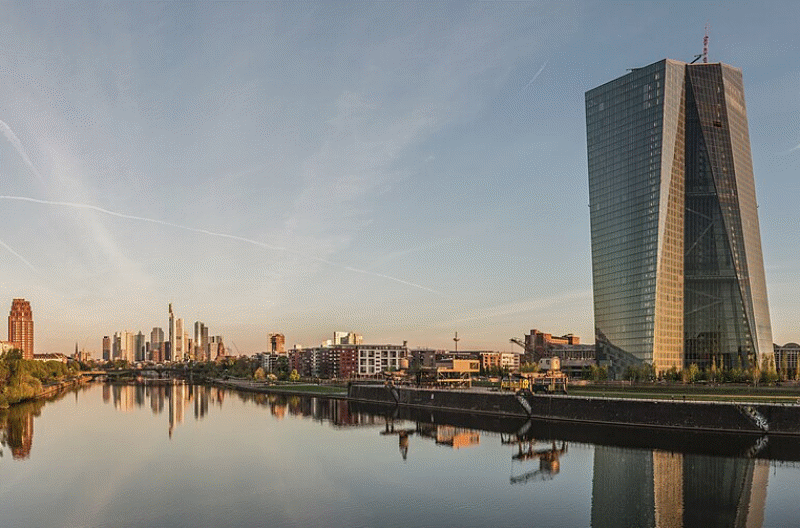
The split between the European powers was palpable when Howard Lutnick spoke later on the same day. Referring to Europe’s economy, he said, “you’re dead”. There was, according the Financial Times report, “widespread jeering” and the evening “descended into uproar” while the host of the event, BlackRock’s Larry Fink, tried to appeal for calm. Eventually, the head of the European Central Bank, and former IMF director, Christine Lafarge, walked out, with some other delegates.
It cannot be emphasised too much that such scenes are unprecedented at Davos.
Trump’s own intervention at Davos was delayed because of technical problems with his plane, allegedly, but when he finally spoke, it was exactly as anticipated. His was the only other speech of significance, but there could be no greater contrast with that of Carney the day before. Where Carney spoke – in the interests of the ‘middling’ capitalist powers – with intelligence and clarity, Trump blustered, as usual, with incoherence, ignorance and an utter inability to distinguish facts from fiction. At least three times he mistakenly said ‘Iceland’ when he meant ‘Greenland’.
Wandering off on a discourse about Greenland, he suggested – to complete silence from the room – “without us, right now you’d all be speaking German and a little Japanese.” (German is an official language in Switzerland). He state clearly that the USA had no intention of taking Greenland by force, although he said it in such a menacing manner – “no-one could stop us” – that as any kind of ‘reassurance’ it would have carried little weight. The reactions to Trump’s speech ranged from polite applause to dead silence.
Tectonic shift in world relations
Trump’s ignorant bombast, and its stark contrast to Carney’s analysis, only emphasise the point the latter was making. We have entered a new global period completely different to the last seven or eight decades. We are in an epoch of unbridled US self-interest, economically, diplomatically and militarily and the smaller capitalist states need to huddle together for their own protection.
The USA is a declining super-power, with an unmatched military machine, but one resting on a weakening economy, having lost ground particularly to the huge economy of China. The growth of China as an economic super-power, eclipsing the USA in terms of exports and, increasingly, in higher level technology, has brought about this tectonic shift in world relations.
Future relations between capitalist states will revolve around the gravitational pull of these two mighty super-powers, one in decline, but still militarily stronger, the other a rising power. Canada has recently signed a long-term trade agreement with China and other states, particularly in South America, Africa and Asia – and some in Europe – will do the same.
‘America First’ will lead to a long and protracted decline in US influence on Europe and on other middle-sized capitalist states as the latter reduce their dependence on the USA in terms of trade, technology, energy, and, not least, defence.
To be sure, such is the current European dependence on the USA that it will take a long time for any significant change to be registered. Even with its new trading agreement with China, Canada cannot escape the facts: its geographical proximity to the USA and 70 per cent of its exports going there. But nonetheless, we are in a period decline for the USA, politically, diplomatically and economically.
As an aside, Mark Carney made some honest comments about the former ‘rules-based’ international order. “We knew the story of the international rules-based order was partially false” he admitted, “that the strongest would exempt themselves when convenient, that trade rules were enforced asymmetrically. And we knew that international law applied with varying rigour depending on the identity of the accused or the victim”.
This is a truism and Marxists have explicitly made the same point many times. It seems today that the only people who hang onto the illusion – the “fiction” – shattered by Carney, are Labour politicans who are unable, or unwilling, to see how the real world works.
We need to bear in mind that all of the posturing and strutting of capitalist politicians – both the intelligent analysts and the buffoons – presuppose that there is no alternative to their system. But there is.
Besides the new cracks and fissures opening up between rival capitalist powers, there are other profound fault-lines under the surface of global politics. When twelve super-rich individuals have as much wealth as four billion people – half the world’s population – and when the economic system is everywhere rigged to make the rich richer and the poor poorer, at some point something has to give.
World capitalism is like a powder keg with a slow-burning fuse and there will inevitably be explosive developments within states, and not just between them. The coming decades will not only be dominated by new rivalries, alliances and possible conflicts between capitalist states. They will be characterised above all by social upheavals, class struggle and civil wars brought on by titanic movements by a working class struggling for a better society.
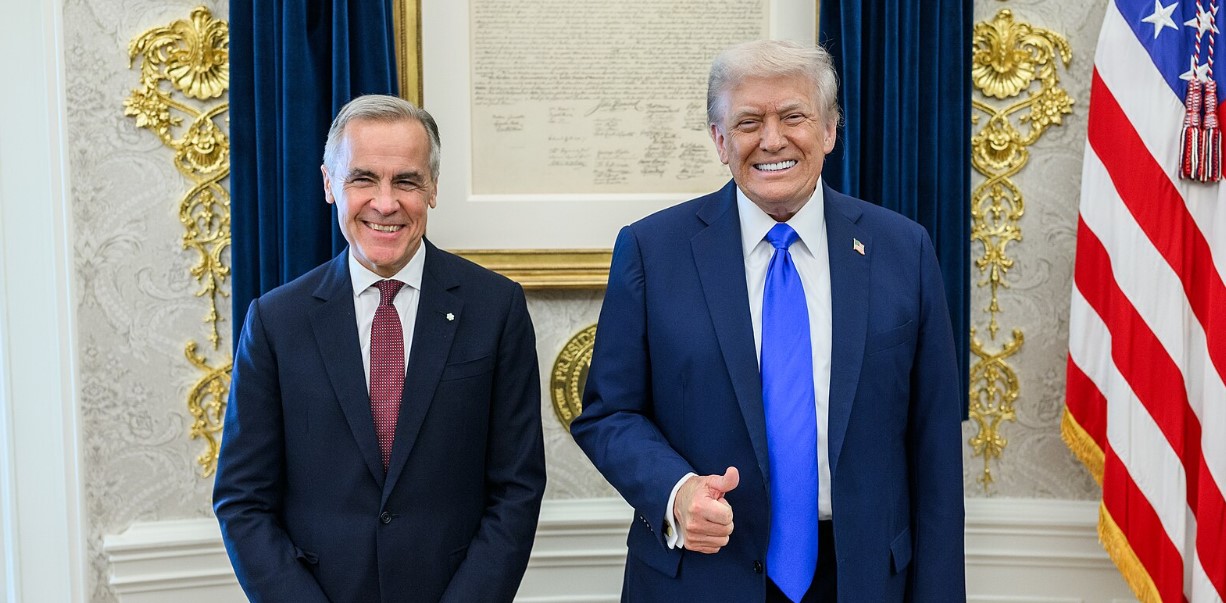
[Feature picture shows Mark Carney with Donald Trump in the White House three months ago. From Wikimedia Commons, here]











“If you know the enemy and know yourself, you need not fear the result of a hundred battles”. Sun Tzu -The Art of War. I think that we should learn whom is the enemy of the working class and here’s the top fifty worldwide.
https://www.bloomberg.com/billionaires/
“When twelve super-rich individuals have as much wealth as four billion people – half the world’s population – and when the economic system is everywhere rigged to make the rich richer and the poor poorer, at some point something has to give.” I didn’t realise that just twelve obscenely super-rich bastards had that much wealth. Time that this rotten-ripe capitalist system was brought down and that task now falls to the younger generation.