By Joe Langabeer
In a previous article I looked at the looming AI bubble and the limitations of its technology. In this article I address another key issue with AI: the harm it is doing to the environment and to society.
**************
Although Sam Altman, head of Open AI claims to be concerned about the sheer volume of investment being poured into generative AI, he appears far more anxious about rival companies overtaking him in the AI race. As reported in December by The Financial Times, he declared a “code red” in a memo to his company as Google ramped up its userbase, with more people turning to its rival service, Gemini, rather than Altman’s ChatGPT.
One of Altman’s other concerns is likely the very scenario Michael Roberts outlines in his blog about the AI bubble and the US economy, where he points out that while AI technology will not disappear if a bust were to happen, it could be acquired at knock-down prices by larger or more stable firms in a process the Austrian economist Joseph Schumpeter called “creative destruction”. But when we understand just how unreliable AI is for the workforce, and how the core problems cannot be fixed without developing an entirely new model rather than tweaking existing ones, I do not believe AI will successfully remove human labour at the pace the capitalist class hopes for.
Negative impact on learning and attention span
Another looming problem for AI lies with its impact on the user. A study from the Massachusetts Institute of Technology found that ChatGPT is beginning to stifle people’s ability to learn. The report, covered by The New York Times, is one of many the paper has published on AI, unsurprising given it is the first major outlet to sue ChatGPT and Microsoft for alleged copyright infringement relating to the use of its articles in AI training.
In the MIT study, students were asked to write an essay of between 500 and 1,000 words. They were split into groups: one used ChatGPT; one used only a traditional Google search; and the final group relied solely on themselves. Each student wore sensors that measured electrical activity in the brain.
The ChatGPT group displayed the lowest level of brain activity, but the most striking finding was that 83% of those who used ChatGPT could not recall a single sentence of what they had written. The other groups could recite lines, and those who wrote independently could recall their essays almost verbatim.
Nataliya Kosmyna, the research scientist who led the study, said that although the experiment focused on essay writing, she is more concerned about AI chatbots weakening retention in learning and education more broadly. This applies not only to academic fields but to critical areas requiring expertise and memory, using the example of “a pilot studying to get a licence”. She argues that more research is urgently needed into how AI may be eroding people’s ability to retain information.
This problem is not unique to AI. Rapid developments in modern technology—from smartphones to the ‘invasion’ of social media, have already reduced our capacity to hold onto information. In an episode of the American Psychological Association’s podcast Speaking of Psychology: Why Our Attention Spans Are Shrinking, Dr Gloria Mark argues that quick interactions on social media, through short posts and videos, combined with constant multitasking on digital devices, make it harder for us to focus and digest what we are looking at. As a result, our ability to retain and meaningfully process information has diminished. AI did not cause these issues in the new media age, but it is certainly intensifying them.
The rise in fake stories and images
As well as concerns about AI reducing our ability to retain information, it is also being used to misinform the public on a scale comparable to social media. An Ipsos analysis of generative AI, drawing on polling from 29 countries, found that 74% of respondents believe artificial intelligence is making it easier to produce realistic fake news stories and images. In the same poll, only 44% of people believe the average person in their country can tell real news from fake. While 66% are confident in their own ability to tell the difference, the rapid increase in realism from new AI tools raises the concern that soon enough we will not be able to discern between the two.
That shift is already happening. Earlier generations of AI struggled with basic details, such as hands or the number of fingers, and images often had the unmistakable sheen of computer generation. But as image quality has advanced, AI is beginning to produce pictures that appear entirely plausible. Google’s new image generator, Nano Banana, can create ultra-realistic visuals that are difficult to distinguish from genuine photographs. ChatGPT’s text-to-video service, Sora, is similarly convincing. Impressive on first viewing, these tools now feed the misinformation pipeline by generating content that looks and sounds real.
Anti-immigrant fake videos
Because of these new video-to-text programs, we are seeing this wave of AI-generated videos attacking migrants. A study by AI Forensics, a Paris-based non-profit, analysed short-form AI videos on TikTok and identified 354 AI-centred accounts pushing around 43,000 AI-generated posts in a single month, amassing a staggering 4.5 billion views, as reported by The Guardian. All were anti-migrant, falsely portraying migrants as violent or sexually abusive.
One account posted 70 times a day; all that is required is a written prompt, and the AI produces the video, no safeguards needed. The researchers found that half the content was unlabelled as AI-generated, and fewer than 2% carried TikTok’s own AI label. Much of this material bypassed TikTok’s moderation entirely, despite violating its terms of service.
AI, whether through its own “hallucinations” or through the people using it to generate misinformation, shows that the so-called ‘AI invasion’ has arrived with virtually no safeguards. Most governments have been unable, or unwilling, to respond. Worse still, they are embracing AI because of its supposed economic potential.
The Environment
Many companies have rushed through the development of AI without thinking about the consequences or how easily it can be manipulated, or worse, how the flaws in their models will eventually break through. But there is also a catastrophic environmental impact associated with AI that is contributing to climate change. A recent report from the UN Environment Programme highlights the toll from the large-scale data centres required to power AI.
Producing the hardware requires around 800kg of materials, alongside microchips mined in environmentally destructive ways. Data centres generate enormous amounts of electronic waste, which contains hazardous substances such as mercury and lead, and they consume huge quantities of water to cool their components. A March 2025 study from the University of California estimated that a single data centre could use six times more water than the entire country of Denmark. As the UN notes, this is alarming when a quarter of the world’s population already lacks access to clean water and sanitation.
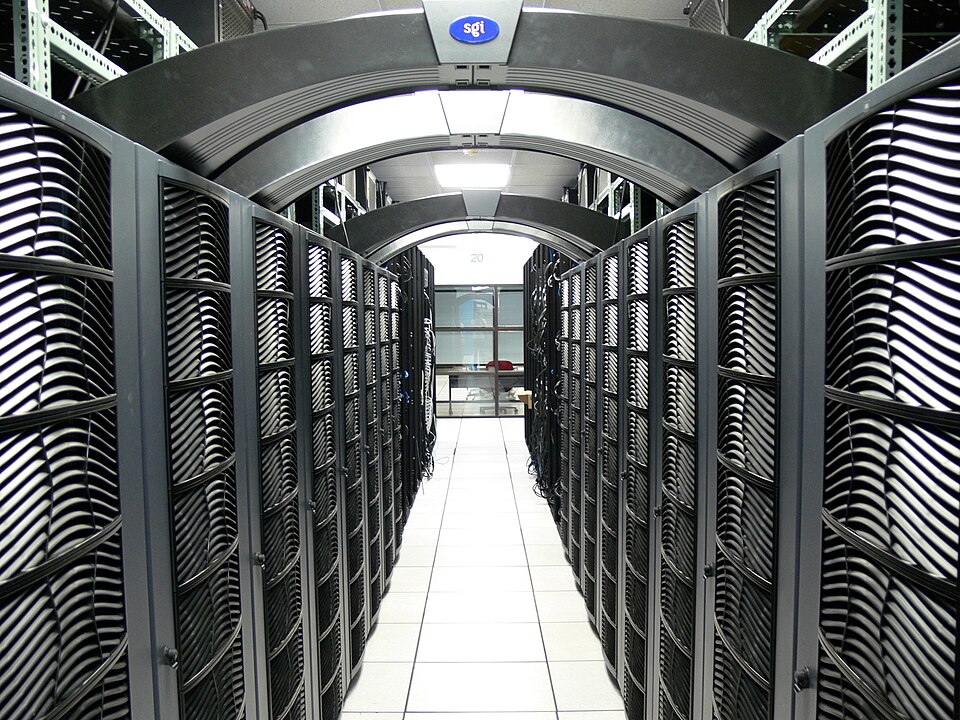
From Wikimedia Commons.
Unsurprisingly, the UN report ends by stressing the vast amounts of energy data centres also require, much of which still comes from fossil fuels. A 2024 report from the International Energy Agency, analysing energy usage up to 2026, suggested that a single ChatGPT request can consume ten times more electricity than a Google search. This demand is expected to increase as giants such as Google and Microsoft continue building data centres worldwide. The UK is set to see its data centre capacity increase by a fifth, according to figures seen by BBC News, raising serious questions about whether the national grid can handle the added strain.OpenAI claims that ChatGPT users send more than 2.5 billion requests per day, 912.5 billion per year, and rising. The energy required to maintain such activity will be enormous. Bloomberg reported in September that wholesale electricity prices have risen by a staggering 267% in regions near AI data centres compared with five years ago.
The worst part is that much of the investment drive for AI in both the UK and the US is centred on building more data centres. Even if we hope energy prices fall, the US is expected to double its energy demand from data centres by 2035. If AI does not crash, then energy bills are set to rise sharply, while the industry continues contributing to the climate catastrophe.
The potential benefits of AI under socialism
Under the capitalist system, which seeks only to extract profit and create efficiencies by cutting staff costs, AI will not succeed. It is expensive, offers poorer value than a human worker, and has well-known flaws that make it unreliable for high-profile or confidential work. No one wins from AI in its current form, though I can still see its potential benefits.
Under a socialist society, with democratic control over the means of production of energy and technology, we could develop more sustainable methods of using AI, alongside proper safeguards to support daily tasks at work, without it having to generate misinformation or fabricating information entirely. We have already seen examples of AI being used to detect illnesses faster than doctors in studies within the NHS, though these are not yet widely adopted for screening.
There are benefits to AI, but not if it is used for profit. AI, and the technologies that underpin it, should be placed under public ownership. Tech giants such as Microsoft, Google and Nvidia, which develop a wide range of services, would serve society far better under democratic control by workers and the public, rather than as exploitative profit-making schemes that ultimately harm people.
Whatever direction the bubble takes, we cannot predict the exact fallout. We only know what might happen based on previous crashes in recent history. But what is clear is that whether AI survives a crash, or whether there is no crash at all, the capitalist class will use it as a tool for exploitation.
It is time that AI and its underlying technologies are placed into public hands, under a socialist banner, where they can be used for the benefit of workers rather than becoming yet another hindrance to humanity.
The featured image at the top of the article is a conceptual image of AI. It is taken from Wikimedia Commons. Accreditation: Jernej Furman, CC SA Generic 2.0