By Tim White
Today, February 16, sees the ninetieth anniversary of the election of the Popular Front in Spain, an event which opened the floodgates to a revolutionary movement that very nearly swept away capitalism and landlordism, and led to a civil war from July 1936 onwards. It was a movement that rekindled the embers of the international socialist revolution and a war that was in many ways a rehearsal for the Second World War.
The Spanish Popular Front was made up of the two main workers organisations, the Spanish Socialist Party (PSOE) and the UGT (General Workers Union) with the smaller Communist Party (PCE) together with various smaller groups tacked on from the left. The Anarchist Federación Anarquista Ibérica (FAI) which had a large following, including its allied trade union, Confederación Nacional del Trabajo (CNT) supported the Popular Front from the sidelines.
However, this alliance of workers’ parties was subordinated to an alliance with various republican capitalist parties, whose most important representatives were Azana and Lerroux. Even although the republicans were merely shadows of the Spanish capitalist class – because the capitalists were shifting their support towards fascism – the “Popular Front” ticket boosted their numbers in the new parliament. Unfortunately, it was this to this capitalist shadow that the leaders of the workers’ parties were to cling, as the revolution unfolded, with ultimately disastrous consequences: the defeat of the revolution, followed by 40 years of Francoism.
How the Popular Front emerged
The opening shots of the Spanish Revolution had really started in the 1920s with the seizure of power by military dictatorship of General Jose Antonio Primo de Rivera in 1921, who was called to power by King Alfonso III, on the back of the failure of an earlier liberal government. He outlawed the anarchist CNT and its sister organisation, the FAI, and numerous groups around the Communist Party.
De Rivera nonetheless allowed the PSOE and the UGT to have a semi-legal position, and indeed, Largo Caballero, a UGT official, sat in the government as Minister of Labour. This was a ‘Bonapartist’ regime, in that it balanced between social classes, and was not a fascist state at that point. Indeed, fascism was only taking it first experimental steps in neighbouring Italy and Portugal.
De Rivera’s regime prospered on the back of the economic boom of the “roaring twenties”, but toward the end of the 1920s the economic boom petered out. In 1928, the Austrian Credit Arnstadt bank collapsed, revealing the fragile state of the world financial system.
While the US and Britain were caught by the chill wind of the economic downturn, the financial collapse devastated relatively backward countries like Spain. The immediate effect of this was the collapse of the Primo de Rivera dictatorship, followed in short order by that of the monarchy. King Alfonso III had staked his reputation on De Rivera’s government. Spain was declared a Republic.
The first Socialist/Liberal government
In the elections of 1930, a liberal and socialist government was elected on the promise of limited land reform, the setting up of a state education system, and various measures to modernise Spain, together with anti-clerical measures to limit the power of the Catholic Church. These policies were enough to weld the capitalists, the landlords and the church into a more solid reactionary political bloc.
But he timid reforms of the 1930-1933 republican and socialist coalition failed to resolve any of the problems of the poor peasants and the working class, and at the same time it faced growing hostility from landowners, capitalists and the Church.
There was land hunger amongst the peasants and agricultural workers, particularly in the west and south, but the capitalists had no interest in land reform or modernising the state. As it was with prerevolutionary Russia, the capitalist class had arrived relatively late in history and could not play anything like progressive historical role of capitalists in northern Europe. The Spanish capitalist class profited from the existing stagnant social order and was tied by a thousand threads to the landed aristocracy and the Church.
In Russia, in 1917, the only truly revolutionary force capable of leading the peasantry into an all-out assault on the landowners, the clergy, and the monarchy, was the urban working class, something which Lenin clearly understood and he organised the working class under the banner of the Bolshevik Party.
Leon Trotsky went further and argued that the working class, in leading the struggle to overthrow absolutism, would not stop at land seizures, but would move towards carrying out the tasks of socialist revolution. This is what happened in Russia in 1917, leading to the creation of the world’s first workers’ state. A similar process had also begun in China in 1926-27, but that movement was derailed and defeated by faulty leadership.
In Spain, the revolution, unfortunately, would also end up in defeat. The first coalition of Socialists and Republicans in 1930-1933, behaved in a similar way the Provisional government of 1917 in Russia, in that it refused to overstep the bounds of capitalism. Even timid reforms were met at the outset with sabotage by the capitalists and landlords, and soon the government was sending troops against striking workers and against peasants who had taken the initiative themselves, seizing land. Many workers were killed by government troops.
In the 1933 elections, right wing political parties cashed in on disillusionment with the government, using the slogan “What did the Republic give you to eat?” and this led to the election of a right-wing government under Lerroux. At the same time, the capitalist class began to finance reactionary gangs under the patronage of Gil Robles and his clerical-fascist Confederación Española de Derechas Autónomas, or CEDA.
The Rise of Fascism
In Europe, by 1933, the international workers’ movement had witnessed the ominous rise of fascism. In Italy, Mussolini had consolidated a Fascist dictatorship and in Portugal, army generals under Salazar were remodelling the state on totalitarian lines. Pilsudski in Poland, Mannheim in Finland and Horthy in Hungary all had regimes of white terror.
In Germany, home to the biggest workers’ parties in the world in the form of the Social Democrats (SPD) and the German Communist Party (KPD) – the labour movement was catastrophically split. It was atomised by the Nazi storm troopers, and thousands of the best activists were already arrested an put in camps. within weeks of Hitler’s assumption to head of government.
This, together with the ongoing economic chaos, led to the radicalisation of the social-democratic parties in Spain. The PSOE, under the growing threat from the CEDA, was no exception. With the election of a right-wing government and Lerroux threatening to bring Gil Robles into the cabinet, the Socialist Party shifted dramatically to the left, threatening to launch a socialist revolution. Largo Caballero, once a minister under De Rivera, was pushed under the influence of rank and UGT militants to the left. He lurched from a reformist position to being on the extreme left of the movement, at least in words.
Ferment in the Spanish Socialist Party
The ferment in the ranks of the socialist party can be attested to by its youth wing who openly called on Andre Nin, then Spain’s most well-known Trotskyist, to join the PSOE to “bolshevise” it. That would have presented a marvellous opportunity to develop a mass revolutionary movement in Spain, but tragically, Nin refused this offer. “If you want to be bolsheviks”, he said, “then join me!” That was a mistake that was to have disastrous consequences in the following years, as the Stalinists of the Communist Party took the opportunity to take over the youth wing in their place and made their party – for the first time – a large party.
In early 1934, the socialists began importing and stockpiling arms as the CEDA moved towards entering the government. The socialists and UGT threatened a general strike if Gil Robles entered the government, but he finally did in October of that year. Meanwhile, the anarchists stood aloof from the growing political crisis, keeping the formidable force of the CNT aside. In keeping with the traditional anarchist disdain of ‘politics’, they argued that the political crisis was just a spat between politicians.
The entry of Gil Robles into government did indeed trigger a general strike in October. In most regions of Spain, it was a strike with folded arms, as the call to arms was botched by the socialists almost everywhere, but with one heroic exception: Asturias!
The Asturian Commune and the rise of the “dinamiteros”
Asturia in Northwestern Spain was a centre of the mining industry. It provided Spain’s industry in Bilbao and Barcelona with coal. Like so many other coal mining regions, it was a hotbed of class warfare politics and militant working class struggle. Here, the battles between miners and mine owners meant that class solidarity transcended the political divisions between socialists and anarchists.
When CEDA entered government, the call to arms by the Socialists was solidly answered in the Asturias, irrespective of political affiliation. For six weeks, the region was run as a workers’ commune. The mine workers’ committee was the sole authority in Asturias, and, unlike the rest of Spain, arms were distributed by workers’ committees, who also oversaw production and food distribution.
As well as arms, the miners had access to ample supplies of dynamite and made good use of it. The Commune rallied its troops under cry of Uníos Hermanos Proletarios! Proletarian Brothers Unite! The Asturian “dinamiteros” were to become a legend in Spain, alongside the anarchist Durruti Column and the International Brigades during the civil war. The Asturian Commune and its brutal suppression were to be repeated on a much bigger scale during the civil war two years later.
The Lerroux-Robles government reacted with characteristic savagery, using troops from Spain’s colonial Foreign Legion to crush the uprising under the leadership of an obscure young officer, General Francisco Franco. It was in many ways a dress rehearsal for the civil war to follow.
El Bieno Negra…the two black years.
The general strike and the Asturian commune were bloodily defeated in mid-November and Gil Robles had entered the government. There followed what was termed El Bieno Negra, the two black years, years of reaction as the Lerroux -Robles government cracked down on the left. There were mass imprisonment, torture, murders, and executions, in addition to the thousands already killed in suppressing the commune.
But try as they might, the reactionaries could not consolidate a viable dictatorship on an all-Spain level. Despite the grim and brutal repression of Asturia, a tradition of resistance had been established, unlike in Germany where the left had allowed Hitler assume power virtually unopposed.
Against vicious government repression, the working-class fought back across Spain, with strikes and class battles. The working class was united as an effective force alongside agricultural workers and peasants. Faced with a combative workers’ movement, Lerroux was forced to concede elections in January 1936.
This was the background to the victory of the Popular Front in February 1936, which threw out Lerroux. But it was a very narrow victory, the Popular Front winning by a margin of only 150,000 votes, 2% of the total. Nonetheless, the voting system gave them an overall majority in the parliament, the Cortes.
Unfortunately, this victory was not the united front made by the Asturian miners and workers in 1934. The Popular Front had a nasty sting in its tail, in the form of the Republicans and liberals, who acted as a drag anchor on the ambitions and aspirations of the workers’ movement.
What was the Popular Front?
A workers’ united front, is like the tactic used during the Russian Revolution of 1917, and it was commended by Leon Trotsky in the fight against the rise of Hitler’s forces in Germany. He had argued for common action front between Socialists and Communists, to build a formidable army of the working class against Hitler.
Such a united front had existed in Asturias in 1934, where it demonstrated its full potential. The failure of the Spanish Fascists over the next two years was in large measure because they had not at that time, despite the crushing of the Asturian communte, to fully break the will of the industrial and agricultural workers to struggle.
The Popular Front, however, was an electoral pact, a parody of a workers’ united front. Rather than an alliance of workers’ parties, united around a common program of action, it tied the workers’ parties electorally to the representatives of the so-called “liberal” wing of capitalism. The idea was that the simple combination of “all progressive forces” against a common enemy would succeed.
According to the Socialists and their Stalinist partners, these liberals had common interests with the working class. There were undoubtedly historic tasks uncompleted, such as land reform and the destruction of the baleful power of the Church over society. But the Republicans and liberals were no ‘allies’ in the task of modernising Spain, because of their fundamental support for capitalism.
The Popular Front, therefore, was a coalition of mutually opposing forces and the leaders of the workers’ movement were desperate to keep to an agreement to keep the liberals on board and not scare them away by policies that threatened capitalism.
The election of February 1936 was fought around basic demands for defence of civil liberties and democracy and the struggle against fascism. But the rank and file of the workers’ parties, and some leaders, stood solidly for revolutionary change, for going beyond the limited programme of the Popular Front, seizing land and factories.
Largo Caballero, for example, now moved to a left position, campaigned on a programme of revolutionary expropriation, dissolving the armed forces, and disarming reactionaries. Workers took the victory of the Popular Front as their cue to demand increases in wages, and many other radical measures. In the rural areas, peasants and agricultural workers seized land, without waiting for laws implementing land reform.
The capitalist class and their political representatives understood the Popular Front victory for what it was: the opening act of a full-blown revolution. But such was the desire on part of the workers’ leaders to keep the liberals on board, that they resisted this pressure from below, as far as they could.
The Communist Party were in the forefront of holding back the workers’ movement, and its Stalinist apparatus went so far as to murder some workers’ leaders who challenged their policy.
For the working class, the stakes were clear. Having seen the experience of the crushing of the Asturian movement in blood, only a few years before, the ranks of the workers’ movement understood that they faced the threat of total annihilation. A victory for fascism would mean the elimination of their organisations and of any reforms and conquests they had made in the past. Their very lives were at risk.
The Republicans ran no such risk. They were mainly concerned about losing the perks of their parliamentary careers and in any case, they strove to save capitalism at any cost. Most of the capitalist class in any case, had already decisively moved towards reaction and if they were not already on board with the Church and landowners, they soon would be. The Popular Front was, in effect, an alliance between the workers’ movement and the political shadow of the capitalists.
After the Election of the Popular Front
Within days of the election of Popular Front, not trusting the so-called liberals, the working class moved into action. Workers and peasants went beyond the “moderation” of their leaders. They didn’t wait for the liberals to proclaim any measures.
The gates of prisons were torn down, and workers and left-wing activists imprisoned over past two years were released. A huge strike wave began to win back reforms and wages lost during the two “black years”. Inspired by and under the direct influence of the unions, the peasant moved to seize the land.
The most decisive phase of the Spanish Revolution had begun. The propertied classes, landowners and capitalists alike took fright and redoubled their efforts to finance conspiracies against the Popular Front. Workers and peasants fought back. The February election itself had not solved their fundamental needs. And now began the countdown towards Franco’s military rebellion in the summer and the advent of civil war.
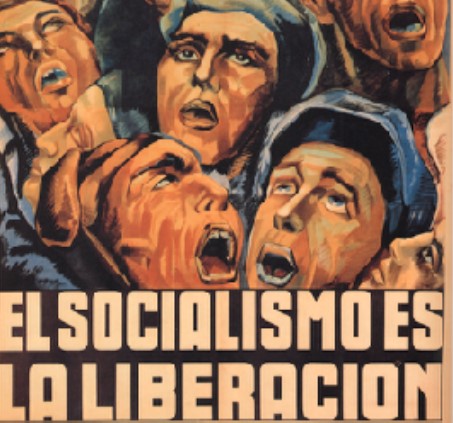
[Feature picture is cropped from a POUM poster, one of many mentioned in a paper by Ray Physick on Spanish Revolutionary Posters, which we will review at a later date]