By Mike Kennard
In 1936 Palestine was paralysed by a general strike which lasted from April to October and heralded 3 years of brutal suppression of the Palestinian people by the British colonial power and the increasing dispossession from their land.
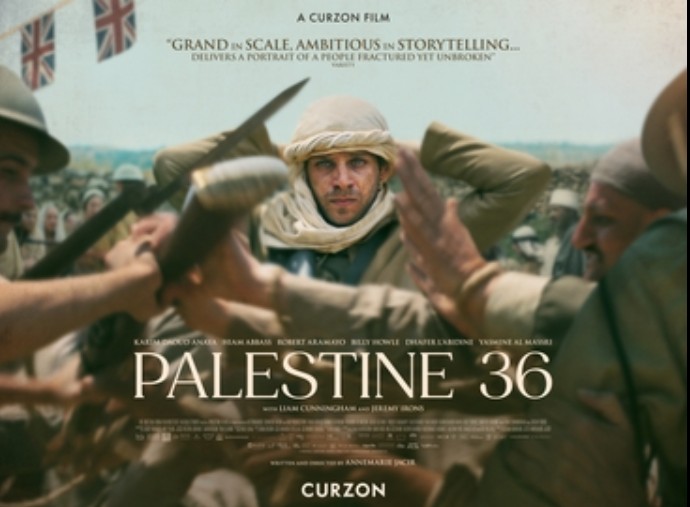
The revolt was savagely suppressed by the British colonial forces, with an estimated 10% of the male Palestinian population either killed, deported or imprisoned. The film Palestine 1936 is a fictionalised account of the beginnings of the revolt.
The creation of the ethnostate of Israel is yet another stain on the pages of history left by the British empire. For centuries before the defeat in WW1 of the decaying Ottoman Empire by the British army advancing from Egypt, different communities had co-existed mostly peacefully in Greater Syria, the old Roman province of Syria Palaestina.
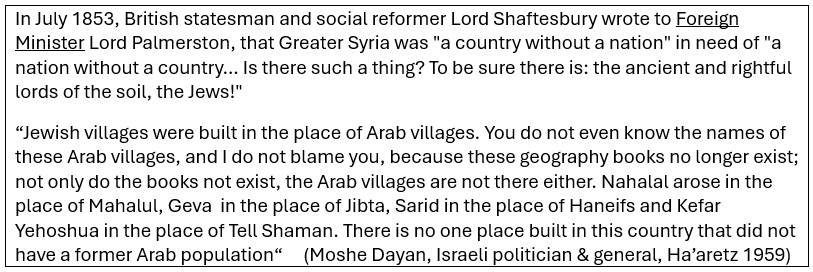
However, antisemitism in Europe had given rise to Zionism, with its most fervent advocates, both in the Jewish community and in wider Christian circles, calling for the restoration of a largely mythical Jewish state in Western Asia. Pogroms in the Russian empire in the late 19th century led to an exodus of Jews and a wave of migration to Western Europe, the USA and Britain. A smaller number emigrated to Western Asia, settling in Palestine and Lebanon. The Ottoman census of 1878 estimated that approximately 25,000 Jews lived in Palestine – just over 5% of the population – of which 10,000 were recent immigrants.
Balfour and antisemitism
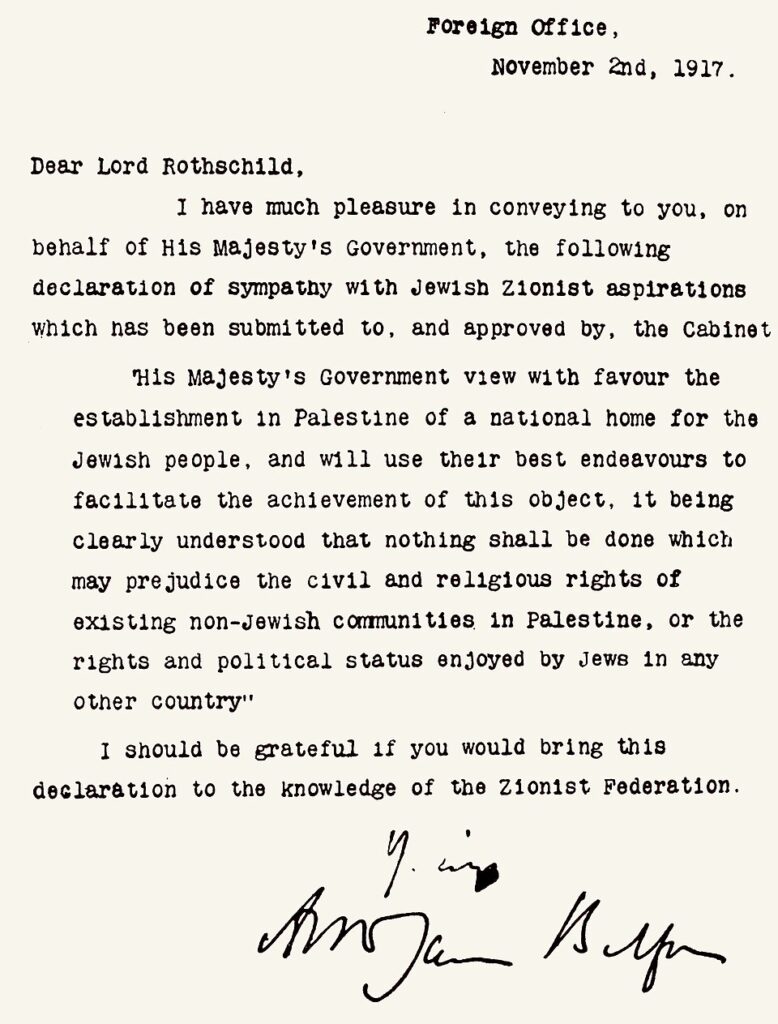
Britain was not welcoming to these émigrés. The existing British Jewish population, who had arrived since the 17th century, were largely socially integrated into Western culture, whereas most East European Jews came from closed societies, speaking a different language with different customs. In 1905, the “Liberal” government of Prime Minister Arthur Balfour passed the Aliens Act, aimed at keeping them out, in contrast to an historic open door policy. The 1917 Balfour Declaration, penned by the same man, was in part motivated by antisemitism.
The influx of Jewish settlers to Palestine was encouraged by wealthy Zionists and in 1901 the Jewish National Fund was set up to buy land to establish settlements in Palestine. This was discouraged but not prohibited by the Ottoman administration. This was an empire in decay, riddled with corruption, and administration of land ownership had become poorly organised. By 1920, when the British established its colonial control, the Jewish population had trebled, and the dispossession of Palestinian families had already led to conflict between communities.
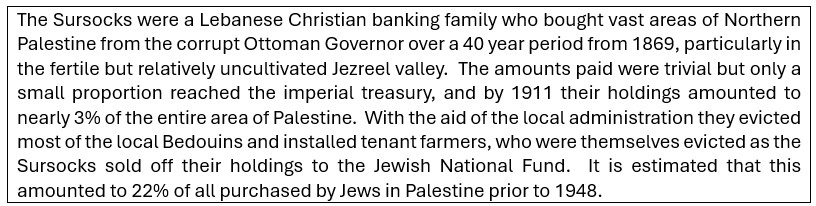

Protests against evictions of the Arab peasants had started by the end of the 19th century, and in 1901 the forerunner of Haganah, later the largest Zionist militia, was formed with small armed groups protecting new Jewish settlements. During WW1 Britain established the Jewish Legion as part of the British army fighting the Ottoman empire, and in the intercommunal riots of 1920 Haganah was formally set up with the British administration largely turning a blind eye.
[image from wiki commons]
Britain had occupied Palestine in 1917 after driving out the Ottomans, with a clear policy favouring the Zionist aim of a Jewish state laid out in the Balfour Declaration of that year. Initially a military police force, the Palestine Police was established along the lines of other British colonial police forces, with British officers overseeing locally recruited personnel.
Intercommunal violence flared in in 1920, and the Zionists forced the dismissal of the director of public security and gained autonomy of policing Jewish communities. The British response was to recruit a Palestine Gendarmerie, with a Palestinian section, of which half was recruited from non-Muslim minority communities, and a British sections which was largely made up of former Black & Tans, notorious for their brutality against Irish nationalist communities. In 1926 it was dissolved and most were integrated into the Palestine Police, which had an increasing proportion of Palestinian personnel.
Demonstrations brutally put down by the British
In 1929 religious tensions rose over access to the Western Wall in Jerusalem. Jewish communities were attacked, with 133 killed, and in reprisals by the British 116 Palestinians were killed. The Palestine Police was reorganised, with a greater British presence and increased recruitment of Jewish personnel. The global recession and favouritism shown to Zionist companies led to increased Palestinian opposition to colonial rule, while at the same time Palestinian members of the police became increasingly divorced from their communities. Massive demonstrations took place in 1933 which were brutally put down with many Palestinian deaths.

The funeral of al-Qassam in November 1935 attracted thousands of mourners and provided the stimulus for increase opposition activity. Arab political parties formed a coalition which demanded an end to Zionist immigration and land sales. This was opposed by a section of the urban Arab bourgeoisie who were merchants affected by the paralysis of economic activity and absentee landlords benefitting from the sale of agricultural land to the JNF.
[photo from wiki commons]
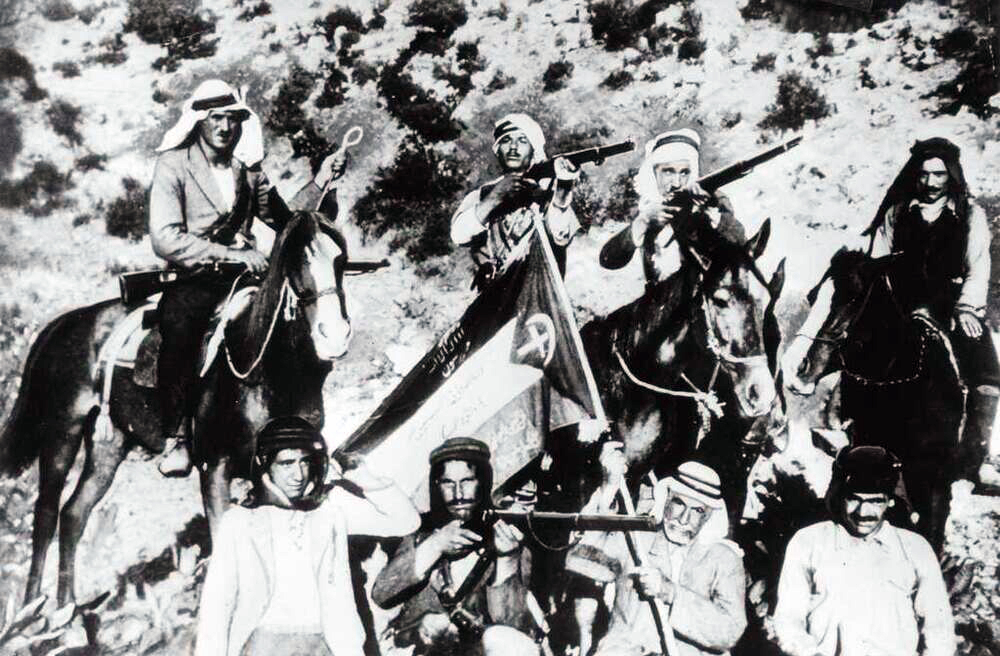
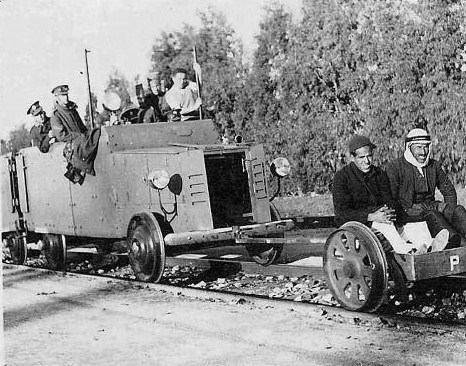
They were a tiny minority and the revolt began in April 1936 with a general strike which shut down most of the country. The urban proletariat were quickly joined by an uprising of the dispossessed in the country. Street fighting in the towns was joined by sabotage and attacks on Zionist settlements and British installations. In the first 6 months over 200 Palestinians, 80 Jews and 28 British had been killed.
As the revolt developed, Palestinian members of the security forces were sidelined and thousands of Jews were recruited, and the Jewish Settlement Police was formed from the Zionist colonies – a paramilitary front for the Haganah. A combination of repressive measures and the promise of a commission of enquiry weakened the strike, which was called off in October 1936. The guerilla activity in the countryside continued at a lower level, increasing after the issuing of the Peel Commission report in 1937, and was met with savage repression by the British and Zionist forces, finally ending in 1939.
[photo – wikicommons]
Partition
The Peel Commission report proposed partition of Palestine into 3 sections, a small part comprising a corridor from Jerusalem to Jaffa on the coast to remain under British control, a coastal section in the centre comprising a Jewish state with 20% of the territory, with the rest allocated to Palestinians. The Palestinian population of the Jewish zone were to be removed to Palestinian territory or to Transjordan. While it fell short of the territorial ambitions of the Zionist movement, it established the principle of a Jewish state in Palestine, while no statehood was promised to Palestinians.
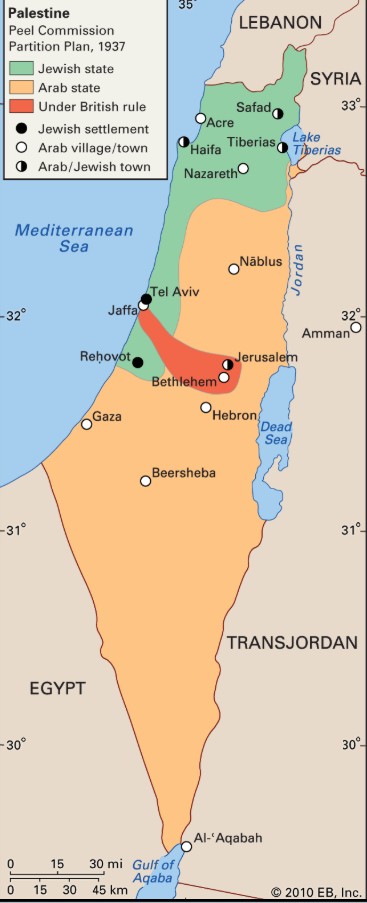
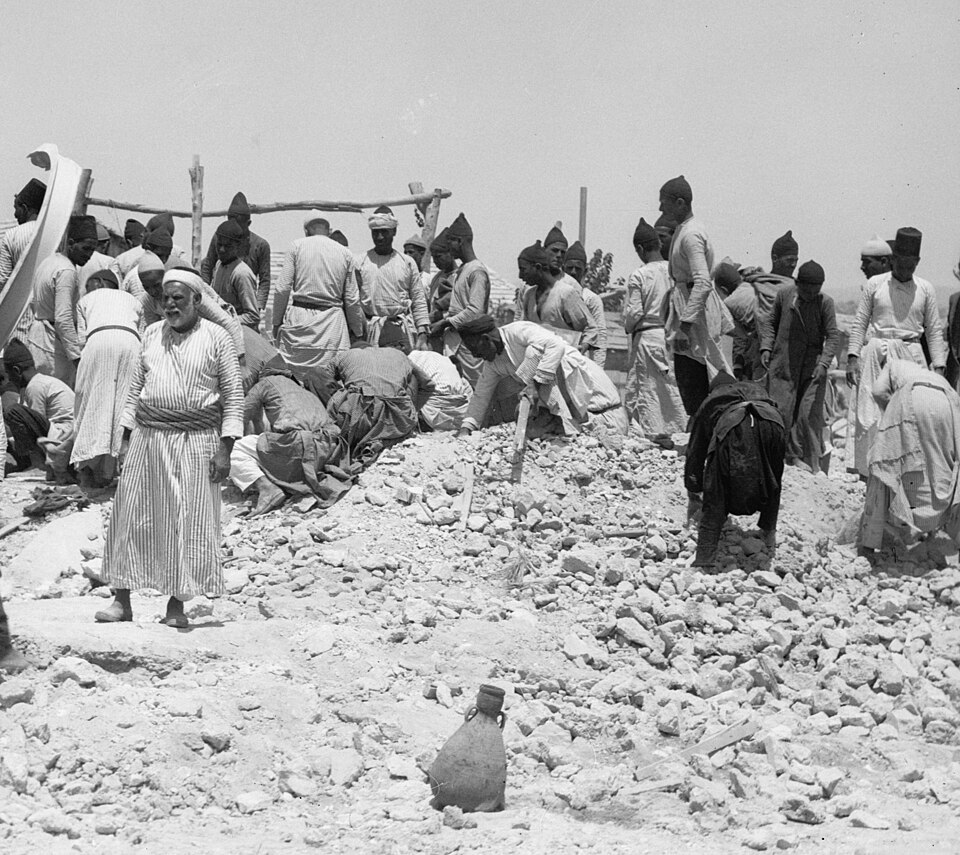
The effect was to regalvanise the anti-colonial movement and in 1937-1938 the rebels made significant gains, taking over parts of the central highlands and driving the British and Zionists out. However, huge military resources were mobilised by British imperialism and a free hand was given to Zionist militias. Palestinian political parties were banned, the press shut down, thousands interned and villages occupied.
In an attempt to put an end to the insurrection, the British government created another commission of enquiry. In November 1938 the Woodhead Commission recommended the shelving of partition. Following this though, the British administration stepped up repression, with more hangings and detentions in an all-out offensive.
The Palestinian opposition became divided and there was conflict between the independence fighters and those willing to compromise. In May 1939 the British government White Paper proposed limiting future Jewish migration and land acquisition and a unitary state after 10 years if community relations were harmonious.
Savage repression
The combination of savage repression and future promise brought an end to the revolt in the summer of 1939. However, the Palestinian community had been devastated and divided. and the Zionist genie was out of the bottle. Some of the Zionist militias turned their attention to getting Britain out, considering that the gains they had made in territory and military organisation gave them a strong chance of capturing the whole of Palestine. Many Palestinian businesses affected by the strike and the repression had been supplanted by Zionist companies.
Most importantly, the British empire was already in decline, and this would be hastened by WW2. A strong pro-Zionist strand emerged in British political parties, especially the ruling Labour Party, which oversaw the proposed Partition of Palestine by the United Nations.
The scene was set for the Nakba – the “catastrophe” – of 1947-48, in which around 750,000 Palestinians were forced out of their homes by violence or under threat of violence. Many were massacred by Zionist militias in systematic ethnic cleansing and expansion of the territory allocated by the partition plan. This was followed by the foundation of the Zionist state of Israel in May 1948. The ethnic cleansing has, of course continued to this day in the West Bank and as a main aim of the genocide in Gaza.
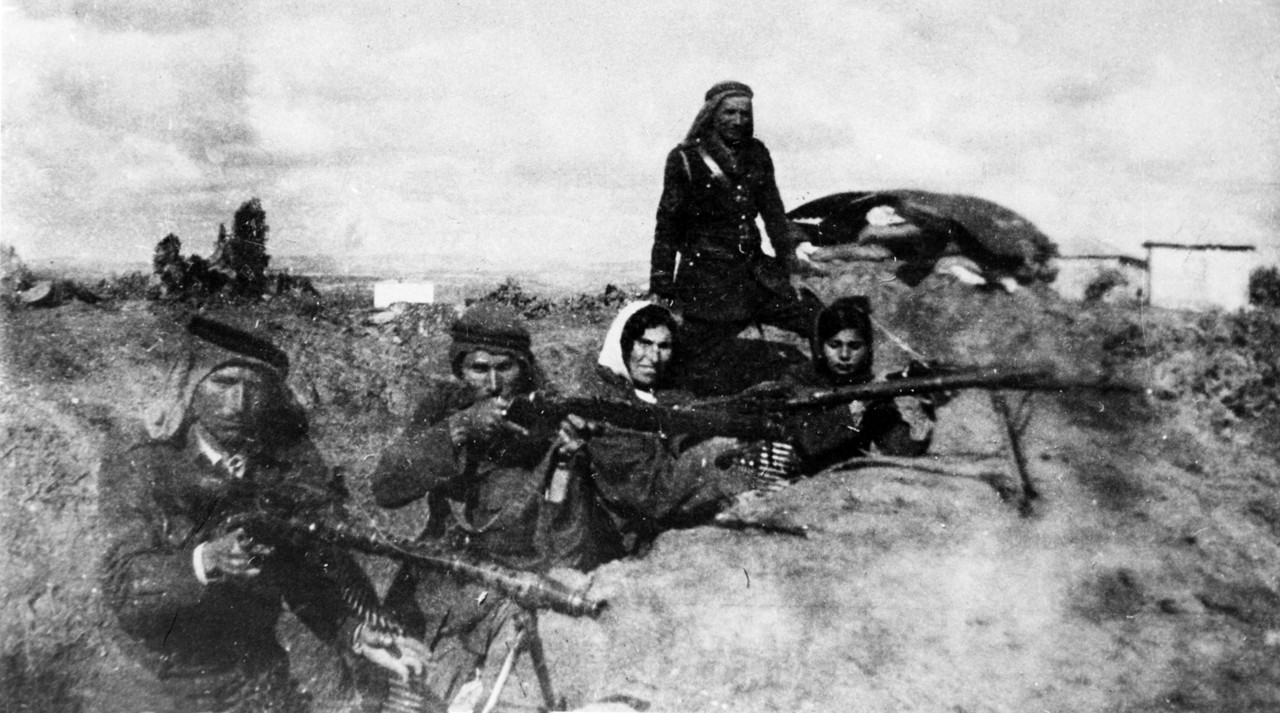
[Featured photo – Arab resistance fighters 1936-39 including Fatima Khalil Ghazal, in the white veil. Photo – wikicommons]
NOTES
The term “Zionist” has been used throughout this article rather than “Jewish” to distinguish between the largely European Ashkenazi immigrants, who came with the intention of establishing a Jewish state, and the historic Mizrahi Jewish population who had never left the land of Canaan and lived side by side with their Muslim and Christian neighbours.
“Great Arab Revolt, 1936-1939” www.palquest.org.uk
Hughes, Matthew. “From Law and Order to Pacification: Britain’s Suppression of the 1936–1939 Arab Revolt in Palestine.” Journal of Palestine Studies 39, no.2 (Winter 2010): 6–22. (not for the faint hearted, as it goes into some detail about atrocities and torture by the British Army)
“Sursock Purchases” Wikipedia
“Palestine Police During The British Mandate” www.palquest.org.uk
The Channel 4 documentary series “The Blue Box” is about the work of the Jewish National Fund told by the granddaughter of one of its leading figures, showing her growing sense of guilt about the replacement of the native Palestinian population.